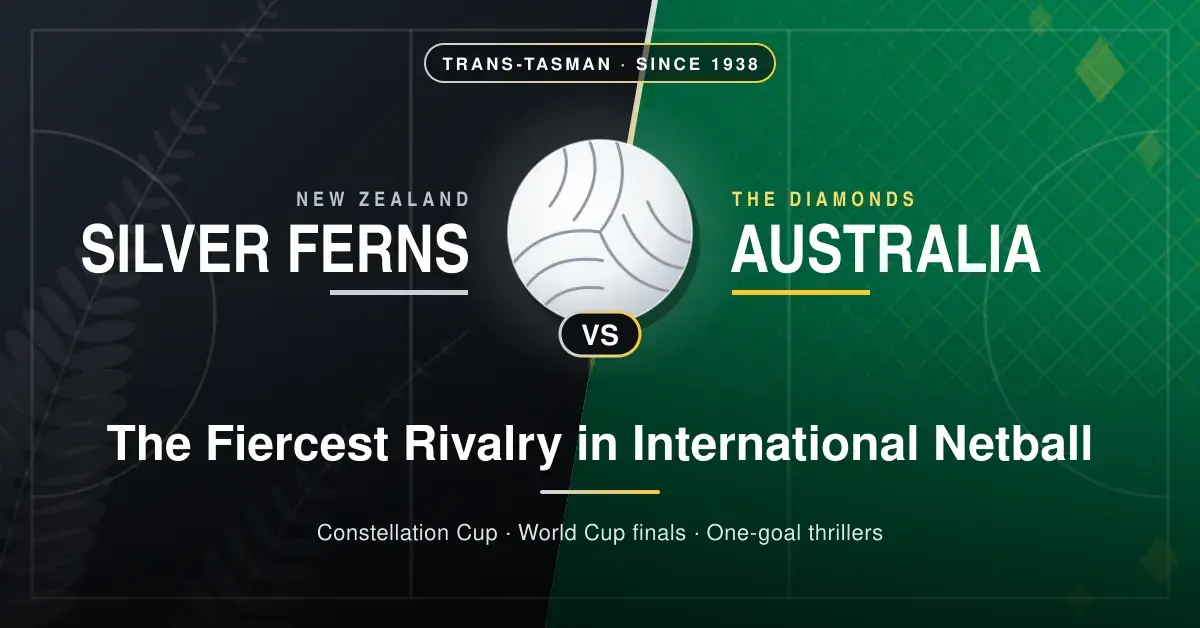
Few contests in world sport carry the intensity of the Silver Ferns against the Australian Diamonds. Since their first meeting in 1938, these two neighbours have met in the finals of almost every major netball event, trading one-goal thrillers, extra-time epics and long winning streaks. This guide traces how the trans-Tasman rivalry began, why the Constellation Cup matters so much, how the two nations’ contrasting styles collide, and where the head-to-head record and the modern era — through the dramatic 2024 and 2025 series — stand today.
Key facts
- First meeting: 20 August 1938 in Melbourne — Australia won 40–11 in the world’s first international netball test.
- Annual trophy: the Constellation Cup, contested every year since 2010.
- Constellation Cup titles: Australia 12, New Zealand 3 (through 2025).
- Netball World Cup titles: Australia 12, New Zealand 5.
- Current head coaches: Dame Noeline Taurua (New Zealand), Stacey Marinkovich (Australia).
- Silver Ferns captain: Karin Burger.
- Next major meeting: 2027 Netball World Cup in Sydney.
The origins of the trans-Tasman battle
The rivalry began on 20 August 1938 at Royal Park in Melbourne, where New Zealand faced Australia in what is recognised as the world’s first international netball test. Australia won 40–11, but the match set the tone for a contest that has never cooled. In the decades since, the two nations helped standardise the modern seven-a-side game while remaining fierce opponents on court — a relationship often described as a sibling rivalry between neighbours who refuse to give an inch.
New Zealand’s breakthrough on the world stage came at the 1967 World Championships in Perth, where the Ferns went unbeaten and beat Australia 40–34 to claim their first world title. Their first win over Australia had actually come earlier, in 1960.
| Milestone | Year | Result | Significance |
|---|---|---|---|
| First international test | 1938 | Australia 40–11 | The world’s first netball international |
| First world-tournament meeting | 1963 | Australia 37–36 | NZ finished runners-up in a round-robin event |
| First NZ world title | 1967 | New Zealand 40–34 | The Ferns went unbeaten in Perth |
| World Cup final glory | 2019 | New Zealand 52–51 | New Zealand’s fifth world title |
The one-goal phenomenon
More matches between these two teams have been decided by a single goal than in any other international pairing. The pattern stretches back to the inaugural 1963 world tournament in England — a round-robin event with no final, in which Australia edged New Zealand 37–36 on the way to the title — and it has produced a long line of nerve-shredding finishes ever since.
The Constellation Cup: an annual test of supremacy
Introduced in 2010, the Constellation Cup is the perpetual trophy the two nations contest every year, usually across a four-test series split between New Zealand and Australia. The trophy is a striking three-kilogram sterling-silver cup set with 101 diamonds totalling 3.38 carats. For most of its history it has belonged to Australia, who won seven titles in a row between 2013 and 2019. New Zealand ended a nine-year drought in 2021 for their first success since 2012, but Australia remains well ahead overall — 12 titles to New Zealand’s three through 2025.
| Year | Winner | Series result | Note |
|---|---|---|---|
| 2021 | New Zealand | 3–1 | First NZ Cup since 2012 |
| 2022 | Australia | 2–2 (aggregate) | Decided on goal difference |
| 2023 | Australia | 2–2 (aggregate) | Decided on goal difference |
| 2024 | New Zealand | 3–1 | First NZ series win on Australian soil |
| 2025 | Australia | 2–2 (Series Decider) | First-ever mini-game decider; Australia 12–11 |
How the Cup is decided
The Cup goes to the team that wins the most of the four tests. When a series finished 2–2, the trophy was awarded on aggregate goals across the four matches — a rule that often favoured Australia’s higher-scoring style. From 2025 that changed: a tied series is now settled by a standalone “Series Decider,” a 14-minute mini-game of two seven-minute halves played from 0–0.
Titles at a glance
| Honour | New Zealand | Australia |
|---|---|---|
| Netball World Cup titles | 5 | 12 |
| Commonwealth Games gold | 2 | 4 |
| Constellation Cups (2010–2025) | 3 | 12 |
| All-time tests won (approx.) | ~60 | ~100 |
World Cup clashes: the ultimate stage
The Netball World Cup has produced the rivalry’s most famous moments. In the 1999 final in Christchurch, Australia snatched a 42–41 win when Sharelle McMahon scored in the dying seconds. New Zealand hit back at Kingston in 2003, winning 49–47, before Australia edged an extra-time thriller 58–57 in Singapore in 2011, Caitlin Bassett landing the last shot. New Zealand’s finest modern hour came in Liverpool in 2019, a 52–51 victory that delivered a fifth world title. Australia still leads the all-time roll of honour with 12 world titles to New Zealand’s five.
| World Cup | Host | Result |
|---|---|---|
| 1999 | Christchurch | Australia 42–41 (McMahon, final seconds) |
| 2003 | Kingston | New Zealand 49–47 |
| 2011 | Singapore | Australia 58–57 (extra time, Bassett) |
| 2019 | Liverpool | New Zealand 52–51 |
The “Kiwi style” zonal defence
New Zealand is closely associated with a “zonal” defence: rather than chasing opponents one-on-one, defenders work as a unit to block passing lanes and slow Australia’s fast ball movement. You can read more about the national team on Wikipedia.
Commonwealth Games drama
Netball made its official Commonwealth Games debut at Kuala Lumpur in 1998, and the podium has often come down to these two sides. New Zealand won gold in 2006 and 2010; Australia took the title in 1998, 2002, 2014 and 2022. The 2010 Delhi final is widely regarded as the greatest netball match ever played — New Zealand winning 66–64 after double extra time, with Maria Tutaia (now Maria Folau) scoring the decisive goal. Not every Games has pitted the pair against each other: England won a landmark gold in 2018, and in 2022 the two did not meet, with New Zealand taking bronze.
| Games | Gold medallist | New Zealand v Australia |
|---|---|---|
| 1998 Kuala Lumpur | Australia | Australia won the first CWG netball final |
| 2002 Manchester | Australia | Australia 57–55 (after extra time) |
| 2006 Melbourne | New Zealand | New Zealand won the final |
| 2010 Delhi | New Zealand | New Zealand 66–64 (double extra time) |
| 2014 Glasgow | Australia | Australia 58–40 |
| 2018 Gold Coast | England | The pair did not meet for gold |
| 2022 Birmingham | Australia | Teams did not meet; New Zealand won bronze |
The 84-minute epic
The Delhi final ran to about 84 minutes — the longest official international on record — and showcased the extreme fitness of the modern game, with players such as Casey Kopua and Laura Langman on court for the entire marathon.
Two philosophies: zone versus one-on-one
The teams’ contrasting defensive identities are central to the rivalry. Australia traditionally favours relentless one-on-one pressure, shadowing opponents to force errors and fatigue. New Zealand leans on space, interceptions and a zonal structure, which under Dame Noeline Taurua evolved into a hybrid that switches between zone and one-on-one depending on where the ball is. Understanding the seven netball positions helps explain why the midcourt duel between wing attack and wing defence so often decides these games.
| Element | New Zealand focus | Australia focus |
|---|---|---|
| Defence | Zonal — blocking passing lanes | One-on-one pressure to force errors |
| Attack | Short passing and deceptive movement | Fast transition and long feeds |
| Shooting | Movement and screens | Holding the post and high volume |
Countering the long ball
Australia is known for the long, high feed straight to a holding shooter under the post. New Zealand counters by having its goal defence and goal keep work in tandem to “sandwich” the shooter, turning that long pass into a high-risk option.
The 2024 breakthrough
The 2024 series marked a genuine shift. New Zealand won the first three tests outright — 64–50 in Wellington, 63–52 in Auckland and 61–43 in Perth — to clinch the Cup with a match to spare, before Australia won a dead rubber 63–50 in Melbourne. The Perth result was historic: it was the first time New Zealand had won the Constellation Cup on Australian soil. Grace Nweke’s dominance in the shooting circle and a suffocating defensive effort were at the heart of the win.
2025 and the first Series Decider
The 2025 series was arguably the most dramatic yet. Australia won the opening two tests 69–52 and 68–51, only for New Zealand to level the series with wins in tests three (61–52) and four (62–57), forcing the first-ever Series Decider. In a frantic 14-minute finish, Australia prevailed 12–11, Sophie Garbin scoring the winner with seconds left; Australian defender Sunday Aryang made a crucial final defensive play but suffered a serious knee injury in the process. It was a fittingly close end to a memorable year in New Zealand sport (Wikipedia).
Coaches and captains
The modern rivalry has been shaped by two respected coaches: Dame Noeline Taurua for New Zealand and Stacey Marinkovich for Australia, who guided the Diamonds to the 2023 World Cup title in Cape Town. Taurua’s tenure had a turbulent 2025 — she was stood down by Netball New Zealand mid-year, with Yvette McCausland-Durie stepping in as interim, before being reinstated and, in 2026, retained as Silver Ferns head coach through the 2027 World Cup. On court, Karin Burger was confirmed as captain in late 2025 after long-serving skipper Ameliaranne Ekenasio stepped away from the international game.
The stars of the current era
The headline duel is between New Zealand’s Grace Nweke, a 1.93-metre goal shoot with rare strength, and Australia’s Courtney Bruce, one of the game’s most disruptive defenders. In the midcourt, Diamonds captain and wing attack Liz Watson tries to dictate tempo while New Zealand’s Karin Burger looks to shut her down. Depth matters too, as extra-time finishes and the new decider reward fresh legs. You can explore the current Silver Ferns squad to see how the roster is evolving.
| Matchup | Positions | What’s at stake |
|---|---|---|
| Grace Nweke v Courtney Bruce | Goal shoot v goal keep | Circle dominance and rebounds |
| Liz Watson v Karin Burger | Wing attack v wing/goal defence | Control of the midcourt feed |
| Squad depth | Full benches | Fresh legs for extra time and deciders |
What’s next: 2026 and the 2027 World Cup
With the Constellation Cup as balanced as it has been in years and other nations rising, both sides must keep innovating. New Zealand’s rivalry with England has added a further edge to the calendar, but the biggest prize is the 2027 Netball World Cup in Sydney. For the Silver Ferns, winning a world final on Australian soil would rank among their greatest achievements; for the Diamonds, home advantage will be a powerful motivator to stay on top.
Reference sources
Vanliga frågor (FAQ)
Who leads the all-time Silver Ferns v Australia rivalry?
Australia leads clearly. The Diamonds hold more Netball World Cup titles (12 to 5), more Commonwealth Games golds and more Constellation Cups, and they are ahead on the all-time head-to-head record — although recent series have been extremely close.
What is the Constellation Cup?
It is the annual trophy the Silver Ferns and Australian Diamonds have contested since 2010, usually across a four-test series. The winner is the side that wins the most tests, and the prize is a sterling-silver cup set with 101 diamonds.
What happened in the 2025 Constellation Cup Series Decider?
After the four tests finished 2–2, a new 14-minute mini-game of two seven-minute halves decided the Cup. Australia won it 12–11, with Sophie Garbin scoring the winner in the closing seconds, to reclaim the trophy.
Who coaches the Silver Ferns now?
Dame Noeline Taurua. She was stood down by Netball New Zealand during 2025, with Yvette McCausland-Durie serving as interim, before being reinstated and retained as head coach through the 2027 World Cup.
Where is the next Netball World Cup?
Sydney, Australia, in 2027 — setting up another marquee trans-Tasman showdown, this time on Australian soil.