Netball is a fast, structured team sport in which every player has a clearly defined job. Each team fields seven players, and each one wears a lettered bib that marks their position and the areas of the court they are allowed to enter. Knowing what each role does — and where it can go — is the foundation of good netball, whether you are stepping onto the court for the first time, coaching a junior side or simply following a match. This guide explains all seven roles, the parts of the court they cover and how they combine into a working team.
Key Points
- Each netball team has seven positions, and every player is limited to set areas of the court.
- Only the Goal Shooter (GS) and Goal Attack (GA) can score, and only from inside the goal circle.
- The roles fall into three groups: attack (GS, GA, WA), midcourt/Centre (C) and defence (WD, GD, GK).
- The Centre is the only player allowed in all three thirds, but never inside either goal circle.
- Knowing your allowed areas avoids offside penalties and keeps the team structured.
Understanding the Netball Court
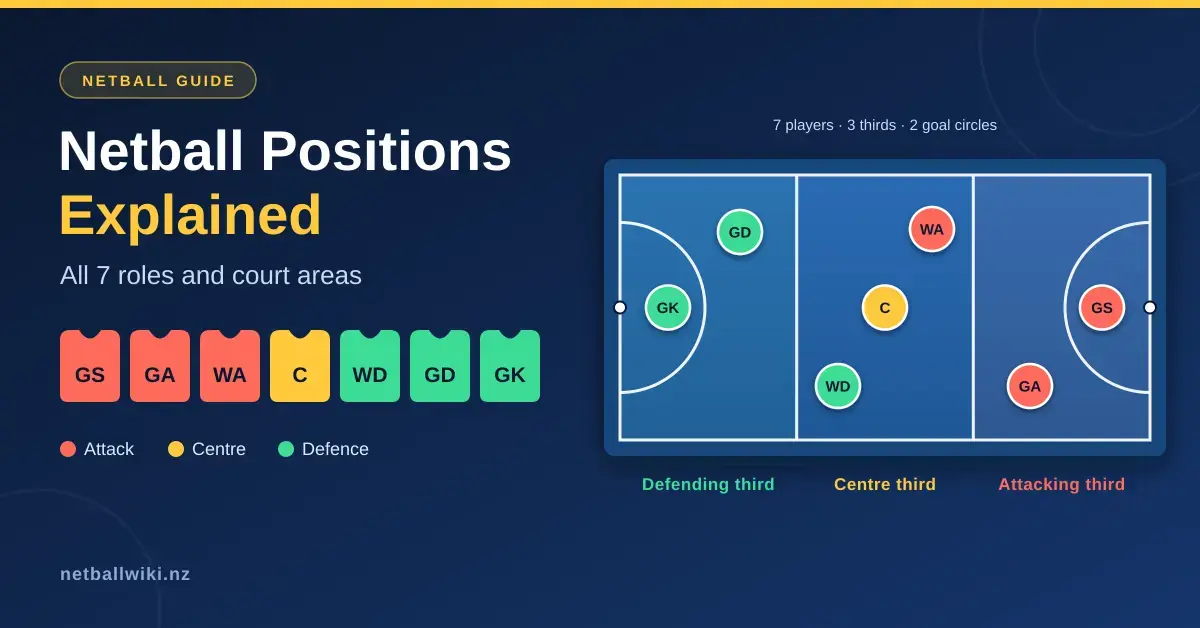
A standard netball court is 30.5 metres long and 15.25 metres wide. Two transverse lines split it into three equal thirds: a centre third in the middle and a goal third at each end. Play starts and restarts from the small centre circle, which is 0.9 metres in diameter. At each end sits a semi-circular goal circle with a radius of 4.9 metres, measured from the goal line, and only two players from each team are ever allowed to shoot from inside it. If you want the full measurements, see our guide to netball court dimensions.
The Seven Netball Positions and Their Roles
Netball uses seven positions, and each player’s bib shows a one- or two-letter abbreviation. The allowed areas are strictly enforced: straying into a zone your position is not permitted in is an “offside” infringement. The table below summarises where each position can go and whether it may shoot, and the sections that follow describe each group in more detail. Teams often colour-code or number their position bibs so officials and spectators can tell the roles apart.
Position Areas
| Position | Bib | Group | Allowed court areas | Can shoot? |
|---|---|---|---|---|
| Goal Shooter | GS | Attack | Attacking goal third, including the goal circle | Yes |
| Goal Attack | GA | Attack | Attacking goal third (incl. circle) and centre third | Yes |
| Wing Attack | WA | Attack / midcourt | Attacking goal third (excl. circle) and centre third | No |
| Centre | C | Midcourt | All three thirds, excluding both goal circles | No |
| Wing Defence | WD | Defence / midcourt | Defensive goal third (excl. circle) and centre third | No |
| Goal Defence | GD | Defence | Defensive goal third (incl. circle) and centre third | No |
| Goal Keeper | GK | Defence | Defensive goal third, including the goal circle | No |
Attacking positions (GS, GA and WA)
The attacking unit creates and finishes scoring chances. The Goal Shooter (GS) works closest to the post, holding position inside the goal circle to take high-percentage shots. The Goal Attack (GA) is more mobile: it shares the shooting circle with the GS, drops out into the centre third to collect passes, and acts as the team’s second shooter. The Wing Attack (WA) does not shoot but is the main feeder, carrying the ball through the centre third and delivering it into the circle for the shooters.
The Centre (C)
The Centre is the engine of the team and the only player allowed in all three thirds — though never inside either goal circle. The C takes the centre pass that restarts play after each goal, links defence to attack, and needs the stamina to cover the most ground on court. Balancing attacking drives with a quick recovery back into defence is what makes the Centre such a demanding role.
Defensive positions (GK, GD and WD)
The defensive unit tries to win back the ball and stop the opposition scoring. The Goal Keeper (GK) marks the opposing Goal Shooter and defends the goal circle, staying within the defensive goal third. The Goal Defence (GD) marks the opposing Goal Attack, working from the defensive goal third out into the centre third, and is often a team’s most versatile athlete. The Wing Defence (WD) shadows the opposing Wing Attack to cut out the feed into the circle; like the WA it plays the centre and defensive thirds but cannot enter the goal circle.
How the Positions Work Together
Netball is won in the spaces between positions. In attack, the WA and GA create passing angles so the GS can receive the ball in a strong shooting position. In defence, the GK and GD combine to crowd the shooters while the WD pressures the feed further out. The Centre stitches the two halves together on every transition. Clear communication and disciplined spacing matter far more than individual brilliance — you can review the fundamentals in our overview of how to play netball.
Netball Rules Every Position Must Know
Positions only make sense alongside the game’s core rules. A handful apply to every player, whatever their bib:
- Footwork: once you land, you cannot re-ground or drag your landing foot before passing or shooting.
- Three seconds: you must pass or shoot within three seconds of catching the ball.
- Offside: stepping into a court area your position is not allowed in hands possession to the other team.
- Obstruction: when defending the player with the ball you must stand at least 0.9 metres away before attempting to intercept or block.
- Contact: pushing, holding or otherwise interfering with an opponent is penalised.
A match is played over four 15-minute quarters. For a full breakdown of timings, see how long a netball game lasts; for the wider rulebook, our guide to the netball rules and this rules summary are good starting points.
Common Penalties and Infractions
Umpires enforce the rules and award penalties when they are broken. The most common are obstruction (defending closer than 0.9 metres), contact and offside. Depending on the offence, the other team is awarded a free pass or a penalty pass, taken from where the infringement happened; for serious or repeated breaches an umpire may warn or suspend a player. Read more NZ articles.
Tips for Mastering Your Position
Improving at netball starts with owning your role. Defenders should focus on reading the play, staying patient and contesting the ball without breaking the obstruction rule. Attackers should work on sharp changes of direction, timing their leads and shooting accuracy. Midcourters need a bit of everything, plus the fitness to keep transitioning between attack and defence. Regular netball drills that mirror your position’s movements are the fastest way to build these habits.
Sources
Frequently Asked Questions (FAQ)
How many positions are there in netball?
Each team has seven on-court positions: Goal Shooter, Goal Attack, Wing Attack, Centre, Wing Defence, Goal Defence and Goal Keeper. Every position is limited to specific areas of the court.
Which netball positions are allowed to shoot?
Only the Goal Shooter and the Goal Attack can score, and both must shoot from inside the attacking goal circle. No other position is permitted to take a shot.
Which position can move across the whole court?
The Centre is the only player allowed in all three thirds. Even so, the Centre may never enter either goal circle.
What do the letters on netball bibs mean?
The letters are abbreviations of each role: GS (Goal Shooter), GA (Goal Attack), WA (Wing Attack), C (Centre), WD (Wing Defence), GD (Goal Defence) and GK (Goal Keeper). They let players, umpires and spectators identify positions at a glance.
What happens if a player moves into an area they are not allowed in?
Moving into a restricted zone is an offside infringement. Play stops and the opposing team is awarded a free pass from the spot where the offence occurred.