A netball bib has one job: to tell players, umpires and spectators which of the seven positions a player is filling, and therefore which parts of the court she is allowed to enter. That makes it the only piece of team kit with a formal specification attached to it — and the specification is exactly where most club and school buyers get caught out.
This guide explains what the rules require, the practical choices between fabrics, colours and fittings, and the checks worth doing before you order a full set for a New Zealand team.
Compliance checklist
| Before you order, confirm… | What good looks like |
|---|---|
| Lettering height | 150 mm — ask for the figure in millimetres |
| Printed both sides | Front and back, above the waist |
| Visibility | Strong contrast between lettering and base fabric |
| Set contents | Seven positions: GS, GA, WA, C, WD, GD, GK |
| Fabric | Breathable mesh or sublimated polyester, not unvented plastic |
| Seams | Reinforced stitching where the elastic straps attach |
| Spare set | A contrasting backup for colour clashes |
What the rules require
Netball’s uniform rules are set internationally by World Netball and applied locally by Netball New Zealand and individual centres. Three points matter for bibs specifically:
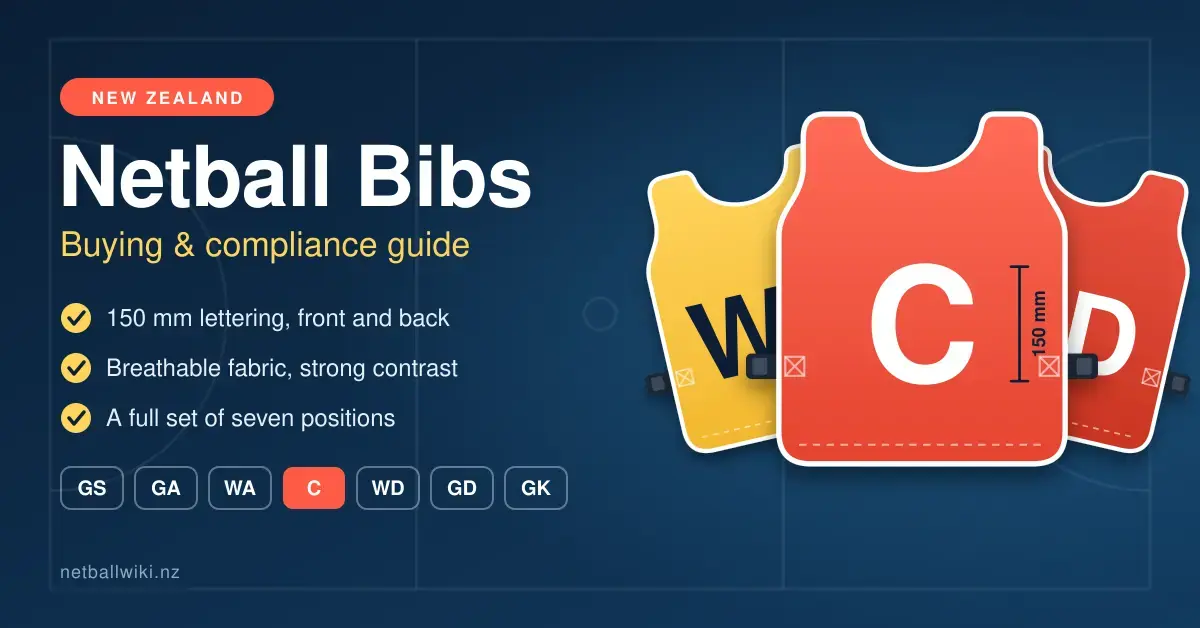
- Lettering height: playing position initials must be 150 mm high.
- Placement: the initials are worn above the waist and printed on both the front and the back, so a player is identifiable from either side.
- Visibility: the initials must be clearly visible, which in practice means a strong contrast between the lettering and the base fabric.
A full set covers the seven positions: Goal Shooter (GS), Goal Attack (GA), Wing Attack (WA), Centre (C), Wing Defence (WD), Goal Defence (GD) and Goal Keeper (GK). Our netball positions guide explains what each role does and where each player is allowed to go. The registered playing uniform, including these initials, is worn throughout the match — you can read the wider ruleset in our netball rules guide, and World Netball publishes the detail on its facilities, equipment and uniform requirements page.
The 150 mm trap
This is the single check worth doing before you place an order, because not every product sold as a “netball bib” actually meets the standard.
Some sets sold through general sports retailers carry lettering around 140 mm (14 cm) tall — just under the 150 mm requirement. Bibs like that are perfectly fine for training, school PE and casual social play, but they are not compliant kit for sanctioned competition. The word “regulation” in a product description is not the same as a stated measurement.
So ask the supplier for the lettering height in millimetres before you buy, and confirm the initials are printed on both sides. A quick email saves replacing a whole set mid-season.
Fabric and construction
Modern netball bibs come in two broad types, plus one to avoid.
Open-weave mesh is light, breathable, dries quickly and is cheap enough to buy in multiples. It usually has elastic side straps and pulls on over winter layers — useful in New Zealand, where a lot of club netball is played outdoors through the colder months.
Sublimated polyester has the lettering dyed into the fabric rather than printed on top, so it cannot crack or peel. It costs more and looks more finished, and it is the usual choice when a club wants a crest or sponsor branding built in.
The failure mode to avoid is thin screen printing over cheap fabric. After a season of mud and hot washes the ink flakes, a “WA” becomes unreadable, and the bib stops doing its one job. Also avoid unvented plastic tabards: they trap heat, and netball is a high-intensity sport played across four quarters.
Bib types compared
| Type | Lettering | Best for | Watch out for |
|---|---|---|---|
| Open-weave mesh vest | Usually screen-printed or heat-pressed | Schools, social teams, buying in bulk | Cheap prints can flake — check the letters are 150 mm |
| Sublimated polyester vest | Dyed into the fabric; will not crack or peel | Clubs wanting a crest or sponsor branding | Higher cost and a longer lead time to produce |
| Velcro patch set | Printed patch on a matching dress | Clubs where every player has the uniform dress | Useless without the corresponding loop-panel dress |
| Plastic tabard | Printed on the surface | Very short-term or indoor casual use | Traps heat; not suited to four quarters of play |
How bibs attach: straps or patches
Over-the-head vests with elastic side straps are the default for schools and social teams. One set stretches across a wide range of body sizes and layers, and it passes down easily between age groups.
Velcro patch sets attach to matching playing dresses fitted with loop panels. They sit flat, have no loose fabric to snag and look tidier — but they only work if every player already has the corresponding dress, which makes them a club-level rather than a school-level option. If your squad wears a set playing dress, our netball uniform buying guide covers the dresses themselves.
Neither is better in the abstract. The deciding question is simply whether your team has a uniform dress for patches to attach to.
Choosing a colour, and why black is popular
Dark bibs are common in New Zealand for a practical reason: winter netball on uncovered asphalt produces mud, court spray and sunscreen marks, and black or navy hide all three across a full season.
The trade-off is contrast. Dark fabric needs light lettering, and light lettering is the first thing to degrade if it has been screen-printed rather than sublimated. Whatever base colour you choose, the initials must stay clearly visible — including under floodlights and on the grey, overcast afternoons that make up a good part of the New Zealand season.
Colour clashes
If both teams arrive in similar colours, one side has to change so the umpires can tell them apart. Which team changes is set by your competition’s own bylaws, not by a single universal rule, so check your centre’s regulations rather than assuming the away team switches. The practical fix is a cheap contrasting spare set kept permanently in the manager’s bag, or reversible bibs with a light colour on the reverse.
Sizing a team set
Sizing is not standardised between manufacturers, so measurements vary from supplier to supplier. Order against the supplier’s own size chart rather than a generic guide, and where you can, get one sample in hand before committing to a full set.
| Size tier | Typical age | Grade |
|---|---|---|
| Junior | Primary school | futureFERNS lower years |
| Youth | Intermediate | futureFERNS Years 7–8 |
| Senior | Secondary and adult | School, club and social |
| Extended sizing | Adult | Mixed and business-house leagues |
Broadly, junior sets suit primary-aged players, youth sets cover intermediate, and senior sets run from secondary school through to adults. A full seven-position set only becomes necessary once a team plays the full seven-a-side game; younger Woolworths futureFERNS grades use modified formats with fewer players and fewer bibs. Mixed and social leagues generally need generous elastic side panels to fit a wider range of body shapes without stressing the seams.
For schools running several teams, mark the interior tags with a waterproof textile marker so junior sets don’t drift into the senior kit bag.
Where the rules come from, and who to check with
World Netball sets the international rules, but the day-to-day detail a buyer needs — grades, uniform variations and colour-clash procedures — is decided by your local centre. It is worth reading your own centre’s published information before ordering, because requirements differ between competitions and age groups.
The North Canterbury Netball Centre is a useful worked example of the kind of detail a centre publishes. Its pages set out grades, days and venues, the Year 7 and 8 competition information and season dates, the Year 5 and 6 draw and court-duty requirements, and the open-grade and senior representative fixtures. If you cannot find a uniform detail online, the centre contacts and committee page is the place to ask. For the wider regional picture, see our Canterbury netball guide.
Caring for netball bibs
Bibs are cheap individually but expensive in bulk, so basic maintenance pays off.
- Turn them inside out before washing to protect the printed lettering.
- Wash cool on a gentle, short cycle — around 30°C is enough for sweat and light mud.
- Skip fabric softener on synthetic sports fabrics: it coats the fibres, reduces breathability and traps odour.
- Never store gear damp. Dry sets fully, then keep them in a breathable mesh bag rather than a sealed plastic tub, where mildew develops quickly.
Beyond the bib: the rest of the uniform check
A bib is only one part of uniform compliance. Before a sanctioned match, players are also checked for the following:
- Jewellery: none is permitted except a wedding ring or a medical alert bracelet, and each must be taped over.
- Fingernails: must be short and smooth.
- Footwear: suitable sports shoes with no spikes.
Our netball equipment guide covers the rest of the kit, and our guide to netball shoes explains what to look for in footwear. New Zealand’s NetballSmart programme, run by Netball New Zealand, adds injury-prevention guidance; its work with ACC on reducing ACL and other injuries is a good primer for coaches and managers.
Please note: this article is for general information only. It is not purchasing advice and does not recommend particular retailers or brands. Uniform requirements are set by World Netball and applied through local competition bylaws, which vary — confirm the current requirements with World Netball, Netball New Zealand and your own netball centre before ordering competition kit. Details on this page were verified in September 2026.
Reference sources
Frequently asked questions (FAQ)
How tall do the letters on a netball bib need to be?
150 mm high. They must be clearly visible and worn above the waist on both the front and the back of the player.
Are all netball bibs sold online compliant?
No. Some retail sets use lettering around 140 mm, just under the 150 mm standard. Always ask for the lettering height in millimetres before buying kit for sanctioned competition.
What positions go on a netball bib set?
Seven per team: GS, GA, WA, C, WD, GD and GK. Each initial must be printed on both the front and the back.
Why do so many New Zealand clubs use black bibs?
Practicality. Most club netball here is played outdoors through winter, and dark fabric hides mud, court spray and sunscreen marks far better than white or pale colours across a full season.
What’s the difference between sublimated and screen-printed bibs?
Sublimated lettering is dyed into the fabric and cannot crack or peel. Screen printing sits on the surface and degrades with repeated washing, which is how position letters end up unreadable by the end of a season.