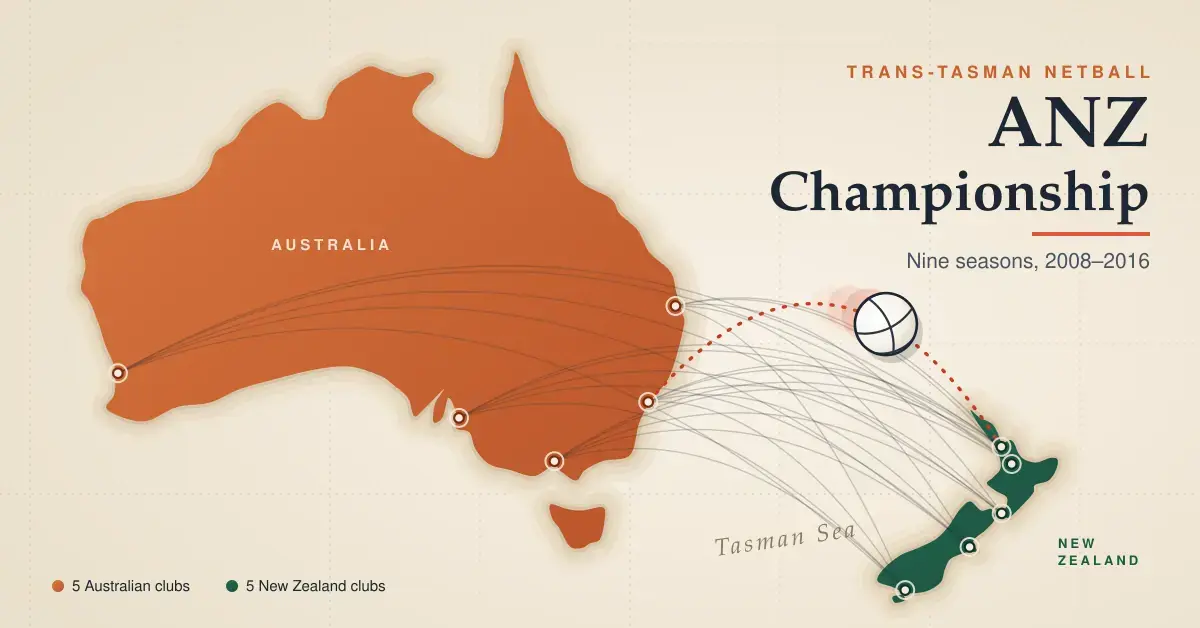
The ANZ Championship was the top-level club netball competition for Australia and New Zealand from 2008 to 2016. Run jointly by Netball New Zealand and Netball Australia, it was the first fully professional, trans-Tasman league in the sport, bringing together five clubs from each country in a single competition. Although it lasted only nine seasons, it reshaped how netball was played, watched and funded on both sides of the Tasman Sea. This guide explains what the league was, how it worked, which teams and players defined it, who won it, and why it eventually split into two separate competitions.
What the ANZ Championship was
Netball is a fast, non-contact team sport played mostly by women and girls. Two teams of seven compete on a court divided into thirds, moving the ball by passing (players cannot run with it or bounce it) and scoring by shooting through a ring with no backboard. Specific positions are only allowed in certain parts of the court, which makes positioning and quick passing central to the game.
Before 2008, Australia and New Zealand ran separate national leagues: Australia’s Commonwealth Bank Trophy and New Zealand’s National Bank Cup. The ANZ Championship merged the best of both into one trans-Tasman league, named after its principal sponsor, the ANZ bank. It gave the region’s leading players regular matches against the strongest opponents available, raised playing standards, and created a professional pathway that fed directly into the Australian Diamonds and New Zealand’s Silver Ferns.
Key Facts
| Competition | ANZ Championship (trans-Tasman netball league) |
|---|---|
| Countries | Australia and New Zealand |
| First season | 2008 |
| Final season | 2016 (9 seasons) |
| Teams | 10 — 5 Australian, 5 New Zealand |
| Format | Single round-robin (2008–2014); two conferences (2015–2016) |
| Most titles | Queensland Firebirds (3) |
| Only NZ champion | Waikato Bay of Plenty Magic (2012) |
| Replaced by | Suncorp Super Netball (Australia) and the ANZ Premiership (New Zealand), from 2017 |
How the ANZ Championship worked
The competition’s structure changed roughly halfway through its life. Understanding the two phases makes the champions list and the rivalries much easier to follow.
The round-robin era (2008-2014)
For its first seven seasons the league ran as a single trans-Tasman competition. Each of the ten teams played 13 regular-season games: home-and-away fixtures against the other clubs from its own country, plus one match against each club from the other country, with the host nation alternating year to year. Matches could not end in a draw during this period.
The top four teams on the ladder advanced to the finals, which used the Page-McIntyre playoff system. This format gives the higher-placed teams a second chance: the first-versus-second winner goes straight to the grand final, while the loser drops into a preliminary final against the winner of the third-versus-fourth match. The two survivors then met in the grand final for the title.
The conference era (2015-2016)
In 2015 the league was restructured into two conferences, an Australian Conference and a New Zealand Conference, with a six-team finals series replacing the old top-four playoff. A secondary competition, the Challenge Trophy, was added for the sides that missed the finals. Draws were also introduced for the first time, each worth one competition point; the first drawn game was a 47-47 result between the NSW Swifts and Queensland Firebirds in March 2015.
Finals, extra time and the golden goal
Grand finals were played at a neutral or host venue. If a finals match was level at full time, two periods of extra time were played. If the scores were still tied, a “golden goal” rule decided it: the first team to score during a further short period won the match. This dramatic tie-breaker only applied in the finals, not the regular season.
The ten teams
The league was always made up of five Australian and five New Zealand clubs. Several of these teams still compete today in the two successor leagues, which is why their names remain familiar to fans.
Australian teams
- Adelaide Thunderbirds – South Australia’s club and a two-time ANZ Championship winner.
- Melbourne Vixens – the Victorian side and another two-time champion.
- New South Wales Swifts – the Sydney club that won the inaugural 2008 title.
- Queensland Firebirds – the most successful club of the era, with three titles.
- West Coast Fever – the Perth-based team representing Western Australia.
New Zealand teams
- Central Pulse – the Wellington region’s franchise.
- Northern Mystics – based in Auckland and the upper North Island.
- Waikato Bay of Plenty Magic – the only New Zealand side to win the title.
- Mainland Tactix – the Canterbury-based club, known as the Canterbury Tactix until it was renamed the Mainland Tactix in 2015.
- Southern Steel – representing the lower South Island.
It is a common mistake to list the Northern Stars among the ANZ Championship teams. The Stars did not exist during the league; they were created later as a sixth franchise for New Zealand’s ANZ Premiership, which succeeded the ANZ Championship in New Zealand.
Champions and memorable seasons
Australian clubs dominated the trophy. Across nine seasons, the only New Zealand champion was the Waikato Bay of Plenty Magic, who beat the Melbourne Vixens 41-38 in the 2012 grand final. The Queensland Firebirds were the competition’s benchmark team, winning three titles and becoming the only side to go back-to-back, in 2015 and 2016.
ANZ Championship Champions by Season
| Season | Champion | Runner-up | Grand final score |
|---|---|---|---|
| 2008 | NSW Swifts | Waikato Bay of Plenty Magic | 65–56 |
| 2009 | Melbourne Vixens | Adelaide Thunderbirds | 54–46 |
| 2010 | Adelaide Thunderbirds | Waikato Bay of Plenty Magic | 52–42 |
| 2011 | Queensland Firebirds | Northern Mystics | 57–44 |
| 2012 | Waikato Bay of Plenty Magic | Melbourne Vixens | 41–38 |
| 2013 | Adelaide Thunderbirds | Queensland Firebirds | 50–48 |
| 2014 | Melbourne Vixens | Queensland Firebirds | 53–42 |
| 2015 | Queensland Firebirds | NSW Swifts | 57–56 |
| 2016 | Queensland Firebirds | NSW Swifts | 69–67 |
The grand finals drew large crowds by netball standards. The biggest was the very first, in 2008, when the NSW Swifts beat the Magic 65-56 in front of 12,999 fans at Sydney’s Acer Arena. Close finishes became a hallmark of the league’s final years: the 2015 decider was settled by a single goal (57-56), and the last-ever grand final in 2016 was a 69-67 thriller between the Firebirds and the Swifts.
Famous players of the ANZ Championship era
The league was a showcase for many of the greatest players in the sport’s history, from both nations. A handful of names captured the era.
Irene van Dyk
A goal shooter widely regarded as one of the finest ever, Irene van Dyk played for the Central Pulse and later the Southern Steel in the ANZ Championship. Famous for her accuracy and calm under pressure, she became the most-capped international in netball history after switching from South Africa to the Silver Ferns.
Maria Tutaia
A New Zealand shooter who played for the Northern Mystics, Maria Tutaia (later Maria Folau) was known for her long-range shooting and became a key figure for the Silver Ferns during the league’s lifetime.
Catherine Cox
One of Australia’s most prolific shooters, Catherine Cox captained the NSW Swifts to the inaugural ANZ Championship title in 2008 and was named grand-final MVP. She later moved west to captain the West Coast Fever before finishing her career with a 2014 premiership at the Melbourne Vixens.
Sharelle McMahon
An Australian goal attack and former Diamonds captain, Sharelle McMahon played for the Melbourne Vixens and was one of the most recognisable faces of Australian netball when the league began.
Laura Geitz
A commanding Australian defender, Laura Geitz captained the Queensland Firebirds through their most successful period, leading them to ANZ Championship titles in 2011 and to the back-to-back crowns of 2015 and 2016. Her shut-down defence at goal keeper was central to the Firebirds’ dominance.
Why the league ended in 2016
Despite its on-court success, the ANZ Championship faced growing structural problems. The trans-Tasman model meant heavy travel costs and awkward broadcast timeslots across two countries and multiple time zones, which made it harder to grow television audiences and secure stable, long-term sponsorship. Netball Australia, in particular, wanted a richer domestic broadcast deal that a shared league could not deliver.
In 2016 the two governing bodies announced that the competition would be discontinued after that season. Both federations concluded that separate national leagues would let each country control its own broadcasting, commercial deals and player payments, and better develop homegrown talent.
What replaced the ANZ Championship
From 2017 the single trans-Tasman league was replaced by two competitions:
- Suncorp Super Netball in Australia, an eight-team domestic league backed by a lucrative broadcast deal, widely regarded as one of the strongest club competitions in world netball.
- The ANZ Premiership in New Zealand, a six-team domestic league built around the existing New Zealand franchises plus the new Northern Stars.
The split ended regular club-level matches between Australian and New Zealand teams, but the national rivalry continued through international fixtures such as the Constellation Cup and the Netball World Cup. Some observers felt the loss of weekly trans-Tasman club games weakened the contest, while others argued that stronger, better-funded domestic leagues ultimately raised standards in both countries.
The legacy of the ANZ Championship
For nearly a decade the ANZ Championship set the professional standard for club netball. It gave players consistent high-pressure matches, pushed coaches to innovate tactically, and lifted the sport’s profile through live television coverage. Many of the athletes who starred in it went on to become household names for the Silver Ferns and the Australian Diamonds, and the franchises it created still form the backbone of both the ANZ Premiership and Suncorp Super Netball. Though it no longer exists, the league remains an important chapter in the history of trans-Tasman netball.
Sources
- Netball New Zealand — Centenary feature: the ANZ Championship era
- The Spinoff — Looking back at netball’s brief and brilliant ANZ Champs era
- Te Ara, the Encyclopedia of New Zealand — Netball
- Netball Queensland — Laura Geitz profile
- Netball Australia — Cath Cox AM inducted into the Australian Netball Hall of Fame
- Suncorp Super Netball — official website
Frequently Asked Questions (FAQ)
When did the ANZ Championship start and finish?
The ANZ Championship ran for nine seasons, from 2008 to 2016. It was replaced from 2017 by Suncorp Super Netball in Australia and the ANZ Premiership in New Zealand.
Which teams played in the ANZ Championship?
Ten teams competed: five from Australia (Adelaide Thunderbirds, Melbourne Vixens, NSW Swifts, Queensland Firebirds and West Coast Fever) and five from New Zealand (Central Pulse, Northern Mystics, Waikato Bay of Plenty Magic, the Canterbury/Mainland Tactix and Southern Steel).
Who was the most successful ANZ Championship team?
The Queensland Firebirds were the most successful club, winning three titles (2011, 2015 and 2016) and becoming the only team to win back-to-back championships.
Did any New Zealand team ever win the ANZ Championship?
Yes. The Waikato Bay of Plenty Magic were the only New Zealand side to win the title, beating the Melbourne Vixens 41-38 in the 2012 grand final.
Why did the ANZ Championship end?
High travel costs, split broadcast markets across two countries and the desire for stronger domestic commercial deals led Netball Australia and Netball New Zealand to replace the single trans-Tasman league with separate national competitions after the 2016 season.