In New Zealand, the term National Netball League refers to the country’s top-flight domestic netball competition — the professional league that sits at the summit of the club game and feeds talent into the Silver Ferns. Today that competition is branded the ANZ Premiership. It is contested by six regional franchises, organised by Netball New Zealand, and has crowned a champion every year since 2017. This guide explains what the national league is, where it came from, how a season works, and which teams have lifted the trophy.
Quick Facts
| Competition | ANZ Premiership (New Zealand’s National Netball League) |
|---|---|
| Governing body | Netball New Zealand |
| Founded | 2017 (succeeded the ANZ Championship) |
| Teams | 6 regional franchises |
| Format | Round-robin regular season plus a two-match finals series |
| Current champions (2026) | Northern Mystics |
| Most successful team | Northern Mystics (4 titles) |
| 2026 broadcaster (NZ) | TVNZ 2 and TVNZ+ (free-to-air) |
| Official website | anzpremiership.co.nz |
What the National Netball League is today
New Zealand’s national netball league is run under licence by Netball New Zealand, the sport’s governing body, and currently carries the naming-rights title ANZ Premiership. It began in 2017 as a fully New Zealand-based competition, replacing the trans-Tasman league that had come before it.
Six franchises take part, each representing a region of the country. They are professional and semi-professional sides that sign the best domestic players as well as a limited number of overseas imports. The league runs through the New Zealand winter, with the season building toward a short finals series and a single grand final that decides the title. Because it is the highest level of club netball in the country, the national league is also the main selection shop window for the national team.
From the National Bank Cup to the ANZ Premiership
New Zealand’s elite club netball has changed name and shape several times. Through the early 2000s the top competition was the National Bank Cup, a domestic league of New Zealand-only teams. In 2008 that tournament was folded into a new trans-Tasman competition shared with Australia: the ANZ Championship.
The ANZ Championship ran from 2008 to 2016 and featured ten teams — five from New Zealand and five from Australia. The New Zealand founders came out of the National Bank Cup: Waikato Bay of Plenty Magic and the Canterbury side (the former Canterbury Flames, rebranded as the Canterbury Tactix) carried over, while other National Bank Cup clubs merged to form the Central Pulse, Northern Mystics and Southern Steel. On the Australian side, clubs from the Commonwealth Bank Trophy — including the Adelaide Thunderbirds — reorganised into five franchises.
The Queensland Firebirds were the most successful club of the ANZ Championship era, reaching five grand finals and winning three titles (2011, 2015 and 2016); they were the only side to win back-to-back championships. The strongest New Zealand team was Waikato Bay of Plenty Magic, who in 2012 became the only New Zealand side to win the trans-Tasman league, beating the Melbourne Vixens 41–38 in the final.
In 2016 Netball Australia and Netball New Zealand confirmed the ANZ Championship would end after that season. The two countries went their separate ways: Australia launched Suncorp Super Netball, and New Zealand launched the ANZ Premiership — the competition that still carries the national league today.
The six teams
The national league is made up of six franchises, each tied to a region of New Zealand. The 2017 launch kept five teams from the old trans-Tasman competition and added one new side, the Northern Stars.
- Central Pulse (Wellington): representing the lower North Island, the Pulse are three-time champions and have been one of the league’s most consistent finals teams.
- Mainland Tactix (Christchurch): the Canterbury-based side, long a nearly-team, who finally broke through to win their first title in 2025.
- Northern Mystics (Auckland): the Auckland franchise and the most successful team of the ANZ Premiership era, known for a fast, attacking style.
- Northern Stars (Takanini): a South Auckland side added when the league launched in 2017; they have reached several grand finals without yet winning one.
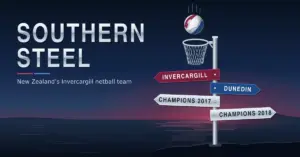
- Southern Steel (Invercargill): the deep-south franchise covering Otago and Southland, who won the first two ANZ Premiership titles in 2017 and 2018.
- Waikato Bay of Plenty Magic (Hamilton): representing the central North Island, the Magic carry a proud history from the trans-Tasman years but are still chasing a first ANZ Premiership title.
How a season and the finals work
A modern ANZ Premiership season is a home-and-away round robin followed by a short finals series. With six teams in the competition, the regular season is built so each side plays the others multiple times; the 2026 edition ran to 30 round-robin matches across roughly 12 weeks before the finals. Fixtures are set in advance by Netball New Zealand, and you can read more about how competition draws are put together in our guide to how netball draws and fixtures are made.
The team that finishes first on the ladder at the end of the round robin is the minor premier. The finals are a two-match series: the sides finishing second and third meet in an elimination final, and the winner advances to face the minor premier in the grand final. The grand final is a single, winner-takes-all match, so a team can top the table all season and still miss out on the title if it loses on finals day.
Since 2025 the league has used a two-point Super Shot. A goal is normally worth one point, but in the last five minutes of each quarter a successful shot taken from the outer part of the goal circle (roughly 3.5 metres or more from the post) is worth two points. The rule rewards accurate long-range shooting and can swing a scoreline quickly, which has changed how coaches manage the closing minutes of every quarter.
Season-by-season champions, 2017 to 2026
Southern Steel set the early standard. Coached by Reinga Bloxham and captained by Wendy Frew, the Invercargill side went through the inaugural 2017 regular season unbeaten and thrashed Central Pulse 69–53 in the grand final. They defended the title in 2018, edging the Pulse 54–53 in a far tighter decider.
Central Pulse then took over. After two near misses, the Wellington team won their first title in 2019, beating the Northern Stars 52–48. They retained it in 2020 with a 43–31 win over the Mainland Tactix, and added a third in 2022, overpowering the Northern Stars 56–37. The 2021 season broke that run: the Northern Mystics claimed their first ANZ Premiership crown with a 61–59 win over the Tactix.
The Mystics went on to define the mid-2020s. They won again in 2023 (74–56 against the Northern Stars) and made it back-to-back in 2024, squeezing past Central Pulse 54–53 in one of the closest finals the league has seen. The Mainland Tactix finally reached the top in 2025, beating the Mystics 58–46 to win their first title. The Mystics responded in 2026 by beating Southern Steel 56–46 at The Trusts Arena in Auckland to take a record fourth ANZ Premiership title.
Champions by Season
| Season | Champion | Score | Runner-up |
|---|---|---|---|
| 2017 | Southern Steel | 69–53 | Central Pulse |
| 2018 | Southern Steel | 54–53 | Central Pulse |
| 2019 | Central Pulse | 52–48 | Northern Stars |
| 2020 | Central Pulse | 43–31 | Mainland Tactix |
| 2021 | Northern Mystics | 61–59 | Mainland Tactix |
| 2022 | Central Pulse | 56–37 | Northern Stars |
| 2023 | Northern Mystics | 74–56 | Northern Stars |
| 2024 | Northern Mystics | 54–53 | Central Pulse |
| 2025 | Mainland Tactix | 58–46 | Northern Mystics |
| 2026 | Northern Mystics | 56–46 | Southern Steel |
Which team has been most successful
Across the ANZ Premiership era, the Northern Mystics are the benchmark, with four titles (2021, 2023, 2024 and 2026) that make them the competition’s most decorated franchise. Central Pulse are next with three (2019, 2020, 2022), followed by Southern Steel with the first two (2017, 2018) and the Mainland Tactix with one (2025). The Northern Stars and Waikato Bay of Plenty Magic are the two sides still waiting for a maiden ANZ Premiership title, though both have been competitive and the Stars have reached multiple grand finals.
The league’s role in the wider game
The national league is more than a club competition — it is the main bridge between community netball and the international stage. Players who stand out in secondary-school and regional netball are recruited into franchise training squads, and strong ANZ Premiership form is one of the clearest routes into the Silver Ferns squad. Selectors watch the league closely, so a breakout season for a young shooter, feeder or defender can translate quickly into a national call-up.
The league also shapes the calendar for New Zealand netball. It runs through the domestic winter and finishes before the main run of international fixtures, allowing players to move from club duty into national camps. Because every franchise draws on a defined region, the competition spreads elite netball across the country rather than concentrating it in one or two cities, which helps sustain coaching, officiating and junior interest in each zone.
Rule experiments tend to arrive here before they filter into the grassroots game. The two-point Super Shot is the clearest recent example: trialled at this level, it changed tactics around the end of each quarter and gave long-range shooters a new weapon, while coaches had to weigh the risk of conceding a two-point reply. Watching how franchises adapt to such changes is part of what makes following a full season rewarding.
How to follow and watch the league
From 2026 the national league returned to free-to-air television in New Zealand on TVNZ, with matches shown on TVNZ 2 and streamed on TVNZ+. That marked a change from the previous arrangement, under which the competition had been broadcast on Sky since the trans-Tasman days in 2008. The shift to free-to-air was designed to put the domestic game in front of a wider audience.
Beyond the broadcast, fans can keep up with squads, fixtures and results through each franchise and through Netball New Zealand. For practical tips on attending games and getting the most out of a season, see our guide to following the ANZ Premiership. For official schedules and news straight from the competition, the league’s official ANZ Premiership website is the primary source.
Sources
- ANZ Premiership — official website
- Netball New Zealand — ANZ Premiership returns to TVNZ in 2026
- NZ Herald — Northern Mystics beat Southern Steel in the grand final
- Otago Daily Times — Steel fall short in premiership final
- RNZ — ANZ Premiership 2025 format and broadcast
- NZ Herald — ANZ Premiership to feature a two-point shot
- 1News — TVNZ to show the ANZ Premiership in 2026
Frequently Asked Questions (FAQ)
What is the National Netball League in New Zealand?
It is New Zealand’s top-flight domestic netball competition. Today it is branded the ANZ Premiership, is run by Netball New Zealand, and is contested by six regional franchises. It is the highest level of club netball in the country and a key pathway to the Silver Ferns.
How many teams play in the ANZ Premiership?
Six: Central Pulse (Wellington), Mainland Tactix (Christchurch), Northern Mystics (Auckland), Northern Stars (Takanini), Southern Steel (Invercargill) and Waikato Bay of Plenty Magic (Hamilton). Each represents a different region of New Zealand.
Who has won the most ANZ Premiership titles?
The Northern Mystics, with four titles (2021, 2023, 2024 and 2026). Central Pulse have won three, Southern Steel two and the Mainland Tactix one. The Northern Stars and Waikato Bay of Plenty Magic have not yet won the competition.
Where can I watch the ANZ Premiership?
From 2026 the competition is free-to-air in New Zealand on TVNZ, with games broadcast on TVNZ 2 and streamed on TVNZ+. Before that the league had been shown on Sky since 2008. Fixtures and results are also published on the league’s official website.
What is the Super Shot in the national league?
Introduced in 2025, the Super Shot is a two-point goal. For the final five minutes of each quarter, a shot made from the outer section of the goal circle (about 3.5 metres or more from the post) scores two points instead of one, rewarding long-range accuracy and making late comebacks possible.