Netball North Harbour is the netball centre for Auckland’s North Shore, running the organised game from five-year-olds in their first modified matches through to premier club teams and representative squads. This guide focuses on the practical questions parents and new players actually ask: how the competitions are structured, which grade suits whom, when the seasons run, what it costs and how to sign up. For the centre’s full history, venue and elite pathway, see our companion guide to North Harbour Netball: the powerhouse of the North Shore.
Quick Facts
| Centre | Netball North Harbour (formerly North Shore Basketball Association) |
|---|---|
| Founded | 1952 (70th anniversary in 2022) |
| Home venue | Barfoot & Thompson Netball Centre, 44 Northcote Road, Northcote, Auckland |
| Indoor arena | Onewa Arena — opened July 2011, interior renovated 2024 |
| Zone | Netball Northern, under Netball New Zealand |
| Elite franchise | Northern Mystics (ANZ Premiership) |
| Main winter season | Approximately May to August |
| Register via | Team Builder on the Sporty platform |
| Contact | 09 481 0022 — [email protected] |
Where Netball North Harbour fits in New Zealand netball
A “centre” is a local administrative body that runs netball for a defined area, affiliating clubs and schools and organising their competitions. Netball North Harbour is one such centre, covering the North Shore and up the Hibiscus Coast. It sits within the Netball Northern zone — one of the regional zones that make up Netball New Zealand, the sport’s national governing body.
The centre was formed in 1952 as the North Shore Basketball Association — netball was officially called “basketball” in New Zealand until 1970 — and celebrated its 70th anniversary in 2022. Within the wider zone the elite representative team is the Northern Mystics, the ANZ Premiership franchise that talented North Shore players can ultimately aim for. If you want the big-picture view of how the region is organised and resourced, our guide to Auckland netball’s high-performance hub sets the scene.
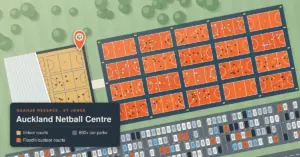
The Barfoot & Thompson Netball Centre and Onewa Arena
Almost all North Harbour netball is played at the Barfoot & Thompson Netball Centre, 44 Northcote Road, Northcote. The site is easy to reach — it sits beside the Northcote Road off-ramp from the Northern Motorway, close to the Harbour Bridge and the Auckland CBD.
The complex combines a large bank of floodlit outdoor courts with the indoor Onewa Arena, which opened to the community in July 2011. Barfoot & Thompson became the centre’s naming-rights sponsor in 2017, and the building’s interior was extensively renovated in February 2024 to modernise it for hirers. Beyond netball, the courts are used by the public for tennis, volleyball and, more recently, pickleball.
Some competitions run at satellite venues rather than Northcote. Selected primary-grade games are held at Westlake Girls High School, and Hibiscus Coast fixtures are played at Edith Hopper Park in Manly, so always check where your specific grade plays before the season starts.
Club netball: grades and the winter season
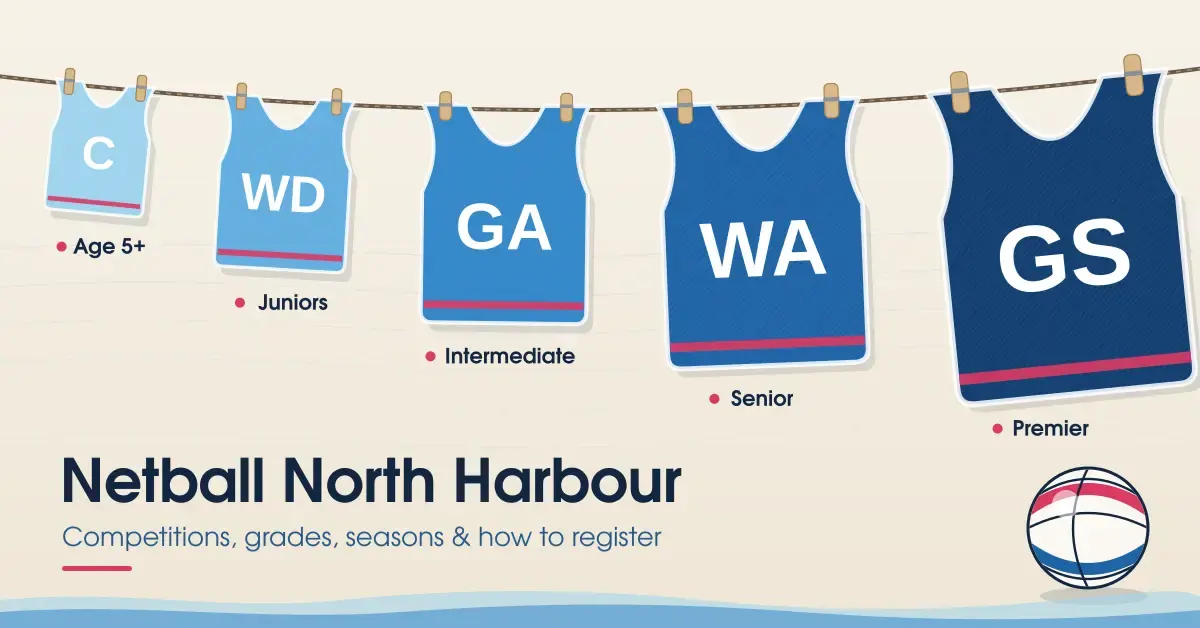
Club netball is the heart of the winter competition and is open to adults and secondary-school-aged players who sign up through one of the centre’s affiliated clubs (there are around 15, including names such as Northcote, Shore Rovers and Westlake). Importantly, club netball does not cater for primary or intermediate players — those age groups play through their schools instead.
Grades are set after a grading weekend so that teams play others of similar ability. The main divisions are:
- Premier 1 — the top grade, played on Tuesday evenings.
- Premier 2 — played on Thursday evenings.
- Saturday grades — a ladder running down from P2 and P3 through Senior 1, Senior 2, Senior 3 and below, so there is a level for genuine beginners as well as experienced players.
Premier games are played at 7.00pm and 8.40pm over two rounds, while Saturday grades typically run from about 1.00pm to 4.00pm. The season follows the standard New Zealand winter calendar — in 2026 the Saturday grades began on 2 May and finished with finals on 29 August, with a mid-season promotion and relegation round and breaks over the July school holidays. If you are curious how the fixtures themselves are produced, see our explainer on how competition draws and grading work.
Competitions at a Glance
| Stream | Who plays | Typical day | Season |
|---|---|---|---|
| Club — Premier 1 | Adults & secondary via clubs | Tuesday evenings | Winter (May–Aug) |
| Club — Premier 2 | Adults & secondary via clubs | Thursday evenings | Winter |
| Club — Saturday grades | Adults & secondary via clubs | Saturday afternoons | Winter |
| Primary & Intermediate | School-aged players via schools | Weekdays | Winter |
| College | Secondary students via schools | Scheduled fixtures | Winter |
| Woolworths futureFERNS | Primary-aged beginners | Weekdays/weekends | Winter |
| Inside 5-a-side | Adults, intermediate & college | Early-week evenings | Indoor, year-round |
| Social twilight 7-a-side | Adults, mixed & social teams | Weeknight twilight | Twilight season |
| Walking Netball | Older or returning players | Scheduled sessions | Year-round |
| Spring Leagues | Primary & intermediate/college | Post-winter | Spring |
School netball: primary, intermediate and college
Children in primary and intermediate school play through their school rather than a club. Netball North Harbour runs separate Primary, Intermediate and College competitions, and the youngest players start with Woolworths futureFERNS — the national entry-level programme that uses modified rules, smaller teams and lower hoops so beginners can learn the game at their own pace.
School teams register through a coordinator rather than individually. A few practical quirks are worth knowing: intermediate teams are usually identified by numbers rather than names, and each team is expected to supply its own umpire — the centre can allocate one for a set fee per game if you cannot. Game days vary by grade, so confirm your child’s day and venue with the school’s netball coordinator.
Social and alternative formats
Not everyone wants a full Saturday club commitment, and the centre runs several lower-pressure formats:
- Inside 5-a-side — fast indoor netball with five players a side, with adult and intermediate/college sessions earlier in the week.
- Social twilight 7-a-side — relaxed weeknight netball (such as the Fantail & Turtle Social Twilight league in Northcote), ideal for mixed and workplace teams.
- Walking Netball — a low-impact, no-running version aimed at older players, returning players and anyone easing back into exercise.
- Pickleball North Harbour — the centre also hosts men’s and women’s pickleball leagues, sharing the courts with the netball programme.
Social and twilight leagues are a great way to get a group of friends or colleagues playing. If you are putting a casual side together, our list of netball team names is a light-hearted place to start.
Spring Leagues and the off-season
Netball North Harbour does not stop when the winter season ends. Spring Leagues run after the main competition, with separate Primary and Intermediate/College options, keeping younger players active and developing between seasons. Combined with year-round indoor 5-a-side and walking netball, it means there is almost always something on at Northcote, whatever the time of year.
Representative and development pathways
For players with higher ambitions, the centre runs a Representative Programme, an Athlete Development Programme, player development clinics, after-school programmes and a school holiday programme. These feed talented juniors into zone squads and, ultimately, towards the Northern Mystics and the Silver Ferns. Because the pathway, the Mystics and the development teams are covered in depth elsewhere, this guide keeps it brief — the sister article linked above is the place to read the full high-performance story.
Umpiring and coaching
Umpires and coaches are always in demand, and both have clear entry points. New umpires can start with an introductory “Rules 101” style course before working through the accreditation pathway, and the centre keeps members updated on World Netball’s rule changes. Coaches can attend coaching courses and information evenings to build their qualifications. Getting a solid grounding in the rules of netball is the natural first step for either role, and even committed players benefit from understanding how the game is officiated.
Fees, registration and how to join
Registration is handled online through Team Builder on the Sporty platform, which Netball North Harbour uses for both club and school entries. The broad steps are simple:
- Choose how you want to play — join or form a club team, enter through your school, or sign up for a social, twilight or walking-netball league.
- Register your team (and players) through the relevant coordinator using Team Builder on Sporty.
- Attend the grading weekend if you are in a club grade, so your team is placed at the right level.
- Pay the club or competition fee by the due date and confirm your draw.
Deadlines fall early in the year and renew each season. In 2026, for example, club team registration closed in mid-March, grading was held in April, and club fees were due in late May. Because these dates reset annually and the following year’s details are usually published late in the year, always confirm the current season’s cut-offs and fees on the official Netball North Harbour website before you commit a team.
Common mistakes to avoid
- Assuming club netball is for kids. Primary and intermediate players must enter through their school — club netball is for adults and secondary students only.
- Missing the March team cut-off. Team registration closes weeks before the first game; leaving it late can mean missing a season.
- Forgetting umpires. School and some club teams are expected to provide their own umpire, so sort this out early rather than paying game-by-game.
- Turning up at the wrong venue. Most netball is at Northcote, but some primary and Hibiscus Coast grades play at satellite venues — check your draw.
- Wearing the wrong shoes. Netball’s quick stops and turns need proper court shoes rather than running trainers, especially for growing juniors.
Who Netball North Harbour suits
The centre is built to take in almost anyone on the North Shore. Families find an easy on-ramp through school competitions and futureFERNS; returning or older players have walking netball and social twilight leagues; competitive adults have a full ladder of club grades; and ambitious juniors have a representative pathway that leads towards the elite game. That breadth — rather than any single flagship event — is what makes it one of New Zealand’s busiest regional centres.
Sources
Frequently Asked Questions (FAQ)
Where is Netball North Harbour based?
Its home is the Barfoot & Thompson Netball Centre at 44 Northcote Road, Northcote, on Auckland’s North Shore, next to the Northcote Road off-ramp from the Northern Motorway. Some primary and Hibiscus Coast grades play at satellite venues such as Westlake Girls High School and Edith Hopper Park in Manly.
When does the netball season run at North Harbour?
The main club and school competitions follow the New Zealand winter, running from around early May to late August. Spring Leagues continue afterwards, and indoor 5-a-side and walking netball run across much of the year, so there are playing options outside the winter season too.
Can primary school children play club netball at North Harbour?
No. Club netball caters for adults and secondary-school-aged players who register through an affiliated club. Primary and intermediate children play through their schools, starting with the modified Woolworths futureFERNS programme for the youngest age groups.
How do I register a team or player?
Registration is done online through Team Builder on the Sporty platform, generally via a club or school coordinator. Team registration closes early in the year (mid-March in 2026), followed by grading and a fees deadline, so check the official website for the current season’s dates.
What is the Barfoot & Thompson Netball Centre?
It is Netball North Harbour’s main home venue. The centre combines a large bank of outdoor courts with the indoor Onewa Arena, which opened in 2011. Barfoot & Thompson has held the naming rights since 2017, and the interior was renovated in 2024.