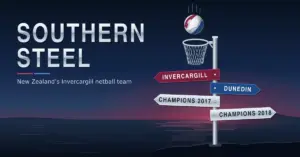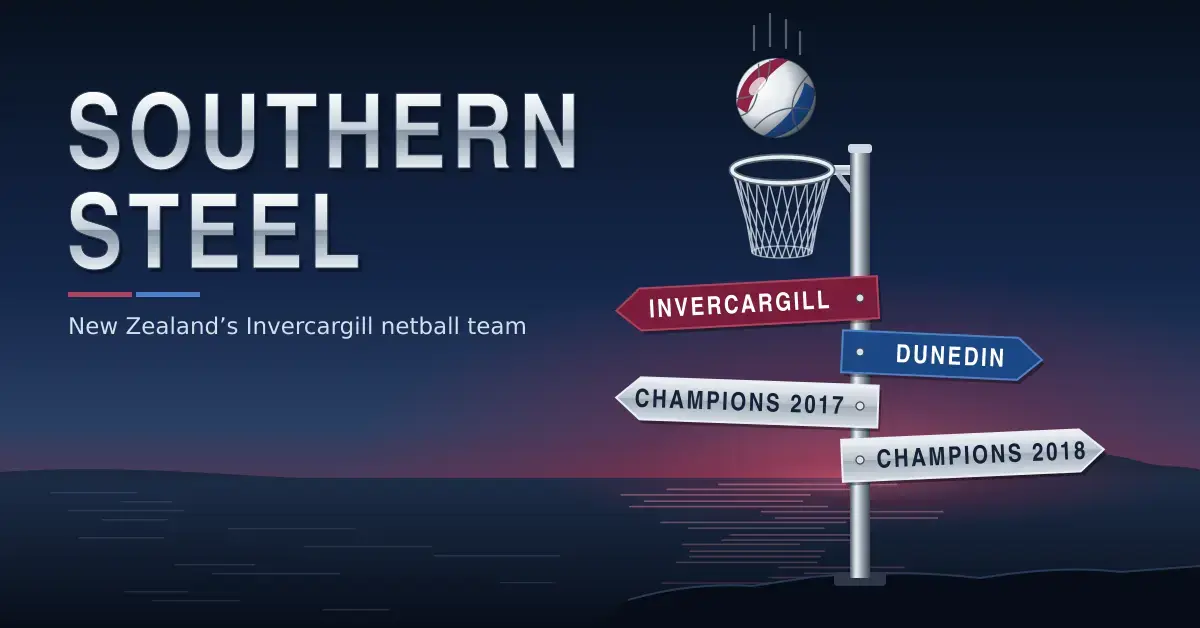
The Southern Steel are a professional netball franchise based in Invercargill at the southern tip of New Zealand’s South Island. They represent the Netball South zone, which covers both Southland and Otago, and they compete in the ANZ Premiership — the country’s elite, six-team domestic league. Formed in 2007, the Steel are one of New Zealand netball’s most successful teams of the modern era, having won the inaugural ANZ Premiership title in 2017 and retained it in 2018. This guide explains where the team came from, what they have won, where they play, and the players and coaches who have shaped them.
Quick Facts
| Founded | 2007 (from the Southern Sting and Otago Rebels) |
|---|---|
| Base | Invercargill, New Zealand |
| Home venues | ILT Stadium Southland (Invercargill); Edgar Centre (Dunedin) |
| Region | Netball South zone — Southland and Otago |
| League | ANZ Premiership (six teams) |
| Colours | Burgundy and blue |
| Head coach | Wendy Frew |
| Captain (2026) | Kimiora Poi |
| Major titles | ANZ Premiership champions 2017 and 2018 |
| Official site | southernsteel.co.nz |
Team history and origins
The Southern Steel were created in 2007 by merging two teams that had played in the National Bank Cup, New Zealand’s semi-professional league of the late 1990s and 2000s and the forerunner of the trans-Tasman era. The two sides were the Southern Sting, a dominant force that won six straight National Bank Cup titles from 1999 to 2004, and the Otago Rebels, who had won the first National Bank Cup in 1998. Bringing the Southland and Otago programmes together under one banner gave the far south a single, stronger franchise.
In 2008 the Steel became one of the five New Zealand founding members of the ANZ Championship, a new trans-Tasman competition that pitted five New Zealand teams against five from Australia. The Championship was a turning point for the sport on both sides of the Tasman, pushing it toward full professionalism and giving provincial clubs a regular stage against the world’s best. The Steel’s primary colours are burgundy and blue, chosen to reflect the Southland and Otago regions they represent, and the team is known for its physical, hard-working style.
The ANZ Championship ran until 2016. When it was wound up, the trans-Tasman model was replaced by two separate national leagues: the ANZ Premiership in New Zealand and Suncorp Super Netball in Australia. The Steel moved into the ANZ Premiership, where they continue to play today against the Northern Mystics, Northern Stars, Central Pulse, Waikato Bay of Plenty Magic and Mainland Tactix.
The ANZ Championship years
Success did not come quickly. Across the trans-Tasman era the Steel were often mid-table: they finished 6th in their debut 2008 season under founding coach Robyn Broughton, reached the semifinals in both 2009 and 2010 after fourth-place regular seasons, then slipped down the ladder in the early 2010s.
Momentum built once Jamaican goal shooter Jhaniele Fowler arrived in 2013 and the squad matured around her. Fowler’s accuracy and towering presence in the circle gave the Steel a scoring weapon few defences could cope with, and recruits in the midcourt and defensive end gradually lifted the whole team. The breakthrough came in 2016, the final Championship season, when the Steel topped the overall ladder as minor premiers with 11 wins, two draws and no losses. They fell short of the trophy — losing the New Zealand Conference Final — but the season proved the franchise could dominate a full campaign, and it set them up perfectly for the league change ahead.
Back-to-back ANZ Premiership titles
The Steel’s finest hour arrived immediately. In 2017, the first ANZ Premiership season, they went through the regular season unbeaten and then beat Central Pulse 69–53 in the grand final at Stadium Southland to be crowned inaugural champions. The side, coached by Reinga Bloxham and powered by Fowler’s shooting, also won the inaugural Netball New Zealand Super Club tournament that year.
In 2018 they did it again, defending the title in one of the tightest finals in the league’s history — a 54–53 win over Central Pulse. Winning back-to-back championships confirmed the Steel as the benchmark of the early ANZ Premiership and remains the high point of the franchise’s history.
Recent seasons
The Steel stayed near the top for several more years, finishing runners-up in the regular season in both 2019 and 2021. A rebuild followed the departure of several title-winning stars, and results dipped sharply: the team finished last in 2023 and 2024 as a younger group found its feet. Under head coach Wendy Frew — herself a former Steel captain — the franchise recovered to a mid-table finish in 2025.
The turnaround continued in 2026, the Premiership’s tenth season, when the Steel won eight of their ten regular-season games to finish second and return to the grand final. Captain Kimiora Poi suffered a season-ending calf injury late in the campaign, so Georgia Heffernan led the side in the decider, which the Steel lost 46–56 to the Northern Mystics in Auckland. It was a strong return to contention after two difficult years, and it showed the rebuild was bearing fruit.
The pattern of the Steel’s history is therefore unusually clear for a young franchise: a slow-burning first decade, a short run of outright dominance, a sharp fall during a generational rebuild, and a steady climb back toward the top. Few New Zealand teams have experienced the full cycle so vividly in such a short span.
Season-by-Season Record
| Season | Competition | Finish |
|---|---|---|
| 2008 | ANZ Championship | 6th |
| 2009 | ANZ Championship | 4th (lost semifinal) |
| 2010 | ANZ Championship | 4th (lost semifinal) |
| 2011–2015 | ANZ Championship | Mostly mid-to-lower table |
| 2016 | ANZ Championship | Minor premiers (lost NZ Conference Final) |
| 2017 | ANZ Premiership | Champions (unbeaten) |
| 2018 | ANZ Premiership | Champions |
| 2019 | ANZ Premiership | 2nd (regular season) |
| 2020 | ANZ Premiership | 5th |
| 2021 | ANZ Premiership | 2nd (regular season) |
| 2022 | ANZ Premiership | 4th |
| 2023 | ANZ Premiership | 6th |
| 2024 | ANZ Premiership | 6th |
| 2025 | ANZ Premiership | 4th |
| 2026 | ANZ Premiership | Runners-up (lost grand final 46–56) |
Where the Steel play
The Steel’s main home venue is ILT Stadium Southland in Invercargill, one of the largest indoor arenas in the lower South Island. Because the franchise represents both Southland and Otago, they also take selected home games north to the Edgar Centre in Dunedin, helping the club serve fans across the whole region. For a short period in the early 2010s the team used the ILT Velodrome while Stadium Southland was repaired after a roof collapse in 2010. Spreading matches between Invercargill and Dunedin is a deliberate strategy to keep the Steel genuinely regional rather than a single-city side.
Notable players
Several of New Zealand and world netball’s standout performers have worn burgundy and blue. The following are among the most influential in the franchise’s history.
Jhaniele Fowler
The Jamaican goal shooter was the engine of the title years. Signed for the 2013 season, Fowler rewrote the Steel’s record books over five seasons, finishing games with huge goal tallies at accuracy rates above 90 percent. She scored 56 goals in the 2017 grand-final win and holds the franchise’s major scoring records before leaving for Australia’s West Coast Fever in 2018.
Gina Crampton
A versatile midcourter and goal attack, Crampton joined the Steel in 2013 and became one of the team’s most reliable creators, known for sharp vision and precise feeding into the shooting circle. She was named New Zealand’s ANZ Championship Player of the Year in 2016 and ANZ Premiership Player of the Year in 2019, and she has represented the Silver Ferns, New Zealand’s national team.
Jane Watson
A specialist defender, Jane Watson was a cornerstone of the championship era and was voted ANZ Premiership Player of the Year in 2017. Her intercepting and circle defence gave the Steel the balance that turned a potent attack into a title-winning team, and she went on to captain the Silver Ferns.
Jodi Brown
Long-serving Silver Ferns shooter Jodi Brown played for the Steel from 2011 to 2014 and captained the side from 2012. Known for her accuracy and composure, she formed an effective shooting partnership before moving to Central Pulse in 2015. Across her international career she earned more than 60 Silver Ferns caps.
Kimiora Poi and Kate Heffernan
The modern Steel are built around two Silver Ferns midcourters. Kimiora Poi, a dynamic centre and wing attack, was named Steel captain for 2026, while Kate Heffernan — a dual-sport athlete who also plays cricket — has been a co-captain and one of the team’s key leaders. Both have been central to the franchise’s return to finals contention.
Coaches
The Steel have had a short but influential list of head coaches. Robyn Broughton, a hugely experienced figure in Southland netball, was the founding coach from 2008. Noeline Taurua — who later led the Silver Ferns to a World Cup — guided the Steel to the 2016 minor premiership before Reinga Bloxham took over and coached the back-to-back 2017 and 2018 title teams. Former Steel captain Wendy Frew became head coach in 2024 and oversaw the franchise’s recovery to a 2026 grand final.
The Steel and the wider league
The Steel are run under the umbrella of Netball New Zealand, the sport’s national governing body. Like every ANZ Premiership franchise, the Steel feel the pressures facing the domestic game: in 2026 Netball New Zealand reported the league was running at a significant financial loss, broadcast arrangements were secured only year to year (with 2026 matches shown free-to-air on TVNZ), and several leading Silver Ferns opted to play in Australia’s Super Netball. These challenges put the long-term shape of the ANZ Premiership under review, though the six-team competition went ahead in 2026 with every game available live. For a regional franchise such as the Steel, the health of the wider league matters: it determines how many professional contracts are on offer, how much the team can invest in its pathway programmes, and whether the best southern talent stays at home rather than crossing the Tasman. Fans can follow the Steel’s draw, squad and news through the official team site, Southern Steel.
On the court, the Steel’s keenest rivalries are with the other South Island side, the Mainland Tactix, and with Central Pulse, the Wellington team they beat in both their grand-final triumphs. Matches against these sides tend to draw the biggest southern crowds and carry the most history.
Who the Southern Steel suit
For a newcomer to New Zealand netball, the Steel are an easy team to adopt: a genuinely regional club with a proud history, a clear identity, and a record that includes the first two ANZ Premiership titles. Supporters in Southland and Otago have a local side to follow, while neutral fans get a franchise that has experienced the full cycle of dominance, decline and revival — a storyline that makes every season worth watching.
Sources
Frequently asked questions (FAQ)
Where are the Southern Steel based?
The Steel are based in Invercargill and play most home games at ILT Stadium Southland. Because they represent both Southland and Otago, they also host selected matches at the Edgar Centre in Dunedin.
How many ANZ Premiership titles have the Southern Steel won?
Two. The Steel won the inaugural ANZ Premiership in 2017 with an unbeaten regular season and defended the title in 2018, beating Central Pulse in both grand finals.
Which teams did the Southern Steel merge from?
The franchise was formed in 2007 by merging two National Bank Cup teams: the Southern Sting and the Otago Rebels. This combined the Southland and Otago programmes into a single southern side.
Who coaches and captains the Southern Steel now?
Wendy Frew, a former Steel captain, is the head coach. Kimiora Poi was named captain for the 2026 season, with Kate Heffernan among the team’s senior leaders.
What colours do the Southern Steel wear?
The Steel’s primary colours are burgundy and blue, chosen to represent the Southland and Otago regions that make up the Netball South zone.