Netball is one of New Zealand’s most widely played team sports, and its rules are what give the game its distinctive fast, non-contact and position-based character. This guide explains how netball is played in Aotearoa under the World Netball “Rules of the Game”, which Netball New Zealand follows: from footwork and the three-second rule to obstruction, contact and player positions. It also covers the 2024 international rule changes and the professional variations used in the domestic ANZ Premiership, so players, coaches, umpires and fans can all follow the game with confidence. If you are completely new to the sport, our guide on how to play netball covers the absolute basics first.
Key Points
- Netball is a non-contact, position-based sport with seven players a side.
- A player must pass or shoot within three seconds and cannot run with the ball.
- When defending the ball-carrier, players must stand at least 0.9 m (3 ft) away.
- Only the Goal Shooter and Goal Attack may score, and only from inside the goal circle.
- Netball NZ follows World Netball’s rules, updated in 2024 (toss-up removed; new game-management sanctions).
- The domestic ANZ Premiership adds professional variations such as the two-point “Super Shot”.
The core principles of netball
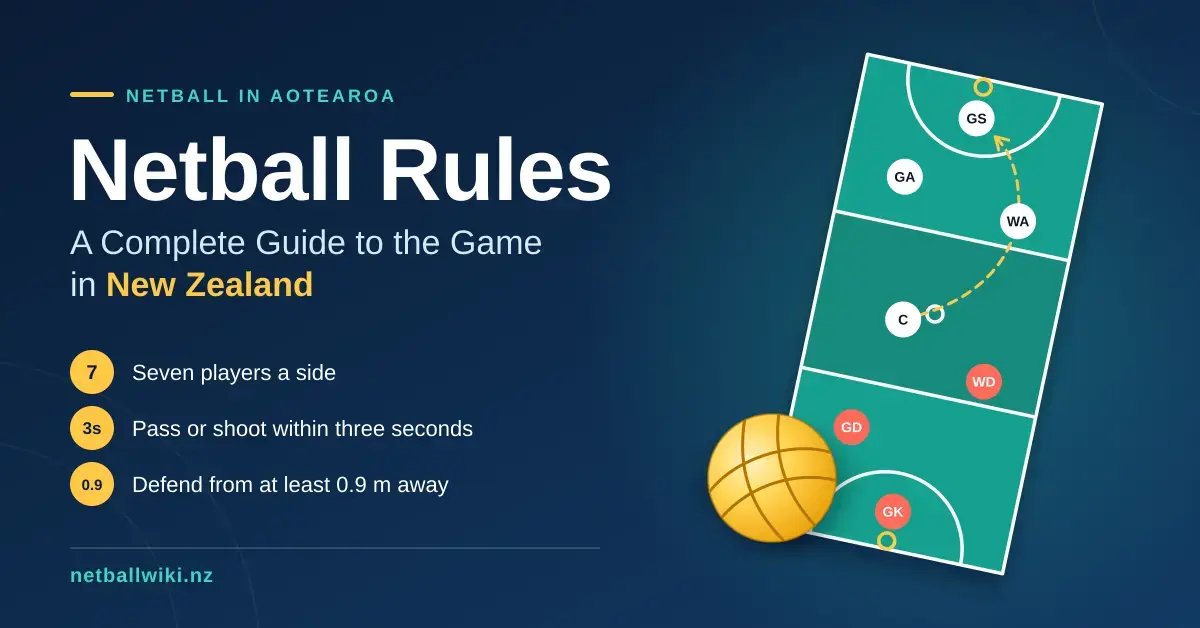
Netball is a seven-a-side game played on a rectangular court divided into three equal thirds. The aim is to shoot the ball through a ring set 3.05 metres (10 feet) above the ground, on a post with no backboard. Unlike basketball, players cannot dribble or run with the ball, and each of the seven positions is limited to specific areas of the court. The game rewards accurate passing, timing and spatial awareness rather than physical strength.
- Match duration: four 15-minute quarters (60 minutes of play in total).
- Team size: seven players on court (GS, GA, WA, C, WD, GD, GK).
- Positional restrictions: players must stay within the thirds and circles allowed for their position.
- Ball handling: a player must pass or shoot within three seconds of catching the ball.
- Scoring: only the Goal Shooter (GS) and Goal Attack (GA) can score, and only from inside the goal circle.
| Rule area | What it means | Typical infringement |
|---|---|---|
| Possession | Three seconds to release the ball | Held ball |
| Movement | No running; the landing foot cannot be re-grounded | Footwork |
| Space | Stay 0.9 m (3 ft) from the ball-carrier when defending | Obstruction |
| Safety | No contact that interferes with an opponent | Contact |
The three-second rule
Once a player gains possession, they have three seconds to pass the ball or take a shot. The rule keeps the ball moving and stops players from holding a position indefinitely. Failing to release the ball in time is a “held ball”, and possession is turned over to the opposing team with a free pass.
Footwork and movement
The footwork rule is the part of netball that new players find hardest. When a player catches the ball, the first foot to touch the ground becomes the “landing foot”. That foot can be pivoted on, but it cannot be lifted and re-grounded before the ball is released. If a player lands on both feet at the same time, they may choose which foot to treat as the landing foot.
- Landing foot: the first foot to touch the ground when catching the ball.
- Pivoting: turning on the ball of the landing foot while the other foot steps.
- Stepping: the second foot can step, but the ball must be released before the landing foot is re-grounded.
- Dragging or sliding the landing foot is an infringement.
| Action | Legal? | Explanation |
|---|---|---|
| Pivoting | Yes | Allowed on the grounded landing foot |
| Stepping | Yes | May step onto the other foot, but must pass before re-grounding the landing foot |
| Jumping | Yes | May jump off the landing foot, but must release the ball before landing again |
| Dragging | No | Sliding or dragging the landing foot is a footwork infringement |
Common footwork errors
Most footwork calls come from small habits: taking an extra step on the catch, dragging the landing foot forward, or re-grounding it under pressure near the circle. Working on a controlled, balanced landing is the fastest way to reduce turnovers — our breakdown of common footwork errors looks at these in more detail.
Obstruction and the 0.9-metre rule
Defending in netball is about position, not physical intervention. A defender must be at least 0.9 metres (3 feet) away from the player with the ball, measured from the ball-carrier’s landing foot to the defender’s nearest foot. Inside that distance a defender may not extend their arms or move them away from the body to interfere with a pass or shot. Defending closer than 0.9 metres with arms up is called obstruction, and results in a penalty pass or penalty shot, with the offending player standing out of play beside the person taking the penalty.
- Defending distance: 0.9 m (3 ft) from the ball-carrier’s landing foot.
- Within 0.9 m: arms must stay by the side and the player may not attempt to intercept.
- Obstruction can also apply to defending a player without the ball if arm movements are used to block.
- Penalty: the offender stands out of play until the pass or shot is taken.
| Distance | Defender’s action | Umpire’s call |
|---|---|---|
| More than 0.9 m | Arms up to defend | Play on |
| Less than 0.9 m | Arms up or outstretched | Obstruction |
| Less than 0.9 m | Arms at the side | Play on (if there is no interference) |
Defending the shot
When defending a shooter, the Goal Defence (GD) or Goal Keeper (GK) uses distance and positioning to pressure the shot rather than blocking it. Even a small breach of the 0.9-metre rule during a shot gives away a penalty shot, which is a strong scoring chance for the attacking team.
Contact and player safety
Netball is officially a non-contact sport: no player may make contact with an opponent in a way that interferes with their play, including pushing, tripping, leaning on or holding. Some incidental contact is unavoidable in a fast game, and umpires only penalise contact that actually affects play. The 2024 rules placed extra emphasis on safety, particularly around head and neck contact, and gave clearer guidance on contact involving a player who is in the air or moving.
- Penalty contact: interference that impedes an opponent’s movement or play.
- Incidental contact: minor touches that do not affect the outcome of play.
- Airborne players must be given space to land safely.
- A player with a bleeding wound must leave the court until it is dealt with.
| Contact type | Definition | Penalty |
|---|---|---|
| Pushing / tripping | Moving into an opponent’s path or unbalancing them | Penalty pass or shot |
| Leaning | Using an opponent for support or balance | Penalty pass or shot |
| Contacting the ball in another’s hands | Touching the ball while an opponent holds it | Penalty pass or shot |
| Simultaneous contact | Both players at fault at the same time | Possession to the team that last held the ball |
Landing space for airborne players
A key safety principle is that a player who is in the air must be allowed room to land. Moving into the landing path of an airborne opponent is treated as a serious contact offence, because it is a common cause of ankle and knee injuries.
Positions and court areas
Netball’s structure depends on each player being limited to certain parts of the court. Every player wears a bib showing their position, and can only enter the thirds and circles allowed for that role. For example, the Centre (C) may go anywhere except the two goal circles, while the Goal Keeper (GK) is confined to the defensive third and the goal circle. Entering an area not allowed for your position is an “offside” infringement. You can read more about each role in our guide to netball positions, and about the markings in our guide to netball court dimensions.
| Position | Areas allowed | Main role |
|---|---|---|
| GS – Goal Shooter | Attacking third and goal circle | Primary scorer |
| GA – Goal Attack | Attacking and centre thirds, and goal circle | Second scorer and feeder |
| WA – Wing Attack | Attacking and centre thirds (not the circle) | Feeds the shooters |
| C – Centre | All thirds, but neither goal circle | Links defence and attack |
| WD – Wing Defence | Defensive and centre thirds (not the circle) | Midcourt defensive pressure |
| GD – Goal Defence | Defensive and centre thirds, and goal circle | Circle defence and rebounds |
| GK – Goal Keeper | Defensive third and goal circle | Main circle defender |
The “over a third” rule
The ball may not be thrown the full length of the court in one pass. It must be caught or touched by a player in each third it travels through. This forces teams to build play through the court and gives the defending team chances to intercept.
Quick Facts
| Sport | Netball (seven-a-side, non-contact) |
|---|---|
| World governing body | World Netball |
| New Zealand body | Netball New Zealand |
| Players on court | 7 per team |
| Court | Rectangular, divided into three thirds |
| Goal post height | 3.05 m (10 ft), no backboard |
| Goal ring diameter | 380 mm (15 in) |
| Ball | Size 5 |
| Match length | Four 15-minute quarters (60 minutes) |
| Possession limit | 3 seconds |
| Defending distance | 0.9 m (3 ft) from the ball-carrier |
The 2024 World Netball rule changes
World Netball updated its Rules of the Game with effect from 1 January 2024, and Netball New Zealand adopted the changes. The updates were designed to improve safety, simplify how umpires manage a match and keep play flowing. The main changes are set out below.
- Toss-up removed: for simultaneous infringements, possession now goes to the team that had the ball immediately before play stopped.
- Tactical changes: teams can now make a substitution or a position change immediately after a goal, in addition to changes at intervals or stoppages.
- Goal after the whistle: a goal counts if the ball has left the shooter’s hands before the whistle is blown.
- Contact and safety: the contact rule was rewritten with specific guidance on head and neck contact and on contact with airborne or moving players.
- Short pass: rewritten so that every pass must give an opponent a genuine chance to intercept or deflect it.
- Game management: cautions were removed in favour of a clearer set of sanctions (see below).
| 2024 change | Before | After |
|---|---|---|
| Simultaneous infringement | Toss-up between two players | Possession to the team that last held the ball |
| Substitutions | At intervals or stoppages only | Also allowed immediately after a goal |
| Goal validity | Judged on ball position at the whistle | Counts if the ball has left the hands before the whistle |
| Discipline | Included a caution | Warning, two-minute suspension, ordering off |
Game management and suspensions
The 2024 update replaced cautions with a graduated set of sanctions. An umpire will usually work through them in order unless the offence is serious: proactive advice, then advancing or escalating a penalty, then an official warning, then a two-minute suspension (the player takes no part in play for two minutes), and finally ordering off. Warnings, suspensions and orderings-off apply across both umpires, so a player already warned at one end can be suspended for infringing at the other.
Umpiring and running the game
Two umpires control a netball match, each responsible for one half of the court and the nearest sideline. They use standard hand signals so players, the bench and spectators can follow decisions, and the whistle starts and stops play. In New Zealand, Netball NZ runs an umpire pathway that lets officials progress from local club badges through to national and international awards.
| Signal | Meaning | Outcome |
|---|---|---|
| T-shape with the hands | Held ball | Turnover; free pass |
| Rotating hand | Footwork | Turnover; free pass |
| Pointing | Offside | Turnover; free pass |
| Arm outstretched | Penalty pass or shot | Offender stands out of play |
Umpire pathways in New Zealand
Netball NZ provides a structured route for umpires, starting with the Centre Award for club netball and progressing through regional and national levels to the International Umpiring Award. This pathway helps keep officiating standards consistent across the game.
Restarting play: centre pass and goals
Every game begins with a centre pass, and teams then take the centre pass alternately regardless of who scored last. The Centre must have at least one foot inside the centre circle. When the whistle blows, the pass must be caught in the centre third. Play also restarts after a goal, and the ball is thrown in from the sideline when it goes out of court.
| Situation | Procedure | Result |
|---|---|---|
| Start of the match | Toss for choice of first centre pass or goal end | Game begins |
| After a goal | Team that did not take the last centre pass | Play restarts |
| Ball out of court | Thrown in from the sideline where it crossed | Play continues |
| Simultaneous infringement | Possession to the team that last held the ball | Play restarts |
Professional variations: the ANZ Premiership
Grassroots and club netball in New Zealand follows the standard World Netball rules. The domestic professional league, the ANZ Premiership, adds a small number of innovations to increase the spectacle. For the 2025 season, which began on 10 May 2025 as part of a busy year for New Zealand sport (Wikipedia), four changes were introduced. These apply to the elite league only — they are not part of the international rules used at events such as the World Cup.
- Two-point shot (“Super Shot”): during the final five minutes of each quarter, a goal scored from an outer zone — an arc beginning about 3.5 metres from the post — counts for two points instead of one.
- Coach’s Box: the head coach may stand in a marked area in front of the team bench to communicate with players during play.
- Team timeout: each team may call one timeout per half.
- Live umpire audio: umpires wear microphones so their calls are broadcast to spectators.
The two-point shot in practice
The longer two-point shot needs a higher, more powerful shooting action, and it changes tactics late in a quarter: a team behind can attempt long-range goals to close a gap quickly, while the team in front must decide whether to defend the outer zone or protect the inner circle. The idea builds on the super shot first popularised in the Fast5 format.
Equipment and uniform standards
Competitive netball in New Zealand has clear equipment and uniform requirements, mostly for safety and identification. Netball-specific shoes give grip and ankle support for rapid changes of direction. Fingernails must be short and smooth, and jewellery must be removed, with narrow exceptions such as a wedding band or a medical alert bracelet, which must be taped. Players wear position bibs so umpires can identify each role at a glance. For a fuller rundown, see our guide to netball equipment.
- Footwear: suitable sports shoes (no bare feet or non-athletic shoes).
- Fingernails: short and smooth so they cannot scratch an opponent.
- Jewellery: removed, other than a taped wedding band or medical alert bracelet.
- Bibs: position initials (for example GS or GK) clearly visible front and back.
| Item | Standard | Why it matters |
|---|---|---|
| Netball shoes | Non-slip sole with ankle support | Reduces ankle and knee injuries |
| Fingernails | Short and smooth | Safety for opponents |
| Position bibs | Clear initials, front and back | Identification for umpires |
| Ball | Size 5 | Consistency across matches |
Variations of netball
Alongside the standard seven-a-side game, New Zealand plays several variations designed to suit different ages and settings. Fast5 is a shortened, higher-scoring format with five players a side; futureFERNS is the modified junior programme; and Walking Netball is a slower, low-impact version for older or returning players.
| Format | Players | Key difference | Who it suits |
|---|---|---|---|
| Standard netball | 7 | Full World Netball rules | Club and elite competition |
| Fast5 | 5 | Six-minute quarters, rolling subs, 1/2/3-point zones and a power-play quarter | High-energy, spectator events |
| futureFERNS | Varies by age | Modified court, hoop and rules by year level | Primary and intermediate juniors |
| Walking Netball | 7 | No running or jumping | Older adults and rehabilitation |
The Fast5 super shot
In Fast5, goals from the inner zone score one point, the middle zone two points and shots from outside the goal circle (with no foot on the ground in the circle) three points. Each team also nominates one “power play” quarter in which its goals are doubled. These ideas influenced the two-point shot later adopted by the ANZ Premiership.
A short history of netball’s rules in New Zealand
Netball arrived in New Zealand in 1906 as “women’s basketball”, a nine-a-side game played outdoors with baskets on posts. Over the following decades the game standardised: international seven-a-side rules were agreed in 1957 and applied in New Zealand from 1959. Since then the rules have continued to evolve through periodic World Netball updates, of which the 2024 changes are the most recent major revision. Netball’s non-contact nature has always set it apart from higher-contact football codes such as Australian rules football (Wikipedia), and that principle remains central to how the game is refereed today.
Reference sources
Frequently Asked Questions (FAQ)
How long can a player hold the ball in netball?
A player has three seconds to pass the ball or take a shot once they have caught it. Holding it longer is a “held ball”, and possession is turned over to the other team.
What is the 0.9-metre rule?
When defending the player with the ball, a defender must keep their nearest foot at least 0.9 metres (3 feet) from the ball-carrier’s landing foot. Defending closer than that with the arms raised is obstruction, which gives away a penalty pass or shot.
What were the main 2024 netball rule changes?
The toss-up was removed, teams can now make tactical changes straight after a goal, cautions were replaced by a warning / two-minute suspension / ordering-off system, and the contact and short-pass rules were rewritten. A goal also now counts if the ball has left the shooter’s hands before the whistle.
Can you score two points in New Zealand netball?
Only in the professional ANZ Premiership. During the final five minutes of each quarter, a shot from the outer zone (an arc beginning about 3.5 metres from the post) is worth two points. Club and international netball use one point per goal.
Can a netball player run with the ball?
No. A player must stop and establish a landing foot after catching the ball, and cannot run or dribble with it. Doing so is a footwork infringement and the ball is turned over.