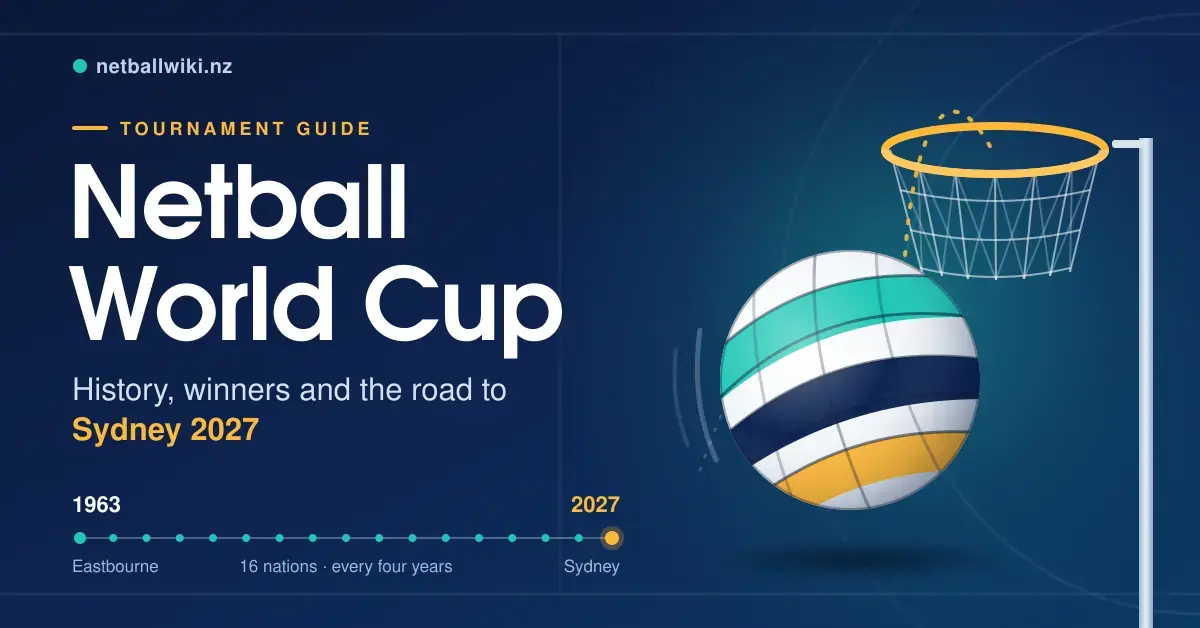
The Netball World Cup is the sport’s flagship international tournament, bringing the world’s leading netball nations together every four years to decide a single world champion. Since the first edition in 1963 it has grown from a modest gathering of 11 teams into a 16-nation event followed by millions, and for New Zealanders it remains the ultimate test of the Silver Ferns. This guide explains where the competition came from, who has won it, how teams qualify, and what to expect when the tournament returns to Sydney in 2027.
A short history of the tournament
The first edition was held in 1963 in Eastbourne, England, where 11 teams competed. It was organised by the International Netball Federation, the body now known as World Netball, and has been staged roughly every four years ever since. For most of its life the event was called the World Netball Championships; the name “Netball World Cup” was adopted from the 2015 edition onwards. The field has settled at 16 nations, drawn from across Oceania, Africa, Europe, the Americas and Asia.
In more than 60 years, only three countries have ever been crowned champion: Australia, New Zealand and Trinidad and Tobago. The table below lists every edition, its host and the top two finishers.
| Year | Host | Champion | Runner-up |
|---|---|---|---|
| 1963 | Eastbourne, England | Australia | New Zealand |
| 1967 | Perth, Australia | New Zealand | Australia |
| 1971 | Kingston, Jamaica | Australia | New Zealand |
| 1975 | Auckland, New Zealand | Australia | England |
| 1979 | Port of Spain, Trinidad & Tobago | Australia, New Zealand & Trinidad and Tobago (shared) | — |
| 1983 | Singapore | Australia | New Zealand |
| 1987 | Glasgow, Scotland | New Zealand | Australia / Trinidad & Tobago |
| 1991 | Sydney, Australia | Australia | New Zealand |
| 1995 | Birmingham, England | Australia | South Africa |
| 1999 | Christchurch, New Zealand | Australia | New Zealand |
| 2003 | Kingston, Jamaica | New Zealand | Australia |
| 2007 | Auckland, New Zealand | Australia | New Zealand |
| 2011 | Singapore | Australia | New Zealand |
| 2015 | Sydney, Australia | Australia | New Zealand |
| 2019 | Liverpool, England | New Zealand | Australia |
| 2023 | Cape Town, South Africa | Australia | England |
Key Facts
- First held: 1963, Eastbourne, England (11 teams)
- Governing body: World Netball (formerly the International Netball Federation)
- Frequency: Roughly every four years
- Teams in the finals: 16
- Most titles: Australia (12)
- Reigning champions: Australia (2023)
- New Zealand titles: 5 (1967, 1979*, 1987, 2003, 2019)
- Next edition: Sydney, Australia, 25 August – 5 September 2027
From grass courts to indoor arenas
Early tournaments were played outdoors, often on grass or hard courts exposed to the weather. The gradual move to indoor venues from the 1980s removed wind and rain from the equation and allowed a faster, more aerial style of play, with higher shooting and longer passing. Modern editions are held entirely in indoor arenas.
New Zealand and the Silver Ferns
For New Zealand, the World Cup is the benchmark of success and the stage for one of the fiercest rivalries in world sport — the trans-Tasman contest with the Australian Diamonds. That rivalry with Australia has produced many of the tournament’s most-watched finals. The Silver Ferns have won five world titles: 1967, 1979 (a three-way shared crown), 1987, 2003 and 2019. They have also finished runners-up on eight occasions, making them the sport’s most consistent challenger to Australia.
| Medal | Count | Years |
|---|---|---|
| Gold | 5 | 1967, 1979*, 1987, 2003, 2019 |
| Silver | 8 | 1963, 1971, 1983, 1991, 1999, 2007, 2011, 2015 |
| Bronze | 2 | 1975, 1995 |
*The 1979 title was shared three ways between New Zealand, Australia and Trinidad and Tobago.
The 2019 Liverpool triumph
The 2019 win in Liverpool is regarded as one of the great turnarounds in New Zealand sport. Under coach Dame Noeline Taurua, the Ferns rebuilt in under a year after finishing off the podium at the 2018 Commonwealth Games, edging Australia in a one-goal final to claim their first world title since 2003.
A more competitive world
Australia and New Zealand once shared the gold medal between them, but the modern game is far more open. England reached their first World Cup final in 2023, taking silver, and their national league has helped professionalise the squad. Jamaica’s “Sunshine Girls” have long been podium contenders, driven by towering, accurate shooters. South Africa hosted the 2023 event and has produced international players such as defender Shadine van der Merwe, whose career is profiled on Wikipedia, while Uganda’s rise saw them qualify among the world’s top six for 2027. Much of this parity flows from stronger domestic leagues such as Australia’s Suncorp Super Netball and England’s Netball Super League, which give players from many nations a high-performance environment.
| Nation | Best World Cup result | Note |
|---|---|---|
| England | Silver (2023) | First World Cup final |
| Jamaica | Bronze (1991, 2003, 2007, 2023) | Consistent podium contender |
| South Africa | Silver (1995) | Hosted the 2023 event |
| Uganda | Top-6 world ranking | Auto-qualified for 2027 |
All-Time Title Winners
| Nation | Titles | Years |
|---|---|---|
| Australia | 12 | 1963, 1971, 1975, 1979*, 1983, 1991, 1995, 1999, 2007, 2011, 2015, 2023 |
| New Zealand | 5 | 1967, 1979*, 1987, 2003, 2019 |
| Trinidad and Tobago | 1 | 1979* |
*The 1979 title was shared three ways between Australia, New Zealand and Trinidad and Tobago.
Format and qualification for 2027
Sixteen teams contest the finals. For the 2027 edition, the six highest-ranked nations on the World Netball ranking as at 1 December 2025 — Australia, New Zealand, Jamaica, England, South Africa and Uganda — qualified automatically. The remaining ten places are filled through five Regional Qualifiers held during 2026 (in Asia, Oceania, Africa, Europe and the Americas), with the top two teams from each earning a spot.
| Pathway | Places | How it works |
|---|---|---|
| World ranking | 6 | Highest-ranked nations on 1 Dec 2025 |
| Regional Qualifiers | 10 | Top two from each of five 2026 regional events |
Because the ranking decides automatic entry, leading nations schedule regular international series to protect their position and avoid the demanding regional-qualifier route.
The demands of a World Cup campaign
A World Cup is one of the most congested schedules in elite sport, with teams often playing on consecutive days over roughly ten days. Squads travel with physiotherapists, nutritionists and analysts, and success in the final stages frequently comes down to conditioning and recovery rather than skill alone.
- Recovery routines such as ice baths, compression wear and structured sleep between matches.
- Nutrition planned around match days to restore energy and aid muscle repair.
- Careful management of court minutes to reduce injury risk across a short, intense tournament.
- Sports psychology to help players handle the pressure of a global final.
How the game is played at the top level
Tactically, the World Cup has trended towards disciplined zone defences designed to clog passing lanes and force turnovers, answered by attacks built around a tall holding shooter such as New Zealand’s Grace Nweke. Unlike the shortened Fast5 format, which uses multi-point shooting zones, every World Cup goal is worth one point, so possession and high shooting accuracy remain decisive.
Hosting and the growth of the game
The 2023 tournament in Cape Town was the first Netball World Cup staged on the African continent, a milestone for a sport that is a leading women’s game across the Commonwealth. Hosting brings tourism, broadcast exposure and investment in grassroots and coaching in the host region, and the event has become a prominent showcase for women’s professional sport.
| Year | Host |
|---|---|
| 2015 | Sydney, Australia |
| 2019 | Liverpool, England |
| 2023 | Cape Town, South Africa (first in Africa) |
| 2027 | Sydney, Australia |
Looking ahead to Sydney 2027
The next World Cup runs from 25 August to 5 September 2027 at Qudos Bank Arena in Sydney, with all matches played at a single venue. It will be the first edition to feature separate Cup and Plate competitions, expanding the schedule to 64 matches. As hosts and the world’s top-ranked side, Australia will start as favourites, but a resurgent England, Jamaica and a rebuilding New Zealand ensure the title is far from settled. For anyone new to the wider calendar, it sits alongside other major international netball tournaments as the sport’s biggest prize.
Sources
Frequently Asked Questions (FAQ)
How often is the Netball World Cup held?
It is staged roughly every four years, with the most recent edition in 2023 and the next scheduled for 2027.
Which country has won the most Netball World Cup titles?
Australia is the most successful nation with 12 titles, ahead of New Zealand with five. Only three countries have ever won: Australia, New Zealand and Trinidad and Tobago.
How many times has New Zealand won the Netball World Cup?
The Silver Ferns have won five times: 1967, 1979 (a shared three-way title), 1987, 2003 and 2019.
Who won the 2023 Netball World Cup?
Australia won the 2023 tournament in Cape Town, beating England 61-45 in the final — England’s first appearance in a World Cup final.
Where and when is the 2027 Netball World Cup?
It will be held at Qudos Bank Arena in Sydney, Australia, from 25 August to 5 September 2027.