Fast5 is a fast-paced, five-a-side version of netball built for quick matches and high scoring. It keeps the core skills of the traditional game but shortens the quarters, cuts the number of players, and adds distance-based scoring and power plays. The result is a spectator-friendly format that New Zealand helped pioneer and where the country’s short-form side has enjoyed plenty of success.
Key Facts
| Governing body | World Netball |
| Format | Five-a-side variant of netball |
| Players on court | 5 per team (GS, GA, C, GD, GK) |
| Match length | Four 6-minute quarters (24 minutes) |
| Scoring | 1, 2 or 3 points by distance; nominated power-play quarter |
| Substitutions | Unlimited, any time during play |
| Premier event | Fast5 Netball World Series (top six nations) |
| Most recent series | 9-10 November 2024, Wolfbrook Arena, Christchurch – Australia champions |
| NZ women’s titles | 7 (2009-2018) |
What Is Fast5 Netball?
Fast5 is a modified form of netball designed to be quicker and easier to follow than the standard seven-a-side game. Fewer players, shorter quarters and a scoring system that rewards long-range shooting make matches intense from start to finish. Because a full game lasts well under an hour, it works well for live crowds and television, which is a big reason the format exists.
How Fast5 Began
The format began in 2009 as “Fastnet,” created by the sport’s world governing body (then the International Federation of Netball Associations, now World Netball) to give netball a shorter, more television-friendly shape. The first events were held in England — Manchester in 2009 and 2010, and Liverpool in 2011 — and at that stage teams still fielded seven players.
Ahead of the 2012 season the rules were overhauled and the game was renamed Fast5. The biggest change was cutting each side from seven players to five, alongside new features such as multi-point shooting and the power play. The five-a-side format has been used ever since.
Rules and Format
Team and positions
Each team has five players on court instead of the usual seven. The wing attack and wing defence are removed, leaving two shooters (Goal Shooter and Goal Attack), one Centre, and two defenders (Goal Defence and Goal Keeper). Squads can carry up to ten players, so coaches rotate freely. If you are new to the roles, our guide to netball positions explains what each one does.
Match length and substitutions
A match is four six-minute quarters — 24 minutes of playing time in total — with short breaks between quarters and a slightly longer half-time. That is far shorter than a standard game; for comparison, see how long a full netball game lasts. Substitutions are unlimited and can be made at any time from the substitution area, keeping players fresh and the tempo high.
Scoring zones
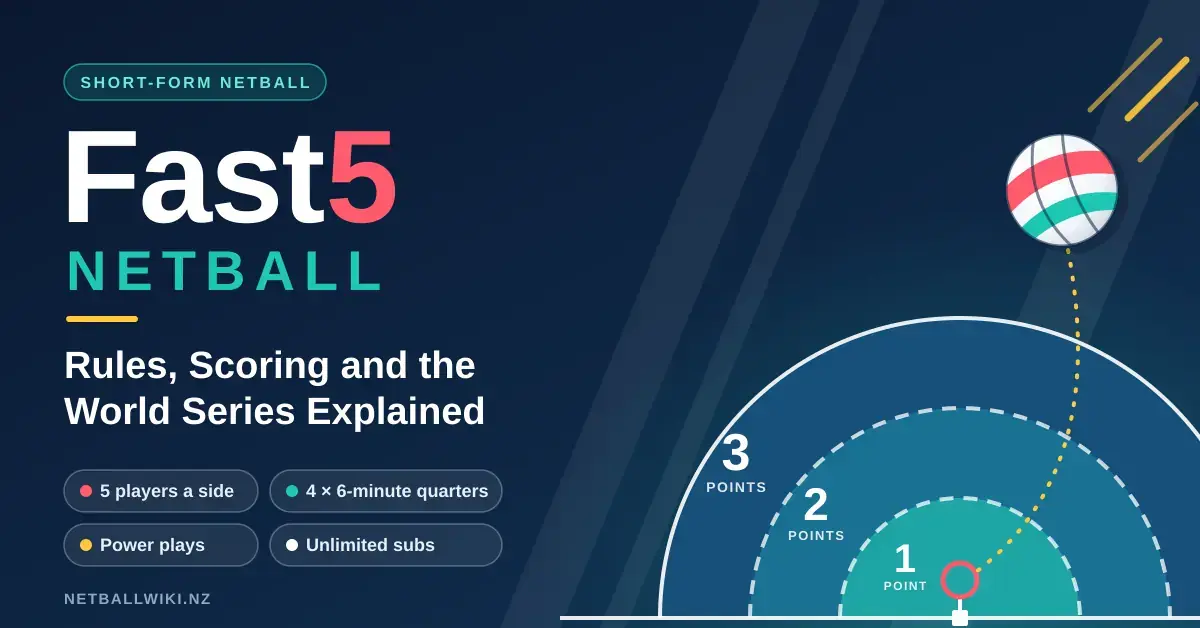
Fast5 replaces netball’s single-value goal with three scoring zones based on distance from the post:
- 1 point — a goal from the inner section of the shooting circle.
- 2 points — a goal from the outer section of the shooting circle.
- 3 points — a “super shot” taken from outside the shooting circle.
This rewards accurate long-range shooting and can turn a match around quickly, which is very different from the standard netball rules, where every goal counts the same.
Power play
Before the game, each team secretly nominates one quarter as its power play, and the two teams cannot choose the same quarter. During a team’s power play, goals from the two-point and three-point zones are doubled, while one-point goals still count as one — a rule tweak designed to encourage bolder, longer-range shooting. World Netball has trialled small variations in how and when the power play applies, but the principle of a nominated, higher-value period has stayed the same.
Centre passes
Unlike traditional netball, where centre passes alternate, in Fast5 the team that conceded the last goal takes the next centre pass. This keeps play flowing and gives the side that has just been scored on an immediate chance to respond.
How Fast5 Differs from Traditional Netball
Fast5 keeps the footwork, passing and shooting of the standard game — if you already know how to play netball, the basics transfer directly. What changes is the pace and the scoring. The table below sums up the main differences.
Fast5 vs Traditional Netball
| Feature | Traditional netball | Fast5 netball |
|---|---|---|
| Players on court | 7 per team | 5 per team |
| Positions | GS, GA, WA, C, WD, GD, GK | GS, GA, C, GD, GK |
| Match length | Four 15-minute quarters | Four 6-minute quarters |
| Goal value | Every goal worth 1 | 1, 2 or 3 points by distance |
| Power play | None | One nominated quarter; 2- and 3-point goals doubled |
| Substitutions | Limited, at breaks or for injury | Unlimited during play |
| Centre pass | Alternates each centre pass | Team that conceded the last goal restarts |
The Fast5 Netball World Series
The showpiece event is the annual Fast5 Netball World Series, which brings together six of the world’s leading nations. New Zealand dominated the early years, winning seven of the nine tournaments played between 2009 and 2018. In recent seasons Australia has been the team to beat, taking three titles in a row across 2022, 2023 and 2024.
The 2024 series was held on 9–10 November at Wolfbrook Arena in Christchurch, where Australia beat New Zealand 34–30 in the women’s final. A men’s Fast5 World Series has run alongside the women’s event since 2022. Fixtures are usually confirmed by World Netball and Netball New Zealand, so check their channels for the latest schedule. You can follow the wider game through our Silver Ferns coverage.
Playing Fast5 in New Zealand
Plenty of local centres run Fast5 or Fast5-style sessions, often within indoor netball programmes. The rules are easy to adapt for social players, juniors and more competitive teams, which makes Fast5 a friendly entry point as well as a serious contest.
If you want to get involved, contact your regional netball centre or Netball New Zealand for details of leagues, coaching resources and rulebooks. Watching a live series — like the recent World Series in Christchurch — is also a quick way to pick up the tactics before you play.
Why Fast5 Appeals to Players and Fans
The short quarters and smaller teams create an intense, end-to-end contest. Multi-point scoring rewards risk and keeps comebacks realistic, while the power play adds a layer of tactics as coaches gamble on when to strike. For spectators, a full match is over in well under an hour, which suits live crowds and television. For players, the extra space and longer shots are a chance to show creativity that the seven-a-side game can limit.
The Future of Fast5
Interest in Fast5 is spreading beyond its traditional strongholds of New Zealand and Australia, with more nations and both men’s and women’s competitions now taking part. World Netball promotes the format as a way to grow participation and reach new audiences. Its short, simple, broadcast-friendly shape is often mentioned in discussions about netball’s long-term Olympic ambitions, though no format has been confirmed for the Games.
Reference sources
Frequently Asked Questions
What is Fast5 in netball?
Fast5 is a shortened, five-a-side version of netball. Teams play four six-minute quarters and can score one, two or three points depending on how far out the shot is taken, with unlimited substitutions and a nominated power-play quarter.
How is Fast5 different from regular netball?
The main differences are five players instead of seven, much shorter quarters, distance-based scoring worth one to three points, a power-play period, unlimited substitutions, and the team that concedes a goal restarting play with the next centre pass.
How does scoring work in Fast5?
A goal from the inner part of the circle is worth one point, the outer part two points, and a super shot from outside the circle three points. During a team’s power-play quarter, its two-point and three-point goals are doubled, while one-point goals stay at one.
How long is a Fast5 match?
A Fast5 match is 24 minutes of playing time — four quarters of six minutes each — plus short breaks between quarters and at half-time, making it much quicker than a standard netball game.
Who won the most recent Fast5 Netball World Series?
Australia won the 2024 Fast5 Netball World Series in Christchurch, beating New Zealand 34–30 in the final for their third title in a row. New Zealand remains the most successful nation overall, with seven titles between 2009 and 2018.