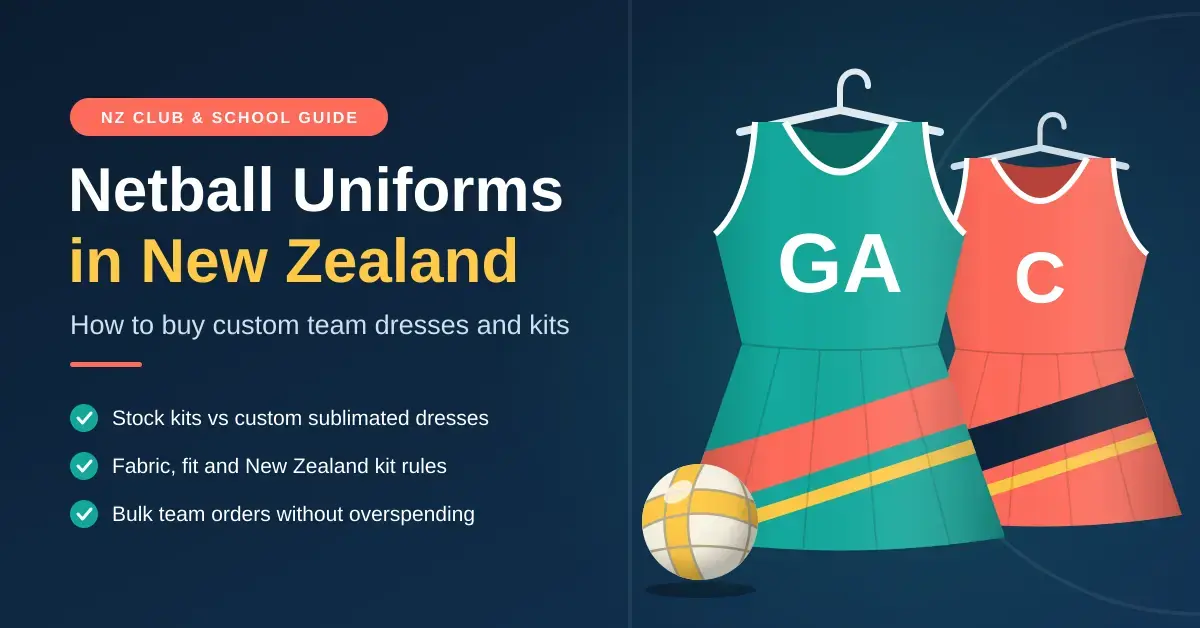
Kitting out a squad with netball uniforms is one of the first jobs on any New Zealand club or school’s pre-season list, and it involves more decisions than a quick online order suggests. A netball dress has to survive a full winter of Saturday games and wash after wash while keeping players cool, covered and clearly marked with their position. This guide explains in plain terms how modern netball uniforms are made, what to look for in the fabric and fit, the rules a kit must meet in New Zealand, and how clubs can order in bulk without overspending, so coordinators, parents and team managers can buy with confidence.
Key Points
- Two main routes: off-the-shelf stock kit (cheaper, faster) or custom sublimated dresses, where the design is dyed into the fabric and will not peel.
- Fabric matters: look for breathable polyester interlock with a little elastane, good stretch and enough opacity to stay non-see-through when stretched.
- Rules to meet: World Netball requires position initials 150 mm high, worn above the waist on the front and back.
- Sizing: plan a full spread from junior (futureFERNS) to adult, and consider a longer hem for tall shooters and defenders.
- Buy smart: NZ suppliers often set minimum orders around 10 units with roughly a six-week turnaround, so order well before the season.
From Cotton Tunics to the One-Piece Sublimated Dress
The look of netball apparel has changed a great deal over the decades. Heavy cotton box-pleat tunics and bulky skirts have largely been replaced by the modern one-piece dress, which is lighter, stretchier and quicker to dry. Many of these garments are now developed with input from athletes and physiotherapists so they move with the player rather than against her during jumps, landings and quick changes of direction. The shift mirrors how everyday clothing has modernised too; if you are curious about the older habit of stiff, formal kit, this overview of school uniform traditions around the world shows how far sportswear has come.
For clubs affiliated to Netball New Zealand, a tidy, consistent uniform also signals organisation on game day. Beyond appearances, though, the practical goal is simple: a garment that fits a range of body shapes, meets the competition rules and lasts more than one season.
Comfort and Weather on New Zealand Courts
Much of the domestic season is played through winter, often on exposed outdoor courts in rain, wind and cold. That puts two opposite demands on the fabric. During play it needs to breathe and move sweat away from the skin, but between quarters and on the bench players can chill quickly. A well-chosen dress balances ventilation with enough structure to cut wind, which is why fabric weight and knit matter as much as colour and design.
Stock Kits vs Custom Sublimated Uniforms
When you start talking to a New Zealand teamwear supplier, the first real decision is whether to buy stock (ready-made) kit or fully custom, sublimated kit. Stock uniforms are pre-dyed plain dresses; club names, numbers or sponsor logos are added on top afterwards using vinyl heat transfers or screen-printed ink. They are usually cheaper and faster, but printed graphics sit on the surface and can crack, peel or fade after repeated washing.
Custom sublimation works differently. The artwork, colours, crests and sponsor blocks are printed and then heat-pressed so the dye turns to gas and bonds into the polyester fibres. The result feels smooth to the touch and will not peel, because the design is part of the fabric rather than a layer on top. It costs more and takes longer to produce, but for a club planning several seasons it is generally the more durable choice.
| Consideration | Stock (pre-dyed) kit | Custom sublimated kit |
|---|---|---|
| Typical price per unit (NZD, approx.) | Lower, around $45–$65 | Mid to high, around $75–$120+ |
| Lead time | Fast, often a few days | Longer, commonly 4–6 weeks |
| Design freedom | Limited to set colours and panels | Full colour, patterns and gradients |
| Logos and crests | Applied on top; can lift over time | Dyed into the fabric; will not peel |
| Re-ordering later | Stock lines can be discontinued | Design files are kept for repeats |
Why Design Templates Matter for Re-orders
A practical advantage of custom sublimation is continuity. If your club grows and needs more dresses next year, a supplier can reprint from the saved template and match the exact colour formula, so a new batch looks the same as the original. With stock ranges you are at the mercy of whatever the manufacturer still carries, which can leave a team in slightly mismatched shades.
Fabrics: How to Read a Sample Before You Order
The fabric decides how the dress feels, how well it manages sweat and how it copes with contact. Most performance netball dresses use a polyester interlock knit blended with a small amount of elastane (sold under names such as Lycra or Spandex) for four-way stretch. Ask your supplier for a sample ring so you can feel the options in person.
Two things are worth checking closely. First, opacity: pull the fabric taut and hold it to the light to confirm it stays non-see-through when stretched over the body. Second, moisture management: better fabrics wick sweat to the outer surface where it can evaporate, rather than holding it against the skin.
- Lightweight mesh knits (roughly 150–180 gsm): very breathable and cool, well suited to fast indoor play.
- Heavier interlock (roughly 220–240 gsm): denser and more wind-resistant with crisp print clarity, a common choice for outdoor winter netball.
- Higher-stretch performance blends: a closer, contoured fit with less loose material for an opponent to catch during a rebound contest.
Position Bibs: Velcro Patches vs Elastic Vests
Every player must show her position initials — GS, GA, WA, C, WD, GD or GK — clearly on the front and back. How those markers attach affects both comfort and cost. If you are new to what each abbreviation means, our guide to the seven netball positions breaks down each role and the court areas it covers.
On premium custom dresses, four soft hook-and-loop (Velcro) panels are sewn onto the chest and upper back, and matching sublimated position patches press on flat. This keeps the profile streamlined and lets one dress be re-labelled if a player switches position. The trade-off is that you need a set of patches to go with the dresses.
When Over-the-Head Vests Make More Sense
For primary school and social teams, where the line-up changes week to week and players vary widely in size, traditional over-the-head bibs with elastic side straps are often more practical. A single set stretches to fit almost anyone and slips over a jersey or rain layer in seconds. If you are choosing between the two, our dedicated guide to netball bibs compares materials, sizing and print options in more detail.
Sizing From Juniors to Adults
Ordering for a whole school or club means covering a wide range of ages and body shapes. New Zealand sizing runs from small children’s sizes up to adult plus sizes, and experienced kit managers order a generous spread of lengths rather than a single average. Tall shooters and defenders in particular often benefit from a hem extension (for example +5 cm or +10 cm) so the dress stays comfortable and covering during high reaches under the hoop.
Junior grades follow the Netball New Zealand futureFERNS pathway, which uses modified formats: 4-a-side in Years 1–2, 5-a-side in Years 3–4, 6-a-side in Years 5–6 (with 7-a-side introduced from mid-Year 6), and full 7-a-side in Years 7–8. The table below is a rough starting point only — always confirm against your supplier’s own size chart before ordering.
| Size tier | Typical stage | Approx. dress length | Common use |
|---|---|---|---|
| Junior | futureFERNS, primary years | ~54–60 cm | Primary development teams |
| Youth | Intermediate (Years 7–8) | ~64–70 cm | Intermediate squads |
| Teen | Secondary school | ~74–80 cm | College teams |
| Adult | Senior club and social | ~82–90 cm+ | Premier and social grades |
Mixed and Men’s Netball
Mixed and men’s netball has grown steadily, and many suppliers now offer a men’s kit option. Instead of an A-line dress, male players usually wear a moisture-wicking singlet with matching shorts in the same colours and design, so a mixed team still looks unified on court.
The Uniform Rules Your Kit Must Meet
Before you sign off a design, check it against the competition rules so a team is not turned away at the technical bench. Under the World Netball Rules of the Game, the position initials must be 150 mm (about 6 inches) high and worn above the waist, clearly visible on the front and back. That is a defined size rather than a minimum, so oversized or undersized lettering can both cause problems.
Two more points catch teams out. Keep strong contrast between the lettering and the background — dark text on a dark pattern is hard for umpires to read at speed. And remember the small print of the wider netball rules: players remove jewellery, keep fingernails short, and dresses are normally paired with matching undershorts. Local centres and Netball New Zealand can confirm any competition-specific requirements.
Caring for Sublimated Dresses
A custom kit is a real investment for a club or school, and simple laundry habits protect both the fabric and the print. The biggest single hazard is heat: hot dryers break down the elastane, causing sagging and thinning over time. Air drying is almost always the safer option.
- Remove Velcro patches first: loose hook-tape snags mesh in the wash, so detach position patches before washing.
- Turn dresses inside out: this shields the printed surface from rubbing against the drum.
- Wash cold on a gentle cycle: use a mild detergent and avoid bleach or colour strippers.
- Skip fabric softener: it leaves a residue that clogs the wicking fibres and can trap odour.
- Line dry in the shade: keep dresses out of harsh direct sun to preserve colour and stretch.
Buying in Bulk: Club Packages and Sponsors
Buying dresses one at a time from a retailer is expensive. Most clubs do better negotiating a bulk package directly with a teamwear supplier. These bundles typically group a set of custom dresses with matching undershorts, one or two sets of position patches and a carry bag into a single discounted price. New Zealand suppliers such as Impakt, Canterbury Teamwear, Sportclub, Galaxy Teamwear, BLK and Hurrell all offer custom netball kit; minimum orders commonly start around 10 units, with production taking roughly six weeks. It is worth pricing your dresses alongside the rest of your netball equipment so the whole order arrives together.
Funding Kit Through Local Sponsors
Because sublimation prints colour and logos into the fabric during manufacture, adding a sponsor block usually costs little or nothing extra per unit. Many clubs offset the upfront cost by selling a panel on the dress to a local business in exchange for exposure at games. Just make sure any sponsor artwork does not reduce the contrast the umpires need to read position letters.
Buying Checklist
- Confirmed stock vs custom sublimation for your budget and timeline
- Chosen a fabric weight suited to indoor or outdoor play
- Checked opacity and stretch on a physical sample
- Decided on Velcro patches or over-the-head bibs for position markers
- Ordered a full range of sizes, with hem length noted for tall players
- Verified 150 mm lettering and clear text-to-background contrast
- Added matching undershorts to the order
- Allowed roughly six weeks’ production time before the season
Common Mistakes to Avoid
- Undersized or oversized lettering: confirm the 150 mm position-letter rule before printing, or a team can be barred from the court.
- Low-contrast designs: avoid dark text on a dark or busy background that umpires struggle to read.
- Cheap non-breathable fabric: very low-cost nylon or plastic-feel material traps heat and sweat.
- Forgetting undershorts: order matching boy-leg or bike-style undershorts with the dresses.
- Weak seams: ask about flatlock or twin-needle stitching that holds up to defensive contact.
- Ordering too late: allow the full production window — do not leave a custom order until a few weeks before the season.
Sources
Frequently Asked Questions
How tall do the position letters on a netball uniform need to be?
Under the World Netball Rules of the Game, the position initials (GS, GA, WA, C, WD, GD, GK) must be 150 mm — about six inches — high and worn above the waist so they are clearly visible on the front and back. Check with your local centre for any competition-specific detail.
Is sublimation better than screen printing for team kits?
They suit different needs. Sublimation dyes the design into the fabric so it will not crack, peel or fade, which makes it durable for multi-season club use. Screen printing and vinyl sit on the surface, cost less and turn around faster, but wear over time with repeated washing.
How far ahead should we order custom netball dresses?
Custom sublimated kit usually takes around six weeks from final artwork sign-off, and many suppliers set a minimum order near 10 units. Place the order well before grading rounds so there is room for sizing samples, approvals and any reprints.
What should players wear under a netball dress?
Most dresses are paired with matching boy-leg or bike-style undershorts in the same colour, which keeps the kit tidy and comfortable during jumps and quick movement. Some premium dresses have integrated shorts, but separate undershorts are the common standard.
How should netball dresses be washed to make them last?
Remove the Velcro patches, turn each dress inside out, and wash cold on a gentle cycle with a mild detergent. Skip bleach and fabric softener, and line dry in the shade rather than using a hot dryer, which damages the stretch fibres over time.