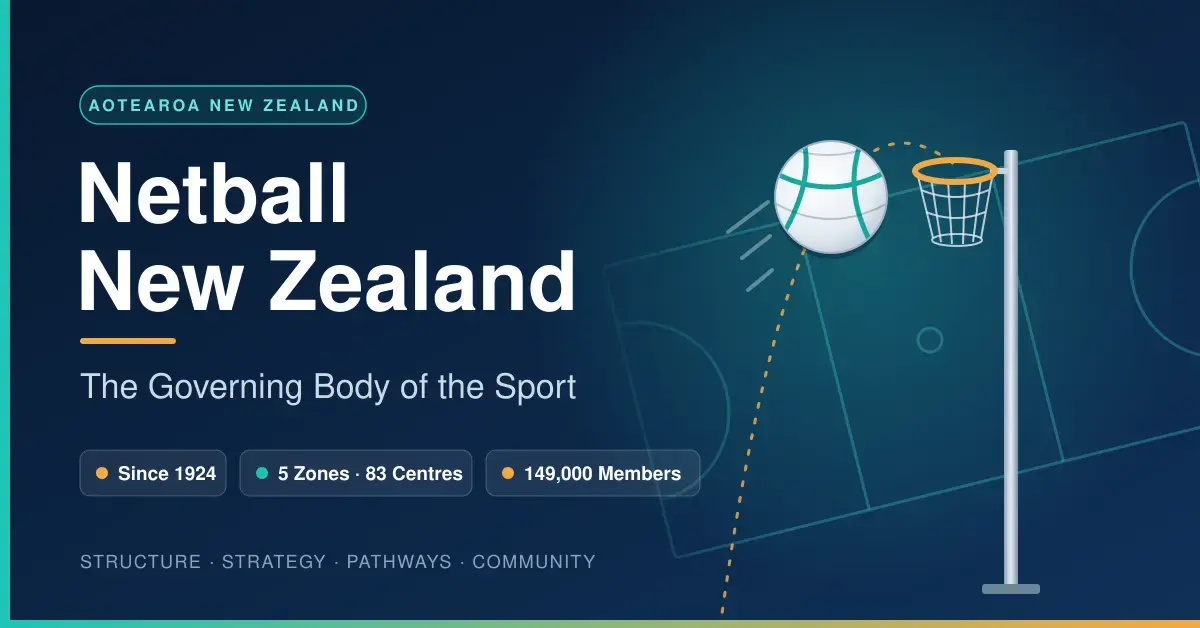
Netball is the most popular team sport for women and girls in Aotearoa New Zealand, and the organisation that guides it from school courts to the world stage is Netball New Zealand (NNZ). Established in 1924, NNZ is the national governing body responsible for the rules, competitions, coaching, officiating and high-performance programmes that keep the game thriving. This guide explains how the organisation is structured, the strategy that shapes its decisions, the pathways that produce the Silver Ferns, and the community programmes that introduce tens of thousands of children to the sport each year.
Key Facts
| Organisation | Netball New Zealand (NNZ) |
| Founded | 1924 (as the New Zealand Basketball Association) |
| Headquarters | Auckland, New Zealand |
| National team | Silver Ferns |
| Chief Executive | Jennah Wootten (from August 2026) |
| Board Chair | Alastair Carruthers |
| Structure | 5 Zones and 83 Netball Centres |
| Participation | Around 149,000 registered members; 300,000+ people play annually |
| Official website | netballnz.co.nz |
A century of history: from basketball to netball
Netball New Zealand began life in 1924 as the New Zealand Basketball Association, reflecting the sport’s early name — for years the game was widely called “women’s basketball.” Teams competed under a mix of local and imported rules for decades. New Zealand aligned with international rules during the 1960s, and in 1970 the association formally changed the name of the game from basketball to netball to match the terminology used overseas. That period also saw the unpopular pleated gym frock replaced with more practical playing kit.
On the court, the defining early milestone came in 1967, when the national team won New Zealand’s first world title in Perth. Over the following decades NNZ grew from a volunteer-led body into a professional organisation that runs elite competition while supporting a large community game.
| Year | Milestone |
|---|---|
| 1924 | New Zealand Basketball Association formed |
| 1967 | National team wins New Zealand’s first world title (Perth) |
| 1970 | Game officially renamed from basketball to netball |
| 2016 | National Netball League established as a development tier |
| 2017 | ANZ Premiership launched as a domestic professional league |
| 2020 | Poipoiā strategic framework launched |
Turning professional
From the 1990s onward the sport moved steadily toward a professional model. Domestic competition grew through the National Bank Cup and then the trans-Tasman ANZ Championship, which raised the game’s profile and media visibility. In 2016 NNZ created the National Netball League as a development competition, and in 2017 it launched a purely domestic top tier, the ANZ Premiership.
The Poipoiā strategy
In 2020, after consulting its Zones, Centres and participants, Netball New Zealand launched Poipoiā — the strategic framework that guides how the organisation connects and inspires communities through netball. Poipoiā is a te reo Māori word associated with nurturing and growth, and the strategy is deliberately holistic: it treats participation, high performance, culture and financial sustainability as connected goals rather than separate silos.
In practice, that means investing in grassroots access and affordability, protecting the pipeline of elite talent, embedding te ao Māori and New Zealand’s wider diversity in the game, and building commercial and broadcast partnerships that keep the sport visible. It also frames NNZ’s response to strong competition from other codes for players and audiences.
The Silver Ferns and high-performance pathways
The Silver Ferns are the pinnacle of the New Zealand game and one of the country’s most successful national teams. Beneath them, NNZ runs a tiered high-performance system that includes a Silver Ferns development squad, a New Zealand under-21 team and secondary-school representative sides, so there is a continuous flow of talent toward the top level. Players are supported with sports science, strength and conditioning, and performance analysis, often in partnership with High Performance Sport NZ.
Recent captains such as Jane Watson (profiled on Wikipedia) show the leadership the programme develops, while coaching direction from figures like Noeline Taurua has shaped the team’s modern era. The main targets for the elite squads are the Netball World Cup and, historically, the Commonwealth Games, along with regular trans-Tasman series against Australia.
Domestic competition: ANZ Premiership and NNL
NNZ oversees two connected domestic competitions. The National Netball League (NNL), established in 2016, is the development tier, while the ANZ Premiership sits above it as the professional showcase. The Premiership features six franchises drawn from the five Zones — the Northern Zone fields two teams — and each franchise is paired with an NNL side that develops the next wave of players.
| ANZ Premiership franchise | Zone / home base | NNL development side |
|---|---|---|
| Northern Mystics | Northern (Auckland) | Northern Marvels |
| Northern Stars | Northern (Auckland) | Northern Comets |
| Waikato Bay of Plenty Magic | Waikato/Bay of Plenty (Hamilton) | WBOP Matarau |
| Central Pulse | Central (Wellington) | Central Manawa |
| Mainland Tactix | Mainland (Christchurch) | Mainland Hellers |
| Southern Steel | Southern (Invercargill) | Southern Blast |
NNZ manages the scheduling and broadcast arrangements for these competitions. Since 2025 the ANZ Premiership has been shown live and free-to-air on TVNZ, with further coverage on Sky Sport, widening access for fans who cannot get to a game in person.
Community netball: futureFERNS and social play
At the grassroots, the Mother Earth futureFERNS programme is the entry point for children from Year 1 to Year 8. It replaces full seven-a-side netball for younger ages with modified, small-sided games so that children get more touches of the ball, more involvement and better skill development. Smaller balls, lower hoops and fewer players are introduced progressively as children grow and their abilities develop.
Alongside the junior game, NNZ supports social and “have-a-go” formats for adults who want to play for fitness and enjoyment rather than serious competition. If you are new to the sport, our guide on how to play netball explains the basics of positions, rules and scoring.
Coaching, officiating and NetballSmart
NNZ accredits the country’s coaches and umpires through structured pathways. Volunteers, parents and teachers usually begin with the Community Coach Award, delivered online and through local workshops, while umpires progress from local centre badges toward national and international awards. Ongoing coach-developer and umpire-support roles in each Zone help lift standards as the game gets faster and more physical.
One of NNZ’s most important initiatives is NetballSmart, its injury-prevention programme run in partnership with ACC (the Accident Compensation Corporation, New Zealand’s no-fault injury insurer). Because netball involves repeated jumping, landing and rapid changes of direction, knee and ankle injuries — particularly to the anterior cruciate ligament (ACL, a key knee ligament) — are common. Evidence indicates the NetballSmart dynamic warm-up can reduce the risk of ACL injury by up to 50%, and ACC data has recorded a marked fall in netball injury claims over recent years.
Governance and leadership
Netball New Zealand is governed by a board and led day-to-day by a chief executive, with headquarters in Auckland. The organisation went through a period of change in 2025 and 2026: long-serving chief executive Jennie Wyllie resigned in early 2026, and after an interim period Jennah Wootten — previously chief executive of the regional sports organisation Aktive — was appointed and took up the role in August 2026, working alongside board chair Alastair Carruthers. Funding comes from sponsorship, government investment through Sport NZ, and membership fees, and the board’s focus is on keeping the sport financially sustainable and relevant.
Key Points
- Netball New Zealand is the sport’s national governing body, founded in 1924 and headquartered in Auckland.
- It supports five Zones and 83 Netball Centres, with about 149,000 registered members and 300,000+ annual participants.
- Its strategic framework, Poipoiā (launched 2020), links participation, performance, culture and sustainability.
- The Silver Ferns sit atop a high-performance pathway fed by the ANZ Premiership (six franchises) and the National Netball League.
- NetballSmart, run with ACC, helps reduce serious injuries such as ACL knee tears.
Sources
- Netball New Zealand — Our Game: History
- Netball New Zealand — About Us
- Netball New Zealand — Poipoiā Plan
- Netball New Zealand — Jennah Wootten appointed Chief Executive
- Netball New Zealand — Broadcasting partnerships for 2025
- NetballSmart — Official injury prevention programme
- ACC — Renewing the NetballSmart partnership
- NZ History — Netball New Zealand
Frequently Asked Questions (FAQ)
What is Netball New Zealand?
Netball New Zealand (NNZ) is the national governing body for netball in New Zealand. Founded in 1924, it runs the rules, national competitions, coaching and umpiring pathways, high-performance programmes and community initiatives, and it supports five Zones and their Netball Centres around the country.
Who leads Netball New Zealand?
NNZ is governed by a board chaired by Alastair Carruthers and led by a chief executive. Jennah Wootten took up the chief executive role in August 2026, following the resignation of long-serving chief executive Jennie Wyllie earlier that year and an interim period.
What is the Poipoiā strategy?
Poipoiā is NNZ’s strategic framework, launched in 2020. The name is a te reo Māori word linked to nurturing and growth, and the strategy aims to connect communities through netball by balancing participation, high performance, cultural inclusion and financial sustainability.
What is the difference between the ANZ Premiership and the NNL?
The ANZ Premiership is New Zealand’s top professional league, contested by six franchises. The National Netball League (NNL), established in 2016, is the development tier below it; each Premiership franchise is paired with an NNL side that helps prepare the next generation of players.
What is NetballSmart?
NetballSmart is the official injury-prevention programme of Netball New Zealand, developed with ACC. Its dynamic warm-up and movement education are designed to reduce common netball injuries, including ACL knee injuries, and are built into NNZ coaching courses.