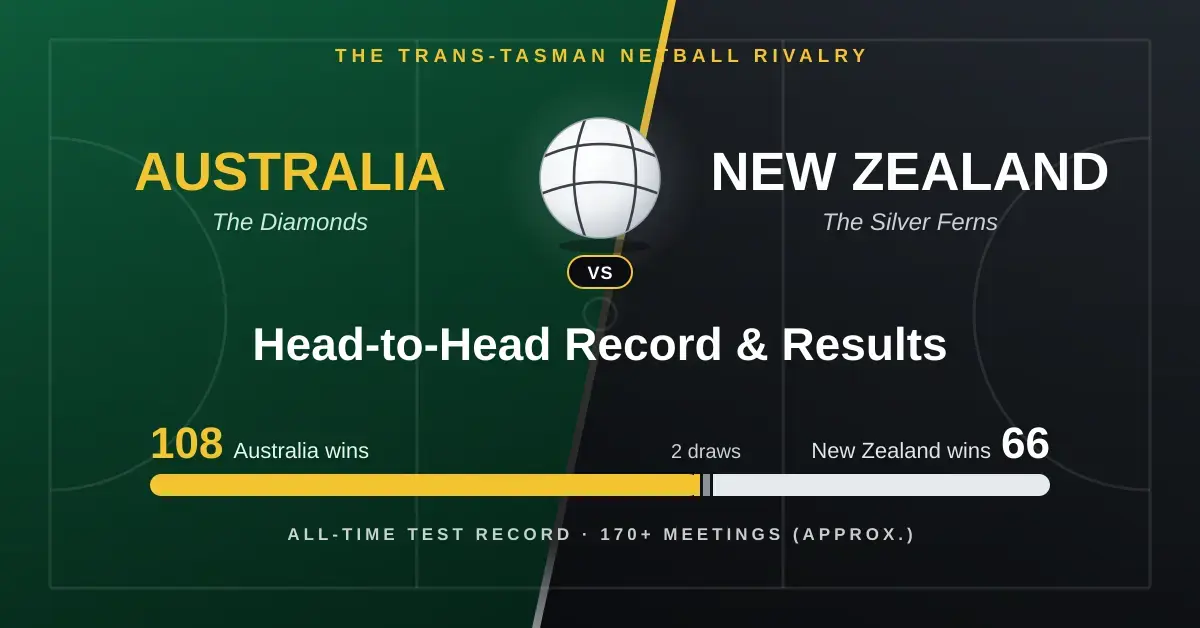
Few contests in world sport are as closely matched as Australia vs New Zealand in netball. The Australian Diamonds and the New Zealand Silver Ferns have met in almost every major final the sport has staged since the 1960s, and the result is frequently settled by a single goal. This guide sets out the all-time head-to-head record, the most recent series results, what the match statistics actually show and how to follow the next instalment of the trans-Tasman rivalry — with every figure fact-checked against official sources.
Key Points
- All-time record: Australia leads, with about 108 test wins to New Zealand’s 66 and two draws from 170-plus meetings.
- 2024 Constellation Cup: New Zealand won the series 3–1.
- 2025 Constellation Cup: Australia regained the Cup, winning a 2–2 series 12–11 in extra time.
- Glasgow 2026 Commonwealth Games: New Zealand won gold; Australia took bronze — the two did not meet in a medal match.
- World rankings (Sept 2026): Australia 1st, New Zealand 2nd, gap around six points.
- Next series: the 2026 Constellation Cup, 18–28 October.
Two teams, one trans-Tasman rivalry
Australia (nicknamed the Diamonds) and New Zealand (the Silver Ferns) are the two most successful nations in netball history, and they sit first and second in the trans-Tasman rivalry that many regard as the fiercest in the sport. The two sides meet across three main stages: the four-yearly Netball World Cup, the Commonwealth Games, and the annual Constellation Cup test series played between New Zealand and Australia each spring.
Because the fixture is contested so often — usually several tests a year — it offers one of the largest head-to-head data sets in women’s international sport. That long history is what makes the rivalry so finely balanced: form swings season to season, but the overall gap between the two teams has stayed narrow for decades.
The all-time head-to-head record
Across the full history of the fixture, Australia holds the advantage. From more than 170 tests played, Australia has won roughly 108 to New Zealand’s 66, with two matches drawn. In percentage terms the Diamonds have taken a little over 60 per cent of all meetings.
The raw record, however, understates how close the biggest games have been. A large share of matches are decided by fewer than five goals, and many of the sport’s defining moments — World Cup finals, Commonwealth Games deciders and extra-time Constellation Cup finishes — have gone New Zealand’s way. The Silver Ferns’ 2019 World Cup final win over Australia is the clearest example: a one-goal victory in the last seconds. In short, Australia wins more often across the whole sample, but New Zealand has repeatedly won the matches that matter most.
Defining matches in the rivalry
The World Cup final has been the stage for the rivalry’s most famous finishes, and the pattern of one-goal results runs right through it. Australia won the 1999 final 42–41 on a last-second goal from Sharelle McMahon, then New Zealand hit back to take the 2003 title 49–47 in Kingston. Australia edged two more finals by the barest margin — 58–57 after extra time in 2011 and 58–55 in 2015 — before New Zealand’s unforgettable 52–51 win in the 2019 final in Liverpool, again settled in the closing seconds.
That run captures the rivalry in miniature: five World Cup finals between the two nations across two decades, not one of them decided by more than three goals. It is why neither side is ever written off, regardless of recent form or ranking.
The Constellation Cup: the yearly battleground
Since 2010 the two nations have played an annual series known as the Constellation Cup, usually four tests split between New Zealand and Australian cities. Points are awarded for each test, and goal difference is the first tiebreaker; if the series finishes level, recent editions have used a short extra-time period to decide the trophy.
The last two series show how the pendulum swings. In 2024, New Zealand won the Cup 3–1, taking the first three tests — 64–50 in Wellington, 63–52 in Auckland and 61–43 in Perth — before Australia claimed the dead rubber 63–50 in Melbourne. It was only New Zealand’s third Constellation Cup win in the series’ history. In 2025 Australia struck back: after the Diamonds won the first two tests (69–52 and 68–51) and New Zealand levelled the series with wins in Hamilton (61–52) and Christchurch (62–57), the decider went to a 14-minute extra-time period, which Australia edged 12–11 when Sophie Garbin scored with four seconds left. That gave Australia its 12th Constellation Cup.
Head-to-Head Snapshot
| Competition | Year | Outcome |
|---|---|---|
| Netball World Cup (Cape Town) | 2023 | Australia champions; New Zealand 4th (no direct final) |
| Constellation Cup | 2024 | New Zealand won the series 3–1 |
| Constellation Cup | 2025 | Australia won 2–2 series, 12–11 in extra time |
| Commonwealth Games (Glasgow) | 2026 | New Zealand gold, Australia bronze (no medal-match meeting) |
| All-time tests | to 2025 | Australia ~108 wins, New Zealand ~66, 2 draws |
Recent results and current form
Beyond the Constellation Cup, the two teams’ recent paths have diverged in interesting ways. At the 2023 Netball World Cup in Cape Town, Australia won its 12th world title, beating England 61–45 in the final; New Zealand finished fourth after losing the bronze-medal match to Jamaica. At the Glasgow 2026 Commonwealth Games the story reversed for New Zealand: the Silver Ferns won gold — their first Commonwealth netball title since 2010 — beating Jamaica 56–48 in the final. Australia, the reigning champion, was upset by Jamaica 46–45 in the semi-final and took bronze, meaning the Diamonds and Silver Ferns did not meet in a medal match in Glasgow.
The world rankings reflect this fine balance. As of September 2026 Australia remained ranked first, with New Zealand second; after their Commonwealth gold the Silver Ferns narrowed the ranking gap on Australia to around six rating points. On current form, the two sides are as close as they have been in years.
What the match statistics show
Games between these two tend to produce high, efficient scoring. Both teams routinely shoot above 85 per cent from inside the circle, and possession usually turns over through defensive pressure rather than loose passing. A few patterns recur across recent tests:
- Defensive gains — Australia often generates more turnovers through an aggressive one-on-one defensive style, forcing errors high up the court.
- Centre-pass conversion — New Zealand typically posts a lower penalty count and keeps possession through structured, patient build-up, converting a high share of its own centre passes.
- Circle feeds — the number of clean feeds into the shooting circle, and how well each team protects the ball there, is usually the statistic that separates the sides in a tight finish.
Because the margins are so small, momentum in a single quarter — especially a strong third quarter, traditionally the “championship quarter” — often decides the result.
Key players and typical line-ups
Line-ups are only confirmed about an hour before each test, and both coaches rotate their benches heavily during a multi-city series. Even so, a recognisable core underpins each team. For New Zealand, towering goal shooter Grace Nweke is the focal point in attack, supported by experienced midcourt and defensive names in the wider current Silver Ferns squad coached by Dame Noeline Taurua. For Australia, shooters such as Cara Koenen and Kiera Austin, midcourt leaders including captain Liz Watson and Jamie-Lee Price, and defenders like Courtney Bruce and Sarah Klau have anchored recent Diamonds teams.
Substitutions in this fixture are rarely just about resting players; they are tactical responses to how the opposition is defending or feeding the circle. A single positional change — moving a defender onto a hot shooter, or introducing a fresh centre — can shift the momentum of an entire quarter.
How the two playing styles differ
At its simplest, Australia tends to play fast, direct netball built on quick ball movement and relentless defensive pressure, while New Zealand favours a more methodical, possession-based game that gradually works the ball into a dominant shooter. Neither approach is strictly superior; in the closest tests the winner is usually the team that best imposes its preferred tempo on the other. That clash of styles is a large part of why the rivalry remains so watchable.
Where to watch and follow the score live
Australia vs New Zealand tests are broadcast through each nation’s rights holders — typically Sky Sport in New Zealand and the designated broadcaster in Australia — with live and replay coverage of World Cup, Commonwealth Games and Constellation Cup matches. For live scores, the official channels of Netball New Zealand and Netball Australia, along with major competition sites, track the score in real time, usually broken down by quarter alongside key statistics such as shooting accuracy, turnovers and intercepts. Highlight packages and full replays are published through the same official channels after each game, which are useful for reviewing how a tight contest swung quarter to quarter.
The next chapter: the 2026 Constellation Cup
The rivalry’s next instalment is the 2026 Constellation Cup, which opens in New Zealand before moving across the Tasman. The scheduled four tests are: Sunday 18 October at Spark Arena, Auckland; Wednesday 21 October at Wolfbrook Arena, Christchurch; Sunday 25 October at Qudos Bank Arena, Sydney; and Wednesday 28 October at John Cain Arena, Melbourne. After losing the 2025 decider in extra time, New Zealand will be out to reclaim the trophy on home soil; you can follow the build-up and results through the guide to the Silver Ferns’ next games and 2026 schedule.
Sources
- World Netball — world rankings update: Silver Ferns closing on Australia
- ABC News — Australia win 2025 Constellation Cup in extra-time thriller
- 1News — Australia regain Constellation Cup in series decider
- Netball Australia — 2026 Constellation Cup schedule
- Glasgow 2026 — Silver Ferns win Commonwealth netball gold
- SuperSport — Australia win the 2023 Netball World Cup
- Netball Scoop — Diamonds and Silver Ferns: netball’s greatest rivals
Frequently Asked Questions (FAQ)
Who has won more netball tests, Australia or New Zealand?
Australia leads the all-time head-to-head. From more than 170 tests, Australia has won roughly 108 to New Zealand’s 66, with two drawn — a little over 60 per cent of meetings. New Zealand, however, has won several of the biggest finals between the two, including the 2019 World Cup.
What is the Constellation Cup?
The Constellation Cup is the annual test series played between New Zealand and Australia, usually four matches split between the two countries each spring. Points are awarded per test and goal difference is the first tiebreaker. New Zealand won the 2024 series 3–1, and Australia regained the Cup in 2025 after a 2–2 series was settled in extra time.
Did Australia and New Zealand meet at the 2026 Commonwealth Games?
No. At Glasgow 2026 the Silver Ferns beat Jamaica 56–48 to win gold, while Australia was upset by Jamaica in the semi-final and finished with bronze, so the two teams did not play each other in a medal match.
When do Australia and New Zealand play next?
Their next series is the 2026 Constellation Cup, beginning on Sunday 18 October at Spark Arena in Auckland and finishing on Wednesday 28 October at John Cain Arena in Melbourne, with tests in Christchurch and Sydney in between.
Where can I watch Australia vs New Zealand netball?
Tests are broadcast by each country’s rights holders, typically Sky Sport in New Zealand and the designated broadcaster in Australia. Live scores, quarter-by-quarter stats, highlights and full replays are published through the official Netball New Zealand and Netball Australia channels and major competition websites.