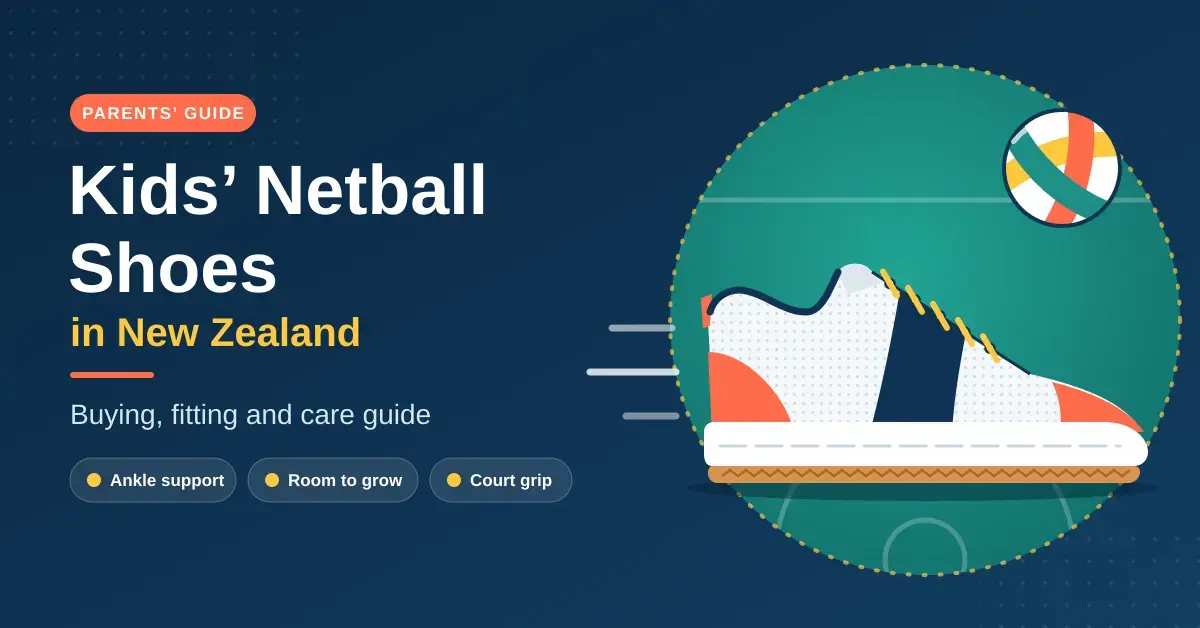
Netball asks a child’s feet to do something running shoes were never built for: stop dead, change direction sideways and land on one leg, over and over, on a hard surface. The right court shoes protect growing ankles and knees and survive a full outdoor season; the wrong pair wears through in weeks or, worse, lets the foot roll on landing. This guide explains why netball shoes differ from running shoes, what to check before you buy, how to fit a growing foot, and which junior models and prices you will actually find in New Zealand in 2026. For the adult and general picture, see our wider guide to choosing netball shoes; this page focuses on children.
Why running shoes don’t work for netball
Running shoes are designed for forward motion. The cushioning is deep and soft, the sole is narrow, and there is little structure resisting sideways movement — because in running there is none. Netball is the opposite: it is built on stopping, pivoting and landing, and a soft forward-biased shoe works against all three.
Running shoes vs netball shoes
| Running shoe | Netball shoe | |
|---|---|---|
| Built for | Forward motion in a straight line | Stopping, pivoting and landing |
| Lateral support | Minimal | Structured upper and sole that resist sideways roll |
| Sole pattern | Forward-facing tread | Pivot patterns and multi-directional grip |
| Foot position | Higher on soft foam | Lower and more stable |
| Outsole durability | Not built for pivoting on asphalt | High-abrasion rubber, often wrapped up the edges |
The practical difference in a child’s shoe is lateral (sideways) support. When a young player plants hard to change direction in a soft-sided running shoe, the foot can roll over the edge of the midsole — the cushioned layer between the foot and the ground. Court shoes sit the foot lower and hold it inside a more structured upper and sole, so it stays over the base instead of tipping off it.
Grip works differently too. Running treads are laid out for a forward roll through the step; netball outsoles use pivot patterns and multi-directional grooves that hold when the load comes from the side. ASICS describes the sport’s demands plainly: the jumping, landing and direction changes are hard on ankles and knees, so its netball shoes pair outsole grooves for stability with GEL cushioning in the rearfoot to absorb shock on landing.
What to look for in a court shoe
You can test most of this in the shop without any technical knowledge.
Torsional stiffness. Hold the shoe at both ends and twist it. A netball shoe should resist. If it wrings out like a wet cloth, it is not a court shoe.
A firm heel counter. The heel counter is the stiff cup at the back of the shoe. Squeeze it — it should hold its shape, not fold flat. That stiffness is what stops the heel lifting inside the shoe on landing.
A wrapped, durable outsole. Rubber that carries up around the edge of the midsole lasts far longer on abrasive outdoor courts and helps the shoe bite during pivots.
A supportive upper. The upper is the part that wraps over the top of the foot. Synthetic leather with reinforcement overlays holds its shape better than an all-mesh upper on wet outdoor courts — the ASICS Netburner Ballistic GS, for example, uses a synthetic leather and mesh upper with PU (polyurethane) reinforcements.
Removable insoles, if your child wears orthotics (prescribed supports that sit under the foot) and needs to swap the standard insole out.
Getting the fit right
Buying two sizes up to make shoes last is the most common mistake, and it quietly undoes the whole reason for choosing court shoes. A shoe that is too long lets the foot slide forward under braking, which produces blisters and bruised toenails — and, more importantly, puts the foot out of position relative to the shoe’s support structures, so the stability features stop doing their job.
Fitting checklist
| Growth room | About a thumb’s width (~1 cm) at the toe |
| Socks | Fit wearing the socks they will play in |
| Time of day | Try on later in the day, when feet have swollen |
| Width | No pinching at the sides; size up in width, not length |
| Heel | No lift when they walk or rise onto their toes |
| Twist test | Shoe resists twisting through the midfoot |
| Heel counter | Firm when squeezed, not collapsible |
| Insole | Removable if your child wears orthotics |
Leave roughly a thumb’s width — about a centimetre — between the longest toe and the front of the shoe, with the child standing and wearing the socks they will play in. Check at the end of the day, when feet are at their largest. Feet and shoe sizes can jump quickly during growth spurts, so it is worth re-measuring each season rather than assuming last year’s size.
Width matters as much as length. If a child complains of pinching along the sides during warm-up, the shoe is too narrow — and going up in length will not fix it, it will only add slide. Some models come in wider fittings, so try a different model rather than a bigger size. Where possible, have the child try shoes on and move in them rather than ordering blind online.
What’s available in New Zealand
The New Zealand kids’ netball market is dominated by ASICS, with adidas the main alternative. Junior sizing typically starts at US 3, and listings are often marked “GS” — Grade School, the industry term for the school-aged size range, as distinct from adult sizing.
| Model | Approx. NZ price | What it offers |
|---|---|---|
| adidas Netcourt Junior | around $110 | Entry-level junior court shoe; EVA midsole cushioning; built for school sport and club training |
| ASICS GEL-Netburner Professional (GS) | around $150 | Lightweight and flexible; EVA midsole with rearfoot GEL; non-marking outsole with forefoot and rearfoot flex grooves for quick direction changes |
| ASICS Netburner Ballistic (GS) | around $160 | More structured; synthetic leather and mesh upper with PU reinforcement; EVA midsole with forefoot GEL cushioning |
Prices are 2026 retail examples from New Zealand stockists and change every season; the junior lines are also re-numbered each year, so the current ASICS models carry the “4” badge (Professional 4 GS and Ballistic 4 GS). “EVA” is the lightweight foam used in the midsole, and “GEL” is ASICS’ cushioning unit that absorbs impact on landing. Which model suits your child depends far more on fit and where they play than on model hierarchy — the cheaper shoe that fits properly beats the dearer one that does not. Try them on.
Indoor or outdoor courts
Where your child plays should shape the choice, because New Zealand courts vary enormously by region and venue.
Outdoor asphalt behaves like sandpaper and wears soft rubber down fast. If your child plays most weekends outdoors, the durability of the outsole compound matters more than a few grams of weight. Indoor timber is kinder to shoes but usually comes with a non-marking sole requirement, enforced to protect the floor finish; most modern netball shoes meet it, but check before you buy if your league plays in a council or school stadium. Court surfaces and the markings underfoot are covered in our netball court dimensions guide.
Match the shoe to the grade and where they play
How your child plays changes what matters in a shoe. The youngest players follow Netball New Zealand’s modified Woolworths futureFERNS — Netball New Zealand format, played on smaller courts with lower hoops and lighter balls, so a secure fit and reliable grip matter more than deep cushioning for big jumps. From Year 7 and 8 the full seven-a-side game and full-size court arrive, landings get heavier, and the structural support of a true court shoe earns its keep.
Governing-body guidance treats footwear as part of a player’s basic kit rather than regulated equipment: World Netball’s Facilities, equipment and uniform requirements — World Netball page specifies courts, posts and uniforms but leaves shoe choice to players, within any non-marking rule a venue sets.
If you play in North Canterbury, the local centre’s pages set out the grades, venues and playing days that decide how much court time — and outdoor wear — a pair will see across a season. Start with the North Canterbury Netball Centre — official website and the practical Want to play netball: grades, days and venues — NCNC guide, then check the Year 5 & 6 draw and court duty requirements — NCNC and Year 7 & 8 competition information and season dates — NCNC for junior grades. Older juniors stepping up can look at the Open grade and senior representative fixtures — NCNC, and the Centre contacts and committee — NCNC page is the place to ask about the surface at a specific venue before you commit to an outdoor-tough or lighter indoor shoe.
Shoes are one part of injury prevention
It is worth keeping footwear in proportion. Netball has one of the higher rates of serious knee and ankle injury in New Zealand sport, which is why ACC and Netball New Zealand run NetballSmart — Netball New Zealand injury prevention programme. ACC reports that a good warm-up programme like NetballSmart can reduce ACL (anterior cruciate ligament, a key knee ligament) injuries by up to 50% — see the NetballSmart and ACL injury data — ACC newsroom story. The official dynamic warm-up takes 15 to 20 minutes and is designed to be done two to three times a week.
Good shoes help. A structured warm-up and sound landing technique do more. Our guide to the netball footwork rule and clean landings covers the technique side. If a child has ongoing foot, ankle or knee pain, that is a conversation with a GP or podiatrist rather than a shoe purchase.
Don’t overlook socks
Cotton school socks hold moisture against the skin, which softens it and produces blisters. Synthetic sports socks with some cushioning under the heel and forefoot are a cheap upgrade that makes a noticeable difference over four quarters, and they help the shoe fit as intended — fit the shoes while wearing the socks your child will actually play in.
Caring for netball shoes
Netball shoes are a real cost for a household, and heat is what kills them. Never put them in a dryer or on a heater — heat degrades the midsole foam and the adhesives holding the sole to the upper.
Let mud dry, brush it out of the grooves, wipe the uppers with a damp cloth and mild soap, and air-dry them indoors; a sheet of newspaper inside helps draw out moisture. Encourage the habit of untying laces rather than levering shoes off at the heel, which breaks down the heel structure that is doing the stabilising. Keeping court shoes for the court — not as everyday walking shoes — also extends their life considerably.
Our netball equipment guide covers the rest of a junior kit, and our netball bibs buying guide covers team uniform.
This article is provided for factual and informational purposes only. It is not medical, podiatric or purchasing advice, and it does not recommend particular brands or retailers. Product ranges, model names and specifications change between seasons — check current listings directly with manufacturers and retailers. If a child has persistent foot, ankle or knee pain, seek advice from a GP or podiatrist. For injury-prevention guidance see NetballSmart. Details on this page were verified in October 2026.
Sources
Frequently asked questions
Can my child wear running shoes for netball?
They can, but running shoes are built for forward motion and lack the lateral support and pivot-oriented grip netball demands, so the foot can roll on a sharp direction change. For regular club or school play, court shoes are the safer choice.
How much growth room should I leave?
About a thumb’s width — roughly a centimetre — between the longest toe and the end of the shoe, measured with the child standing and wearing the socks they will play in. Going bigger than that lets the foot slide and defeats the shoe’s support features.
What does GS mean on netball shoe listings?
Grade School — the school-aged size range used by athletic brands, as distinct from adult sizing. In New Zealand, kids’ netball ranges typically start around a US 3.
Which brands make junior netball shoes in New Zealand, and what do they cost?
ASICS dominates the market, with adidas the main alternative. In 2026 the adidas Netcourt Junior sells for around $110, the ASICS GEL-Netburner Professional (GS) for around $150 and the structured Netburner Ballistic (GS) for around $160. Prices and model numbers change each season, so confirm current listings.
My child has wide feet — what should I look for?
Width, not length. Going up a size to fix pinching only creates a sliding problem instead. Look for a model offered in a wider fitting, and have them try shoes on rather than ordering blind.
Do indoor courts need different shoes?
Often the same shoe works, but many indoor venues require a non-marking sole to protect timber floors. Most modern netball shoes qualify; check with the venue before buying if your league plays indoors.