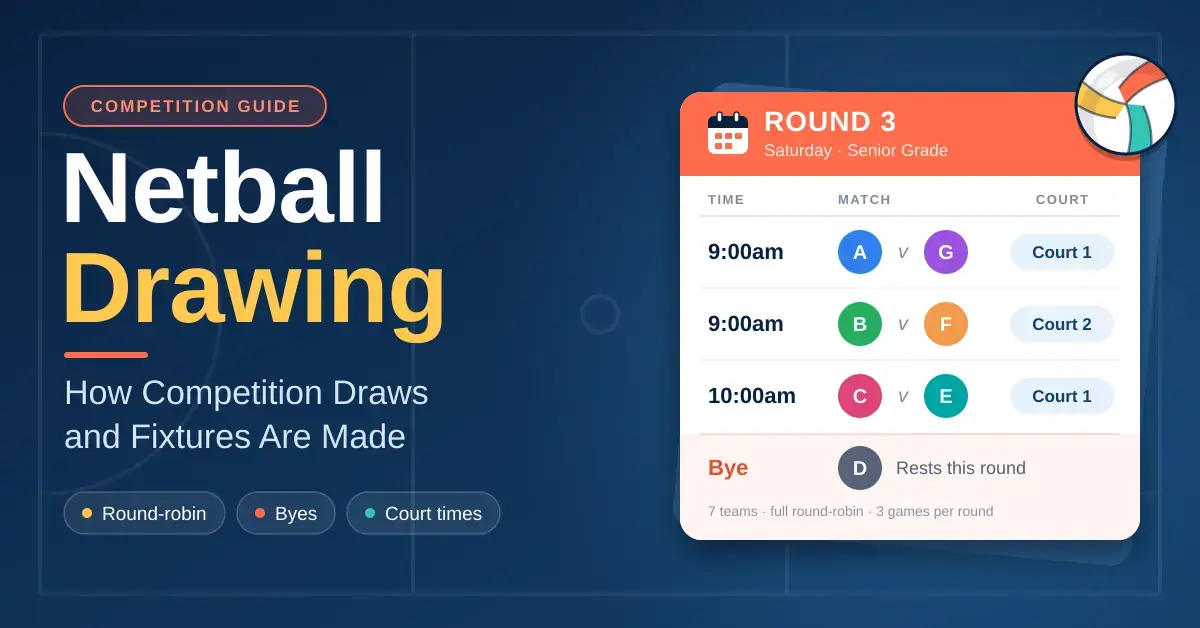
A netball draw is the master schedule of a competition — the document that tells every team who they play, on what date, at what time, and on which court. The term “netball drawing” simply refers to the process of building that schedule. Whether you follow the six-team professional league or a Saturday-morning grade at your local centre, understanding how a draw is put together makes the season much easier to follow. This guide walks through how draws are created in New Zealand, the formats used, and the rules that keep them fair.
What a Netball Draw Actually Is
In netball, the word “draw” has two everyday meanings. Most often it means the fixture list — the full set of scheduled matches for a season or tournament. Less commonly it refers to the act of “drawing” teams into groups or positions, similar to the ceremony used in knockout cups. On this page we use “draw” in the New Zealand sense: the published schedule of fixtures.
A good draw does more than pair teams up. It balances travel, spreads rest fairly, allocates venues and umpires, and makes sure no side is handed an unfair run of matches. Draws are not unique to netball; the same scheduling logic organises everything from a community sports day at Auckland’s Ellerslie driving range to a netball grand final.
Key Points
- What it is: a netball draw is the published schedule of fixtures — who plays whom, when and where.
- How it’s built: entries and grading/seeding → generate fixtures → balance byes, rest, venues and umpires → publish.
- Fairness first: top teams are seeded apart, byes are spread evenly, and back-to-back games are avoided.
- Top level: the ANZ Premiership runs a six-team double round robin (from 2025) with a top-three finals series.
- Community level: NZ centres grade teams and generate draws using MyNetball and the Sporty/SKED platform.
How a Draw Is Created, Step by Step
The process is broadly the same at every level, from international events down to junior grades, even if the tools differ.
1. Team entries and grading
First, organisers confirm which teams have entered. At community level, New Zealand centres then “grade” teams — sorting them into divisions of roughly equal ability so games are competitive. Grading may use last season’s results, pre-season grading games, or a coach’s assessment. Placing similar teams together is the community equivalent of seeding.
2. Seeding the stronger teams
In tournaments and leagues, higher-ranked teams are seeded so the best sides do not meet in the opening rounds. Seedings are usually based on the previous season’s finish, current standings, or qualifying results. This keeps early-round matches meaningful and saves the biggest clashes for later.
3. Building the fixture list
Once teams and seedings are set, the fixtures are generated — often automatically by competition software. The schedule then has to respect venue availability, court numbers, umpire rosters and travel. Organisers review it for clashes before publishing.
4. Byes and rest periods
A bye is a round in which a team has no game, which happens whenever there is an odd number of teams. Byes are spread as evenly as possible so no side gains an unfair break. Draws also avoid sending a team straight back on court after a demanding match; because a netball game runs 60 minutes of hard running, recovery time matters.
5. Venue allocation
Finally, matches are assigned to courts and venues. Bigger fixtures may move to a larger or neutral venue for capacity and fairness, while regular grades stay at a centre’s home courts. Centres such as the Auckland Netball Centre run dozens of parallel games each week, so court allocation is a large part of the job.
Draw Formats Used in Netball
Not every competition is scheduled the same way. The format chosen depends on how many teams there are, how long the season is, and whether a champion is decided by ladder position or by finals.
Draw Formats Compared
| Format | How it works | Best suited to |
|---|---|---|
| Single round robin | Every team plays every other team once. | Leagues with limited weeks or many teams. |
| Double round robin | Every team plays every other team twice (home and away). | Balanced leagues such as the ANZ Premiership. |
| Pool play + crossovers | Teams are split into pools, then top sides cross over to play across pools. | Weekend tournaments with many entries. |
| Knockout (elimination) | Losers are eliminated; winners advance until one remains. | Cups and finals series. |
| Round robin + finals | A round-robin season decides seedings, then top teams play finals. | Most senior competitions. |
Community leagues usually run a round robin so every team gets a fair number of games, while short school tournaments often use pools followed by crossovers or a knockout to fit many teams into one or two days.
Draws at the Top Level: the ANZ Premiership
New Zealand’s elite domestic competition, the ANZ Premiership, shows these principles in action. It features six franchises: Central Pulse, Mainland Tactix, Northern Mystics, Northern Stars, Southern Steel and Waikato Bay of Plenty Magic.
From 2025 the regular season moved from a triple to a double round robin, so each team plays every other team twice — ten regular-season games apiece. Teams earn three points for a win and one point for a loss by five goals or fewer. The top three sides then contest the finals: the minor premier goes straight to the grand final with home advantage, while the second- and third-placed teams meet in an elimination final to decide the other grand-final spot. The domestic season also doubles as a selection window for the Silver Ferns, and reporting on Silver Ferns eligibility shows how closely club form is watched by national selectors.
Community and School Draws in New Zealand
Below the professional league, most New Zealand netball is run by local centres and generated with dedicated software rather than by hand. Netball New Zealand uses the MyNetball registration system, and many centres publish their draws through the Sporty platform and its SKED competition-management tool. SKED can build round robins, reversals, crossovers, knockouts and tournaments, drag teams between grades, and allocate umpires and time slots.
For players and parents, the practical upshot is that draws, results and standings are available online and updated in near real time, including venue and court numbers. Grades are re-checked through the season, and a team may be re-graded if it is clearly too strong or too weak for its division.
Rules That Keep a Draw Fair
Whatever the format, a few principles are close to universal. They sit alongside the on-court playing regulations covered in netball’s rules:
- Balanced seeding: top teams are kept apart in early rounds so the competition builds towards its biggest matches.
- Even byes: where byes are unavoidable, they are shared out so no team is advantaged.
- Adequate rest: back-to-back games with little recovery are avoided.
- Home-and-away balance: over a season, teams get a fair split of home and away or preferred time slots.
- Transparency: the draw and any approved changes are published so everyone plays to the same information.
Once published, fixtures are generally fixed to protect planning. Changes do happen — for venue clashes, weather, or team withdrawals — but they must be approved by the organising body and communicated to every affected team. For a wider look at scheduling across regions, see this guide to netball draws and venues.
Common Mistakes When Reading a Draw
- Assuming a bye is a loss: a bye is simply a rest round, not a forfeited game.
- Missing venue or court numbers: a centre can run several courts at once, so always check the court, not just the time.
- Ignoring re-grading notices: a team’s grade or section can shift after early rounds.
- Trusting an old copy: draws are updated online; always work from the latest published version.
Sources
- ANZ Premiership — official competition site
- Southern Steel — 2026 ANZ Premiership season draw and venues
- MyNetball — Netball New Zealand competition and registration platform
- Sporty (SKED) — competition and draw management tools
- Netball North Harbour — club grading information
- Netball Wellington Centre — draws and results
Frequently Asked Questions
How are teams seeded in a netball draw?
Teams are seeded using their previous-season results, current standings or qualifying performance. Higher-ranked teams are placed so they do not meet in the opening rounds, which keeps early matches competitive and delays the biggest clashes. At community level the equivalent step is grading, which sorts teams into divisions of similar ability.
What is a bye in a netball draw?
A bye is a round in which a team has no scheduled game. Byes occur when a competition has an odd number of teams, so one team sits out each round. Organisers spread byes as evenly as possible, and teams typically use the time for recovery, training or tactical work. A bye does not count as a loss.
How is the ANZ Premiership draw structured?
The ANZ Premiership has six teams and, since 2025, uses a double round robin, so each team plays every other team twice for ten regular-season games. The top three teams reach the finals: the top side goes straight to the grand final with home advantage, and the second and third teams play an elimination final for the remaining spot.
Where can I find my local netball draw?
Most New Zealand centres publish draws, results and standings online through their websites and the Sporty platform, with fixtures managed via the MyNetball and SKED systems. Check your centre’s draws-and-results page for your grade, and confirm the venue and court number as well as the time.
Can a fixture change after the draw is published?
Yes, but only in specific circumstances such as a venue becoming unavailable, weather disruption or a team withdrawing. Any change must be approved by the organising body and communicated promptly to the teams involved, so that everyone is working from the same up-to-date schedule.