Netball and basketball share an ancestor and an identical ring height. Almost everything else about the two games is different.
This guide sets those differences out with the official figures — court size, scoring, movement, positions, contact and equipment — and untangles a piece of shared history that is very often told the wrong way round.
Same origin, two separate sports
Basketball came first. James Naismith invented it in Springfield, Massachusetts, in 1891, and within a year Senda Berenson had adapted the rules for women at Smith College. What happened next is where the two stories usually get tangled.
What Clara Baer actually did
Clara Baer, a physical-education teacher in New Orleans, wrote to Naismith asking for a copy of the rules. The package he sent included a diagram of the court with lines pencilled across it, drawn only to suggest the areas each player might best cover. Baer read those lines as fixed boundaries the players could not cross — and in 1899 that reading was ratified into the rules of women’s basketball in the United States as zones.
That produced zoned women’s basketball in America. It did not produce netball.
How netball actually developed
Netball’s own line runs through England. In 1895, an American visitor, Dr Justin Toles, taught students at Madame Osterberg’s Physical Training College in Hampstead to play basketball indoors — with no printed rules, no lines or circles, and two wastepaper baskets fixed to the wall as goals.
Revisions followed a visit in 1897 by another American teacher, Miss Porter of Baltimore. By then the game had picked up the name “net ball”, reflecting the switch from baskets to rings, and was being played outdoors on grass courts divided into three parts with a larger ball. Our guide to who invented netball follows the full sequence.
Court, ring and ball dimensions
Side by side, the two courts and their scoring hardware line up like this.
Court, ring and ball
| Feature | Netball | Basketball (FIBA) |
|---|---|---|
| Court length | 30.5 m | 28 m |
| Court width | 15.25 m | 15 m |
| Court divisions | Three equal thirds | Two halves |
| Ring height | 3.05 m | 3.05 m |
| Ring internal diameter | 380 mm | 450–459 mm |
| Backboard | None | Yes |
| Match ball | Size 5 — 690–710 mm, 400–450 g | Size 7 — 749–780 mm, 567–650 g |
| Lines count as | Part of the area they enclose | Out of bounds |
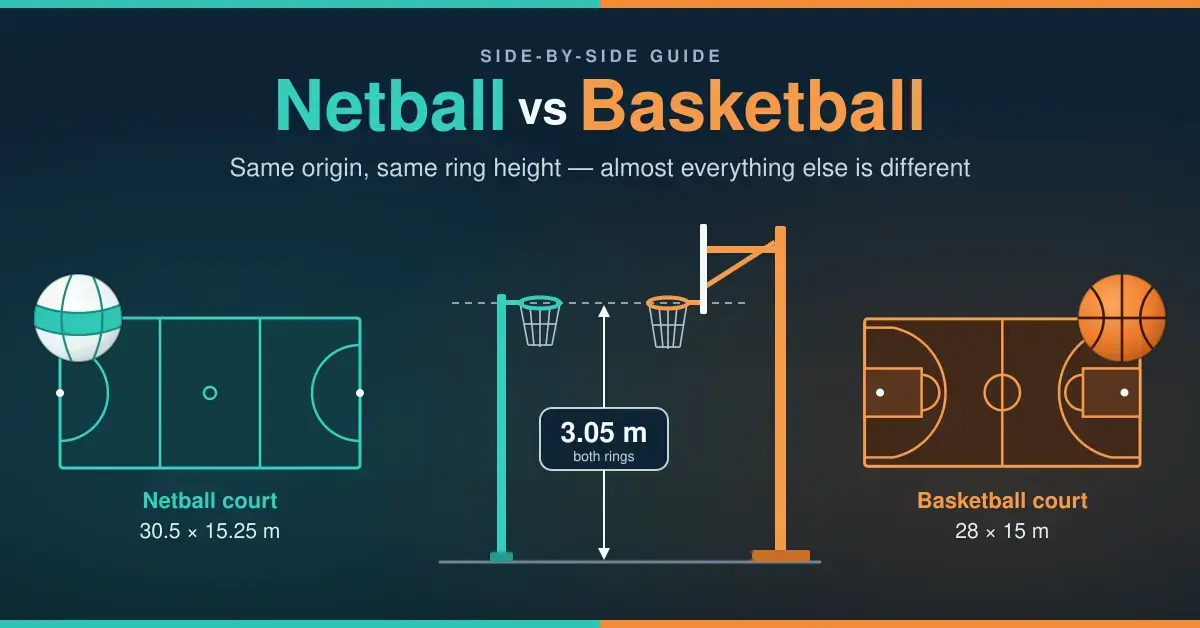
A netball court is both longer and marginally wider: 30.5 m by 15.25 m, against 28 m by 15 m for an international (FIBA) basketball court. The internal geometry is where they stop resembling each other. A netball court has two transverse lines splitting it into three equal thirds, with a semi-circular goal circle of 4.9 m radius at each end. A basketball court has a halfway line, a key, a free-throw line and a three-point arc set 6.75 m from the basket under FIBA rules. Neither layout stands in for the other, so a netball match cannot sensibly be played on basketball markings. Our court dimensions guide has the full measurements.
Lines mean opposite things
This catches people who cross between the two codes. In netball, every line is part of the area it encloses — stand on a line and you are inside that area. In basketball, the boundary lines are out of bounds, so touching the sideline with the ball turns possession over. Same paint, opposite meaning. World Netball publishes the complete court, post and equipment specifications in its facilities and equipment guidance.
Scoring
Both rings sit at 3.05 m above the floor. That is where the resemblance ends. A basketball rim has an inside diameter of 450–459 mm, with a backboard behind it that can be used on purpose or rescue a near miss. A netball ring has an internal diameter of just 380 mm, fixed to a 150 mm bar that projects from the front of the post, with a net open at both top and bottom — and no backboard at all.
Run the numbers and the gap widens. A men’s basketball is about 238 mm across, so the rim is roughly 1.9 times the width of the ball. A netball is about 222 mm across, so its ring is only about 1.7 times as wide. Netball gives the shooter a smaller target, a tighter margin and no second chance off the glass. Our netball hoop guide covers the equipment in more detail.
That is why netball shooting technique is built around a high, soft arc. Research by Elliott and Smith (1983) measured an average release angle of 59.8 degrees from the horizontal, with skilled shooters applying 1 to 1.5 revolutions of backspin to slow the ball as it meets the ring.
How many points a goal is worth
Basketball awards one, two or three points depending on where the shot is taken. Netball’s base rule is one point per goal, but that is no longer universal. Netball New Zealand added a two-point shot to the ANZ Premiership in 2025, active in the final five minutes of each quarter and scored from at least 3.5 m out. The Fast5 format goes further still, with three scoring zones — three points from outside the goal circle, and the circle itself divided into two-point and one-point areas.
Movement
This is the single biggest difference, and the one that most changes how each game looks. Basketball is built on dribbling: a player can carry the ball the length of the court alone, as long as they keep bouncing it, and once they pick it up they have a limited number of steps before travelling is called.
Netball bans dribbling outright. When a player catches the ball and lands on one foot, that foot becomes the landing foot. They may step with the other foot and pivot as often as they like, but the ball must be released before the landing foot is re-grounded — and there is no dragging, sliding or hopping, and no bouncing the ball to themselves to regain it. A netballer also has just three seconds to pass or shoot, while a basketballer can hold the ball far longer if not closely guarded.
The consequence is structural: in basketball an individual can advance the ball, whereas in netball only a pass can move it forward. Our footwork guide explains the rule step by step.
Positions
Basketball fields five players a side. Their labels — point guard, shooting guard, small forward, power forward and centre — describe roles rather than permissions: any player may go anywhere, and any player may shoot.
Netball fields seven a side, each wearing 150 mm position initials front and back: GS, GA, WA, C, WD, GD and GK. Every position is restricted to set areas of the court, and straying outside your area is offside whether or not you touch the ball. Only two players — goal shooter (GS) and goal attack (GA) — may shoot, and only from inside the goal circle. Our netball positions guide maps out each one.
Contact and defending
Here are the gameplay rules side by side.
Key differences at a glance
| Rule | Netball | Basketball |
|---|---|---|
| Players on court | 7 per side | 5 per side |
| Dribbling | Not allowed | Central to the game |
| Time on the ball | 3 seconds | Longer, unless closely guarded |
| Movement | Each position confined to set areas | Free to roam the whole court |
| Who can shoot | Goal shooter and goal attack, from the goal circle | All five players, from anywhere |
| Contact | Non-contact | Controlled contact allowed |
| Defending distance | At least 0.9 m from the landing foot | No minimum distance |
| Match length | 4 × 15 minutes | 4 × 10 min (FIBA) / 4 × 12 min (NBA) |
Basketball allows controlled contact: defenders can hold their position, box out and use their body legally within limits. Netball is a non-contact sport and adds a spacing rule with no basketball equivalent — a defender must be at least 0.9 m from the nearest part of the grounded landing foot of the player in possession before they can defend the ball.
This one is often misstated, so it is worth being precise. The defender does not have to retreat when a catch is made; they can stand wherever they like. What they cannot do is defend the ball from closer than 0.9 m. And if the player in possession pivots, the nearest part of the landing foot can move, so the defender must adjust to keep their nearer foot at least 0.9 m from where the landing foot is now grounded.
The balls
A senior netball is a size 5: 690–710 mm in circumference and 400–450 g. A FIBA size 7 men’s basketball is 749–780 mm and 567–650 g, while the women’s size 6 is 724–737 mm and 510–567 g. So even against the women’s ball, a netball is smaller and lighter.
Construction differs too. Basketballs are built to bounce predictably off a hard floor, because the whole game depends on it. Netballs are not: dribbling is illegal, so the surface is tuned for grip in the hands rather than rebound off the ground — which matters in New Zealand, where much of the season is played outdoors and often in the wet. Inflation reflects the difference, with basketballs run at roughly 7.5–8.5 psi and netballs inflated harder, to around 10 psi.
Choosing between them
If a child is weighing the two up, the honest framing is what each sport asks of them. Netball rewards precise passing, spatial discipline, quick decisions inside a defined role, and shooting accuracy under pressure. Basketball rewards individual ball-handling, versatility across the whole floor, and comfort with physical contact. Neither is a watered-down version of the other; they simply ask for different things. If netball appeals, our guide to how to play netball is a good place to begin.
Getting into netball in New Zealand
If reading this has you leaning towards netball, getting started is straightforward. Netball New Zealand’s junior programme, Woolworths futureFERNS, introduces primary-aged children to the game with modified rules and rotating positions.
Local centres run the grades above that. In the top of the South Island, for example, the North Canterbury Netball Centre sets out its grades, days and venues for new players, along with Year 7 and 8 competition dates, the Year 5 and 6 draw and court-duty requirements, and its open-grade and senior representative fixtures. Its committee and contact details are online too, and you can read more about the region in our guide to North Canterbury netball.
Because netball involves sharp changes of direction, a good warm-up matters. Netball New Zealand’s NetballSmart programme provides dynamic warm-up and injury-prevention routines, and ACC, which partners the programme, backs it as a way to cut serious knee and ankle injuries in the sport.
This article is for general information only. The rules and specifications above are set by World Netball and FIBA and change over time — for the current rules see World Netball and FIBA. Competition-specific variations, such as the two-point shot, are set by individual leagues. The figures on this page were checked in September 2026.
Sources
Frequently asked questions (FAQ)
What is the main difference between netball and basketball?
Movement. Basketball players dribble and can carry the ball the length of the court on their own. Netball bans dribbling and running with the ball, confines each player to set areas of the court, and gives them just three seconds to pass or shoot.
Are netball and basketball hoops the same height?
Yes. Both sit at 3.05 metres to the top of the ring. But a basketball rim is 450–459 mm across with a backboard behind it, while a netball ring is only 380 mm across and has no backboard at all.
Which court is bigger?
Netball. A netball court is 30.5 m by 15.25 m, while an international (FIBA) basketball court is 28 m by 15 m.
Can every player score in netball?
No. Only the goal shooter and goal attack may shoot, and only from inside the goal circle. In basketball, all five players on court can score from anywhere.
Is a netball goal always worth one point?
Not in every competition any more. One point is still the base rule, but the ANZ Premiership uses a two-point shot in the final five minutes of each quarter, and the Fast5 format uses one, two and three-point zones.
Did netball come from women’s basketball?
Only indirectly. Basketball was adapted for women in the United States in 1892, and Clara Baer’s misreading of a court diagram put fixed zones into American women’s basketball in 1899. Netball developed separately in England from 1895, adding rings, nets and thirds by 1897.