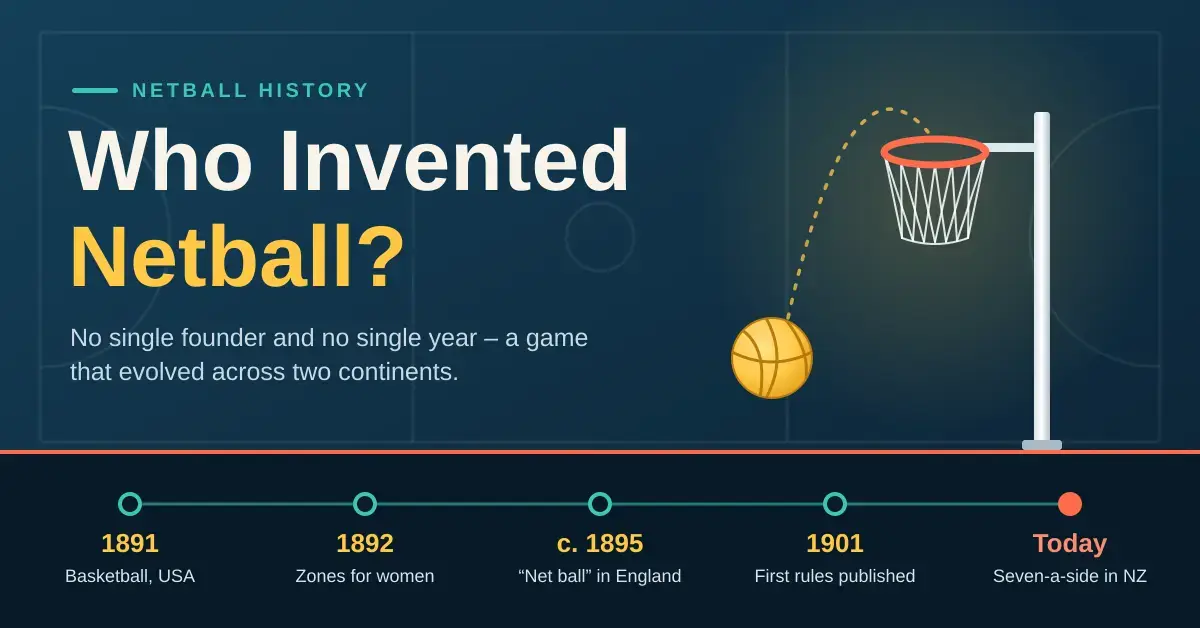
Ask who invented netball and you will not get one tidy answer the way you would for basketball. There is no single founder and no single year. Instead, netball grew out of a chain of adaptations that crossed two continents over roughly a decade — and the version of the story most often repeated online gets one important detail wrong. This guide sets out what the historical record actually shows, from a peach-basket game in Massachusetts to the seven-a-side sport played across New Zealand today.
Key Points
- Netball has no single inventor — it evolved from basketball through a chain of adaptations between about 1891 and 1901.
- James Naismith invented basketball (1891); Senda Berenson adapted it for women with zones (1892).
- The distinct game of “net ball” — rings, nets, thirds and its name — took shape at Martina Bergman-Österberg’s college in England around 1895–1897.
- The famous “misread diagram” belongs to Clara Baer in the United States; it shaped American women’s basketball, not netball.
- The first written rules appeared in 1901; international rules were standardised in 1960, with the first World Tournament in 1963.
- In New Zealand the game was called basketball until 1970; Netball New Zealand turned 100 in 2024.
It started with basketball
Netball’s family tree begins with basketball. In December 1891, the Canadian physical educator James Naismith invented the game at the International YMCA Training School in Springfield, Massachusetts. He fixed two peach baskets to the gymnasium balcony, wrote thirteen rules, and set out to create an active indoor game that could keep students fit through the cold New England winter.
The women’s version followed almost at once. In 1892, Senda Berenson, director of physical education at Smith College in Massachusetts, adapted Naismith’s rules for her students. She divided the court into sections so no single player could dominate, limited how long a player could hold the ball, and cut back on dribbling. Those ideas — zones and restraint rather than end-to-end running — are the seeds of everything netball would become.
The myth about a misread diagram
Search for netball’s origins and you will keep meeting the same colourful story: the sport’s zones came from a teacher who misread a diagram. The story is true. It simply happened in the wrong place to have created netball.
Clara Baer, a physical-education teacher in New Orleans, wrote to Naismith asking for a copy of the rules. The material she received included a sketch of the court with lines pencilled across it, drawn only to show the areas each player could best cover. Baer read the lines as fixed boundaries that players were not allowed to cross. She published her own version — she called it “Basquette” — from 1895, and by 1899 her zoned interpretation had been ratified into the rules of American women’s basketball.
It is a genuine misunderstanding with lasting consequences, but it stayed inside the United States and inside women’s basketball. There is no evidence it was carried to England, and it is not the ancestor of netball. Baer’s zoned American game and the English game that became netball are parallel developments, not a single line.
How the game took shape in England
The line that leads to netball runs through one influential college. Martina Bergman-Österberg, a Swedish physical-education pioneer, returned from a visit to the United States and informally introduced a version of basketball to her students in England in 1893.
Two years later, in 1895, an American teacher recorded in the sources only as Dr Toles introduced the game more formally at Österberg’s Physical Training College, which relocated from Hampstead to Dartford in Kent that same year. It was played indoors, without the lines, circles or boundaries we know today; the goals were simply two wastepaper baskets fixed to the walls at each end of the hall. Early accounts describe baskets set high on the wall, play entirely with the hands, and a limit on how long a player could hold the ball before passing.
The decisive changes came around 1897, after a visit from another American teacher, Miss Porter of Baltimore. (A few accounts place her demonstration a year later, in 1898.) By this point the game had a new name — “net ball” — reflecting the switch from solid baskets to open rings hung with nets. It moved outdoors onto grass courts divided into three parts, and it used a larger ball. The thirds, the rings, the ball and the name had all arrived within about two years.
The first written rules of net ball were published in 1901, when the Ling Association printed a small run of copies. From there, graduates of Österberg’s college carried the game into schools across the British Empire, which is why it took such deep root in New Zealand, Australia, South Africa and the Caribbean.
| Year | Where | What happened |
|---|---|---|
| 1891 | USA | Naismith invents basketball in Springfield |
| 1892 | USA | Senda Berenson adapts the rules for women at Smith College |
| 1893 | England | Österberg informally introduces a version to her students |
| 1895 | England | Dr Toles teaches the game at Österberg’s college using wastepaper baskets |
| 1895 | USA | Clara Baer publishes her “Basquette” rules — a separate American line |
| 1897 | England | Rings and nets replace baskets; court divided into thirds; the name “net ball” |
| 1899 | USA | Baer’s zones ratified into American women’s basketball |
| 1901 | England | First written rules of net ball published |
| 1926 | England | All England Women’s Net Ball Association formed |
| 1960 | Ceylon (Sri Lanka) | International federation founded by six nations; rules standardised |
| 1963 | England | First World Tournament, Eastbourne |
So who actually invented netball?
Put together, the honest answer is that netball has no single inventor. It has a lineage, with each contributor adding one piece:
- James Naismith created basketball, the parent game, in 1891.
- Senda Berenson adapted it for women in 1892 and introduced zoning to the women’s game.
- Dr Toles brought the game to Österberg’s college in England in 1895.
- Martina Bergman-Österberg, her staff and her graduates turned it into a distinct sport with rings, nets, thirds and its own name.
- Clara Baer independently produced a zoned American variant — a parallel story, not netball’s ancestor.
The People Behind Netball
| Person | Contribution |
|---|---|
| James Naismith | Invented basketball in 1891 — the parent game |
| Senda Berenson | Adapted the rules for women in 1892, introducing zones |
| Dr Toles | Introduced the game at Österberg’s college in 1895 |
| Martina Bergman-Österberg | Her college and its graduates turned it into a distinct sport and spread it worldwide |
| Miss Porter of Baltimore | Prompted the 1897 changes: rings and nets, thirds and a larger ball |
| Clara Baer | Zoned American women’s basketball — a parallel development, not netball’s origin |
From local rules to a global sport
For decades the game spread faster than any rulebook. Some regions played nine-a-side, others five or seven, and details such as circle sizes varied between school districts. The first national governing body, the All England Women’s Net Ball Association, was formed in 1926.
Standardisation came much later. An Australian tour of England in 1957 prompted serious discussion about agreeing a single set of rules. In 1960, representatives from six countries — Australia, England, New Zealand, South Africa, Wales and the West Indies — met in Colombo, in what was then Ceylon (now Sri Lanka), and founded the International Federation of Women’s Basketball and Netball Associations. They agreed a common rulebook and decided to hold a World Tournament every four years, beginning in Eastbourne, England, in 1963.
That governing body was later renamed the International Federation of Netball Associations, then the International Netball Federation, before rebranding as World Netball in 2021. Our Netball World Cup guide picks up the tournament story from Eastbourne onward.
Netball in New Zealand
Netball reached New Zealand through the same missionary and school networks that carried it across the Empire. Reverend J. C. Jamieson, Travelling Secretary of the Presbyterian Bible Class Union, is usually credited with organising the first games in 1906 (some sources say 1907), although a form of the game had already been recorded at Wanganui High School as early as 1897.
Jamieson’s version was nine-a-side, played on grass. Dribbling had gone, and the heavy floor-length skirts and leg-o’-mutton sleeves of the day made running impractical, so the ball travelled hand to hand, with lines on the court marking where each player could and could not go.
| Year | Milestone |
|---|---|
| 1897 | A form of the game recorded at Wanganui High School |
| 1906 | Rev J. C. Jamieson credited with organising the first games — nine-a-side, on grass |
| 1915–21 | Local associations form: Otago, Wairoa, Wellington, Auckland, Canterbury |
| 1924 | New Zealand Basket Ball Association inaugurated in May; black with silver fern adopted |
| 1938 | First test: Australia 40, New Zealand 11, in Melbourne |
| 1958–59 | Move to seven-a-side agreed; nine-a-side played until 1959 |
| 1963 | Runners-up at the first World Tournament, after a five-week voyage |
| 1967 | First world title, Perth, unbeaten in seven matches |
| 1970 | New Zealand becomes the last country to adopt the name “netball” |
| 2024 | Centenary — first national netball body in the world to reach 100 years |
Local associations formed steadily through the 1910s and early 1920s — Otago in 1915, Wairoa in 1917, Wellington in 1918, Auckland in 1920–21 and Canterbury in 1921 — each with its own rules. In 1922 the largest associations began pushing for a national body, and in May 1924 the New Zealand Basket Ball Association was inaugurated, adopting black with a silver fern as its colours. The country played its first international test in 1938, losing 40–11 to Australia in Melbourne — the first netball test match played anywhere in the world. Netball New Zealand marked its centenary on 21 May 2024, becoming the first national netball body in the world to reach 100 years; you can read more about the modern organisation in our guide to Netball New Zealand.
From nine players to seven
Two well-known changes are often muddled together, so it helps to separate them. The first was the size of a team. A motion to move to teams of seven passed at the 1958 annual meeting and was phased in over the next two seasons; New Zealand played nine-a-side until 1959. Falling into step with the rest of the world proved a major spur to the game’s growth.
Why the game was called basketball here
The second change was the name. Because the sport had arrived labelled “basketball”, that is what New Zealanders called it for decades. In 1970, New Zealand became the last country in the world to adopt the name “netball”. If the difference between the two sports still puzzles you, our netball vs basketball comparison lays it out.
The international breakthrough
Standardised rules opened the door to the first World Tournament, held in England in 1963. The New Zealand team’s build-up was a five-week sea voyage, training on deck and losing balls overboard; they finished runners-up, losing the deciding match to Australia by a single goal, 36–37. The squad included Lois Muir, later a celebrated Silver Ferns coach. Four years on, at the 1967 championships in Perth, New Zealand won its first world title — coached by Taini Jamison, captained by Judy Blair, and unbeaten across all seven matches, sealing gold with a 40–34 win over Australia. The national team’s story continues on our Silver Ferns page.
What the early rules left behind
Several features of the modern game trace directly back to those first adaptations.
No dribbling and no running with the ball. The passing-only game came straight from the earliest English modifications and remains netball’s defining constraint. It is why possession moves in sharp, quick passes rather than solo runs.
Restricted areas. Dividing the court into thirds dates to 1897 and still dictates where each of the seven positions may go — see our court dimensions guide and our positions explainer.
No backboard. The ring is fixed to a 150mm bar projecting from the front of the post, with nothing behind it. That is why netball shooting relies on a high, soft arc — one classic biomechanics study measured an average release angle of about 59.8 degrees from the horizontal. Our netball hoop guide covers the equipment in detail.
A time limit on the ball. Holding the ball has always been restricted; today the rule is three seconds. Official specifications for posts, rings and court markings are published in World Netball’s facilities and equipment guidance.
Netball in New Zealand today
More than a century on, netball remains one of New Zealand’s most-played sports, organised through a network of local centres. A typical example is the North Canterbury Netball Centre, whose website explains how to sign up and which grades, days and venues are available, alongside Year 7 and 8 competition information, the Year 5 and 6 draw, open-grade and senior representative fixtures, and committee and centre contacts.
The youngest players start on a modified game. Netball New Zealand’s Woolworths futureFERNS programme scales the sport for tamariki, with lower goalposts, a smaller ball and rotating positions before the full-height 3.05-metre goal and seven-a-side format arrive in the intermediate years. Exact age bands and goal heights can vary between centres, so it is worth checking your local policy.
Because netball involves constant stopping, landing and changing direction, injury prevention matters. Netball New Zealand’s NetballSmart programme teaches warm-ups and movement skills that reduce knee and ankle injuries, and ACC has partnered with it to cut the number of players sidelined by anterior cruciate ligament (ACL) injuries. If you are completely new to the sport, start with our guide to how to play netball, or browse our collection of netball facts.
This article is for factual and informational purposes only. Accounts of netball’s earliest years vary between sources, and some fine details are disputed or thinly documented; where they conflict, this page follows the governing bodies’ records and contemporary documents. For the current rules and programmes, see Netball New Zealand. The details on this page were verified in September 2026.
Sources
- History of netball — World Netball
- About us — World Netball
- The rules of netball — History of Physiotherapy
- The origins and formation of England Netball — Playing Pasts
- Netball — Te Ara, the Encyclopedia of New Zealand
- Dispelling the creation myth of netball in NZ — RNZ
- 100 years in the making — Netball New Zealand
- The Österberg Collection
Frequently Asked Questions
Who invented netball?
No single person did. James Naismith invented basketball in 1891, Senda Berenson adapted it for women in 1892, and the game was introduced at Martina Bergman-Österberg’s college in England by Dr Toles in 1895. The rings, nets, thirds and the name “net ball” followed by about 1897, so netball is best understood as the work of many hands rather than one inventor.
Did Clara Baer invent netball?
No. Baer misread a court diagram and built zones into American women’s basketball, ratified in 1899 in New Orleans. That change stayed within the American game. Netball developed separately in England, so her story runs parallel to netball rather than being its origin.
When was netball invented?
If you date it from when the game became clearly distinct, roughly between 1895 and 1897 in England, when the rings, nets, thirds and the name “net ball” appeared. The first written rules were published in 1901.
When did netball come to New Zealand?
Reverend J. C. Jamieson is usually credited with organising the first games in 1906, though a form of the game was recorded at Wanganui High School as early as 1897. His version was nine-a-side and played on grass.
Why was netball called basketball in New Zealand?
Because that was the name the game carried when it arrived. New Zealand kept calling it basketball longer than anyone else, adopting the name “netball” only in 1970 — the last country in the world to do so.
How old is Netball New Zealand?
It was founded in May 1924 as the New Zealand Basket Ball Association and celebrated its centenary on 21 May 2024, making it the first national netball body in the world to reach 100 years.