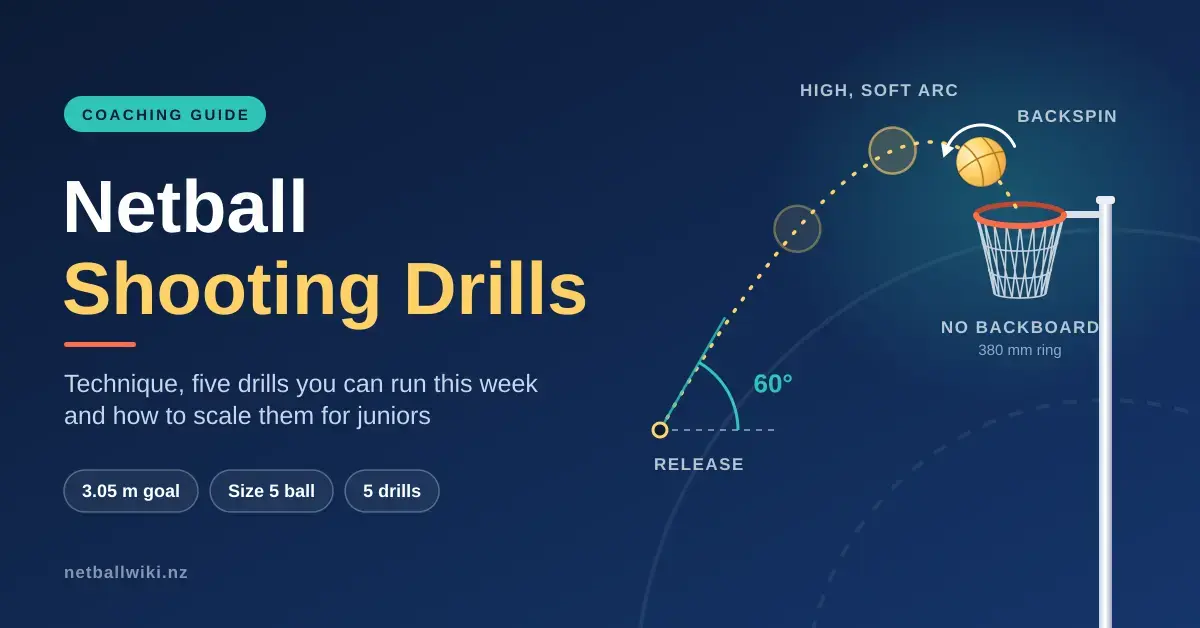
Netball shooting has one feature that shapes everything about the technique: there is no backboard. The ring is 380 mm across, attached to a bar that projects 150 mm from the post, with nothing behind it.
A shot that would bank in during basketball simply misses. That is why netball shooters use a high, soft arc rather than a flat, powerful one — and why practice is about repeatable mechanics rather than force.
This guide covers the technique, five drills you can run this week, and how to scale them for juniors.
Key facts
| Ring internal diameter | 380 mm, on a bar projecting 150 mm from the post — no backboard |
| Full goal height | 3.05 m (Year 7–8 and senior) |
| Match ball | Size 5, inflated to about 10 psi |
| Optimal release angle | Around 60° from the horizontal |
| Backspin | 1 to 1.5 revolutions |
| Elite match accuracy | Roughly 88–92% |
| Two-point shot (ANZ Premiership, 2025) | From 3.5 m, in the last five minutes of each quarter |
| Defender distance | 0.9 m from the shooter’s landing foot |
The mechanics of a netball shot
Power comes from the legs, not the arms. A shooter who pushes the ball with shoulders and triceps loses accuracy as those muscles fatigue — which is why shooting percentages often fall away in fourth quarters. The sequence is one flowing action: balanced stance, knee bend, extension upward through the body, release off the fingertips, and hold the follow-through.
| Phase | What happens | Coaching cue |
|---|---|---|
| 1. Set | Balanced stance, ball on the fingertips of the shooting hand, the other hand steadying it | “Ball high, elbow under” |
| 2. Load | Knee bend that generates the power for the shot | “Power from the legs, not the arm” |
| 3. Release | Extension upward; the ball leaves the fingertips with backspin | “High arc, soft hands” |
| 4. Follow through | Arm stays extended, wrist flexed, eyes on the ring | “Hold it until it drops” |
What the research says about the arc
Netball shooting has been studied far less than basketball, so treat the numbers as guidance rather than gospel.
Elliott and Smith (1983) measured an average release angle of 59.8 degrees from the horizontal in netball shooting. Later summaries put the optimal shot at roughly 60 degrees with backspin of 1 to 1.5 revolutions relative to its direction of travel.
Backspin serves a specific purpose: it helps the ball hold its direction of flight and reduces its speed on impact with the ring, which increases the chance of the ball rebounding off the ring and dropping into the net. In that same research, the most accurate shooters applied 1 to 1.5 revolutions of backspin.
The research also points to greater extension at the knees and at the elbow of the shooting arm, and a higher release point, as ways to improve accuracy.
One honest caveat: there is very little research on netball goal-shooting biomechanics and the findings are divided — some studies suggest better shooters release with less velocity, others report higher success with more. Do not coach a single “correct” release velocity. Coach a repeatable one.
What good accuracy looks like
Useful benchmarks from elite play: Ameliaranne Ekenasio shot 24 from 26 (92%) in the 2019 World Cup gold-medal match. Grace Nweke shot 140 from 158 (89%) across the 2024 Taini Jamison series and again top-scored at 167 from 188 (89%) across the 2025 series against South Africa.
So the elite standard is roughly 88–92% in match conditions. Track your shooters’ percentages at training and in games — it is the only way to know whether a technical change is actually working.
Five shooting drills
Drills at a glance
| Drill | Players | Trains |
|---|---|---|
| Clockface | 1–2 | Adjusting power for angle and distance |
| Feed, spin and strike | 3 | Catch, footwork and shot as one action |
| Pressure penalty | 2 | Holding technique under fatigue |
| Under the arms | 2 | Shooting with vision obstructed |
| Rebound and second shot | 4 | Contested rebounds and quick reset |
1. Clockface
Setup: Five markers around the goal circle — one directly under the post, two at 45 degrees either side, two on the circle edge.
Run it: The shooter takes five shots from each marker in sequence, working outward, and records makes out of five at each position. Rotate a feeder in to deliver the ball so the shooter has to catch, set and shoot rather than starting with the ball in hand.
Why: Distance and angle both change the amount of leg drive required. Shooters who only practise under the post have no calibration for the circle edge.
Progression: Score it — the shooter must make three from five before moving to the next marker.
2. Feed, spin and strike
Setup: Three players — a shooter starting on the circle edge facing away from the post, a feeder outside the circle, and a defender.
Run it: The feeder calls, the shooter drives to a space, lands, pivots to face the post and shoots. The defender applies pressure at the legal distance. Repeat ten times, then rotate roles.
Why: In a match, almost no shot begins with the shooter set and facing the post. This drill joins the catch, the footwork and the shot into one movement.
Coaching point: Watch the landing foot and enforce clean footwork from the first repetition — our footwork guide covers what to look for.
3. Pressure penalty
Setup: A shooter and a rebounder, with the shooter working from the circle edge.
Run it: The shooter takes ten shots from distance, sprinting to a cone and back between each one. The rebounder returns the ball immediately.
Why: Fatigue is what breaks technique. This trains the leg-driven shot under exactly the conditions where an arm-driven shot fails.
Progression: Add a target — the shooter must make six of ten to finish, or the set repeats.
4. Under the arms
Setup: A shooter and one defender standing the legal distance away with arms extended.
Run it: The defender applies a full contest on every shot — arms up and moving, but staying at the legal distance. The shooter takes twenty shots, holding their eyes on a fixed point on the ring rather than tracking the defender’s hands.
Why: Elite defenders do not block the shot, they block the view. This trains the shooter to keep the target rather than the obstacle in focus.
Rules note: A defender must be 0.9 m from the attacker’s landing foot before defending the ball. Enforce it so the shooter is practising against legal pressure — our netball rules guide explains the obstruction distance in full.
5. Rebound and second shot
Setup: Four players in the circle with one ball.
Run it: One shooter shoots deliberately short or long. All four contest the rebound. Whoever secures it must land legally and shoot immediately. Continue until a goal is scored.
Why: Second-phase shooting under contest is where circle possession is won and lost, and it is rarely practised.
Long-range work and the two-point shot
Long-range shooting is now worth more in some competitions. Netball New Zealand introduced a two-point shot to the ANZ Premiership in 2025, active in the final five minutes of each quarter, with the shooter needing to be at least 3.5 metres from the goalpost.
If your competition uses it, mark that distance and build a specific block of shots from just outside it into your sessions. If it does not, long-range work still has value — but as depth of range, not as a scoring tactic.
Junior shooting
For primary-aged players the priority is successful attempts, not perfect technique. A child who cannot reach the ring will develop a two-handed chest heave, and that habit takes years to unwind.
The single biggest fix is equipment, not coaching. Younger year groups use a lighter ball and a lower goal, then step up as they grow.
| Year group | Goal height | Ball | Shooting focus |
|---|---|---|---|
| Year 1–2 | Hula hoop or up to 2.1 m | 20 cm grip ball | Getting the ball to the target at all |
| Year 3–4 | 2.6 m | Size 4 | One-handed release, close range |
| Year 5–6 | 2.6 m | Size 4 | Adding angles and light defensive pressure |
| Year 7–8 | 3.05 m | Size 5 | Full court, contested shooting |
Three games that work at this level:
- Passport. Coloured spots close to the post. Players shoot from each in turn, collecting a “stamp” for every make. Everyone finishes the circuit regardless of how many they make.
- Grab and go. Balls in the middle of the circle. Players sprint, collect, land legally, shoot, then tag the next player. Fast, high-volume, and it embeds the land-then-shoot sequence.
- Stop and shoot. Players move around the circle to music or a whistle. When it stops, they take the nearest ball and shoot from where they are.
Keep queues short. If twelve children share one ball, ten are standing still. Our drills guide has more session structures, and our passing drills guide covers the feeds that create shots.
Before you start any session
ACC and Netball New Zealand developed NetballSmart in response to a high rate of serious knee and ankle injuries, and ACC states a warm-up programme like NetballSmart can reduce ACL injuries by up to 50%. The official warm-up takes 15 to 20 minutes and is designed to be done two to three times a week.
Shooting sessions involve repeated jumping and landing under the post, so this matters more here than in a passing session, not less.
Equipment checks that affect shooting
Post alignment. A post leaning even slightly changes the effective target. Check portable bases and ground sockets at the start of the season.
Ring size. A regulation ring has an internal diameter of 380 mm. Undersized recreational hoops make practice harder in a way that does not transfer.
Ball pressure. Gilbert, the official ball maker, recommends inflating a netball to about 10 psi — lower and the ball performs poorly, higher and it risks going out of shape. Under- or over-inflated balls change the feel of every shot.
Padding. Post padding must be no more than 50 mm thick and should run the full length of the pole. Shooters and defenders contest within a metre of the post at speed.
There is more in our netball hoop guide and equipment guide.
Disclaimer
This guide is provided for general information only. It is not personal coaching or medical advice. The biomechanics research on netball shooting is limited and some findings are contested. For injury-prevention guidance see NetballSmart, and for the current playing rules see World Netball. Details on this page were verified in September 2026.
Sources
- North Canterbury Netball Centre — official website
- Want to play netball: grades, days and venues — NCNC
- Year 7 & 8 competition information and season dates — NCNC
- Year 5 & 6 draw and court duty requirements — NCNC
- Open grade and senior representative fixtures — NCNC
- Centre contacts and committee — NCNC
- Woolworths futureFERNS — Netball New Zealand
- Facilities, equipment and uniform requirements — World Netball
- NetballSmart — Netball New Zealand injury prevention programme
- NetballSmart and ACL injury data — ACC
Frequently asked questions
What angle should you release a netball shot at?
Research on netball shooting points to roughly 60 degrees from the horizontal. Elliott and Smith measured an average release angle of 59.8 degrees, and later summaries put the optimal shot at around 60 degrees with backspin.
Why does backspin matter when shooting?
Backspin helps the ball hold its flight direction and reduces its speed on contact with the ring, which increases the chance of a miss dropping in rather than bouncing away. The most accurate shooters in the research applied 1 to 1.5 revolutions.
What is a good shooting percentage in netball?
At elite level, roughly 88 to 92 percent in match conditions. Grace Nweke shot 89% across the 2024 Taini Jamison series, and Ameliaranne Ekenasio shot 92% in the 2019 World Cup final.
What hoop height should juniors shoot at?
Year 1 and 2 use goals no higher than 2.1 m, and Years 3 to 6 use 2.6 m. The full height of 3.05 m comes in at Year 7 and 8.
How far away can a defender stand when I shoot?
At least 0.9 metres, measured from your landing foot, before they can defend the ball. They may stand closer, but not with arms extended toward the ball.
How do I stop a young player shooting two-handed?
Lower the post and use the correct smaller ball for their year group. Most two-handed heaving is a strength problem created by equipment that is too big, not a technique problem.
How many shots should a session include?
More than most sessions manage. Keep queues to two or three players per ball and per hoop — volume is what builds a repeatable action, and standing in line builds nothing.