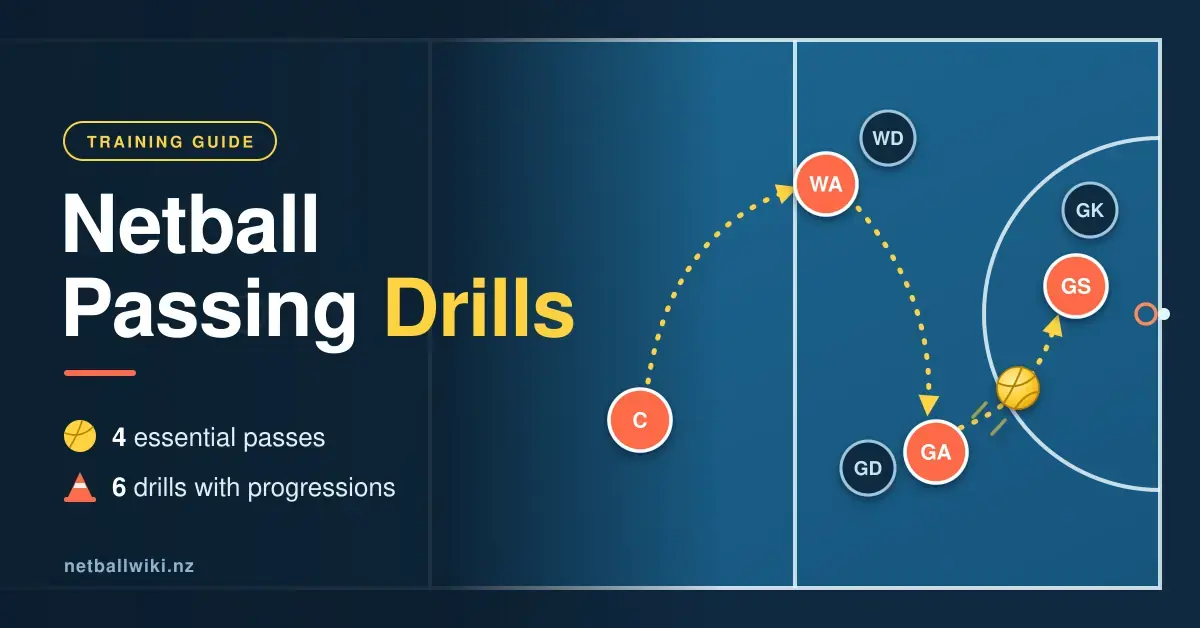
In netball, passing is not one skill among many — it is the only way the ball travels down the court.
Players cannot run with the ball, cannot bounce it and regain possession, and must release it before re-grounding the landing foot. With only three seconds to decide and pass, every metre the ball moves is a delivery someone had to make accurately, under pressure and at speed. That is why passing sits at the centre of almost every training session.
This guide breaks down the four passes every player needs, shows where deliveries most often break down, and gives you six drills — with progressions — that you can run at your next session.
The four passes
Netball allows any style of pass as long as the footwork and three-second rules are obeyed, so the choice comes down to distance, angle and the defender in front of you. If you are still learning those regulations, our guide to the rules of netball covers them in full. Four deliveries cover almost every situation on court.
The Four Passes
| Pass | Hands | Released from | Best used for |
|---|---|---|---|
| Chest | Two | The sternum, thumbs behind the ball | Fast, flat deliveries over short to medium range — the default pass |
| Bounce | One or two | Low, angled to strike the floor about two-thirds of the way to the receiver | Getting under a defender’s arms, especially in the goal circle |
| Shoulder | One | Beside the ear | Long-range balls — switching play or driving down a sideline |
| Overhead | Two | Above the head | Going over a tall defender rather than around them |
Chest pass. Two hands, released from the sternum with the thumbs driving through behind the ball. It is flat, fast and accurate over short to medium range, which makes it the default pass across most of the court.
Bounce pass. Released low and angled so the ball strikes the floor roughly two-thirds of the way to the receiver and arrives at about waist height. Its job is to travel under a defender’s arms, which is why it earns its keep in the goal circle.
Shoulder pass. One hand, released from beside the ear like a throw. It is the long-range option for switching play across the court or driving the ball down a sideline.
Overhead pass. Two hands above the head, used to go over a tall defender rather than around them.
Selection matters as much as execution. A flat chest pass through traffic in the goal circle is one of the most commonly intercepted balls in the game — exactly the situation where a well-timed bounce pass earns its place.
Where passes go wrong
Most poor passes are decided before the ball ever leaves the hands. Four faults cover the majority of turnovers you will see at club level.
- No step. Power comes from a forward step and a wrist snap, not from the arms alone. Passes thrown without a step float, and floating passes get intercepted.
- Looking at the ball. Dropping the chin to watch the ball telegraphs the pass and costs the player vision of the rest of the court.
- Passing to the player, not the space. Receivers should be met at the front of their stride, moving onto the ball, rather than caught standing still.
- Being one-sided. Players who only pass strongly off their dominant side get shut down by defenders who simply work out which side to block.
Six drills you can run this week
The drills below build from simple hand speed to full match-like pressure. Run them in order across a session, or pick the two that target your team’s weakest link. For a wider mix of team practices, see our complete netball drills collection.
Six Drills at a Glance
| Drill | Players | What it trains |
|---|---|---|
| Quick hands | 2 | Hand speed and reaction, with no tactical load |
| Chest to bounce split | 2 | Giving and receiving two pass types at once |
| Triangle feed | 3 | Catch, pivot and pass as a single sequence |
| Three-player weave | 3 | Passing into the space ahead of a moving target |
| Around the mark | 4 (3 v 1) | Creating a passing angle from a fixed pivot |
| Ten passes | 10 (5 v 5) | Decision-making under fatigue, close to match conditions |
1. Quick hands
Setup: Pairs, one ball, three metres apart.
Run it: 30 seconds of chest passes at maximum speed, counting completions. Rest 30 seconds. Repeat with bounce passes, then shoulder passes off each hand.
Why: Builds hand speed and reaction with no tactical load. It works well as a warm-up once players are already moving.
Progression: Add a second ball travelling in the opposite direction.
2. Chest to bounce split
Setup: Pairs, two balls, four metres apart, facing each other.
Run it: Both players hold a ball. On the call, one throws a chest pass while the other throws a bounce pass at the same moment. Both catch, then swap which pass they are making. Continue for 60 seconds.
Why: It forces players to give and receive two different pass types at once, which is far closer to match reality than repeating a single pass a hundred times.
Coaching point: If the balls keep colliding, the bounce pass is too flat or too late. Fix the release angle rather than the timing.
3. Triangle feed
Setup: Trios, one ball, cones set in a five-metre triangle.
Run it: A player passes and follows the pass to the next cone. The ball must be caught, landed legally, pivoted and passed. Run it clockwise for two minutes, then reverse.
Why: It joins the catch, the pivot and the pass into one sequence, which is where most beginner errors sit.
Coaching point: Watch the landing feet. Reversing direction forces players to pivot off their weaker side.
4. Three-player weave
Setup: Three players across the baseline, the middle player with the ball.
Run it: The middle player passes wide, then runs behind the receiver. The receiver lands, pivots, passes to the third player, then runs behind them. Repeat down the court, finishing with a feed to the circle edge.
Why: It trains passing into the space ahead of a moving target while keeping team momentum going down the court.
Important: This drill comes from basketball, where the receiver catches and keeps running. In netball that is a stepping call. Insist on a legal landing and pivot at every catch, or you are simply rehearsing an infringement — see our footwork guide for what a clean landing looks like.
5. Around the mark
Setup: Three attackers in a triangle, one defender in the middle, one ball.
Run it: Attackers move the ball between them while the defender applies legal pressure. Attackers may pivot and step wide with the non-landing foot to open a lane, but must not move the landing foot.
Why: It trains the specific skill of creating a passing angle from a fixed pivot point.
Rules note: The defender must keep 0.9m (three feet) between their nearer foot and the nearest part of the grounded foot of the player in possession. If the attacker pivots so that the nearest point of the landing foot changes, the defender must move to keep that distance. Enforce it — training against illegal pressure teaches nothing useful.
6. Ten passes
Setup: Five versus five in one third of the court. No posts, no shooting.
Run it: The attacking team scores a point for ten consecutive passes. Any turnover, dropped ball or footwork call resets the count to zero and hands over possession.
Why: This is where technique meets decision-making under fatigue, and it is the closest thing to match conditions you can run without a full court.
Progression: Require alternating pass types, or add a rule that the same two players cannot pass to each other twice in a row.
What good feeding looks like
Feeds are the currency of a netball midcourt, and they are measurable. A feed is a pass to a shooter on the edge of the goal circle from which a shot can be taken, and the wing attack is usually the player who delivers the most.
In New Zealand’s 61-54 win over England in the Glasgow 2026 Commonwealth Games semi-final, centre Kate Heffernan produced 19 feeds and five deflections — a reminder that the best feeders defend as hard as they attack. In the opening round of the 2026 ANZ Premiership, Central Pulse training partner Skylah Tainui-Takerei played the full match at wing attack and led all feeders with 23.
Numbers like those are the payoff for the drills above: accurate passing into space, a clean pivot and the right pass for the defender in front of you. Pair this work with your shooting drills so that the feed and the finish are practised together.
Sources
- World Netball / INF — Rules of Netball (2020 edition)
- NZ Herald — Silver Ferns v England, Glasgow 2026 Commonwealth Games semi-final
- Central Pulse — Winning start for Pulse in season opener (2026 ANZ Premiership)
- NZ Herald — Silver Ferns crowned Commonwealth Games champions
- Sportplan — Feeding the circle: drills and coaching
Frequently Asked Questions (FAQ)
What are the four main passes in netball?
The chest pass, the bounce pass, the shoulder pass and the overhead pass. The chest pass is the everyday delivery, the bounce pass travels under a defender’s arms, the shoulder pass covers long range, and the overhead pass goes over a tall opponent. All four are legal as long as the footwork and three-second rules are obeyed.
Which pass is best in the goal circle?
The bounce pass is often the safest choice inside the circle because it travels below a tall defender’s reach and arrives at about waist height. A flat chest pass through congested space is one of the most commonly intercepted balls in the game, so players are usually coached to change the angle rather than force it.
How long can you hold the ball in netball?
Three seconds. Once a player catches the ball they must pass or shoot within three seconds; holding it longer gives away a free pass to the opposition. That short window is exactly why quick, accurate passing under pressure is such a valuable skill.
How far must a defender stand from the player with the ball?
0.9 metres, which is roughly three feet, measured from the defender’s nearer foot to the nearest part of the grounded foot of the player in possession. If the attacker pivots and that grounded point moves, the defender has to adjust to keep the distance, or the umpire calls obstruction.
How can beginners improve their passing accuracy?
Start with a forward step and a wrist snap on every pass, keep the eyes up rather than on the ball, and aim for the space in front of a moving receiver rather than at a stationary player. Repetition drills such as quick hands build hand speed, while small-sided games like ten passes train the same technique under fatigue.