A netball hoop looks simple — a pole, a ring and a net — yet almost every part of it is defined down to the millimetre, and one missing feature changes how the entire sport is played. Unlike a basketball setup, there is nothing behind the ring to help a near miss drop in.
This guide explains what a netball hoop is made of, the official measurements set by World Netball (the sport’s global governing body), the lower heights used for junior grades in New Zealand, and what to look for if you are buying one. Every technical term is explained the first time it appears.
What is a netball hoop?
A netball hoop is the scoring target at each end of a netball court. You will also hear it called a netball goal, a netball post or a goalpost — all four terms describe the same piece of equipment.
Netball is played by two teams of seven. A goal is scored by shooting the ball through the opposing team’s ring. Only two players in each team are allowed to shoot, and only from inside the goal circle (the semi-circular scoring area at each end). Our guide to netball positions explains who does what.
The most important thing to know: there is no backboard
In basketball, a backboard sits behind the ring and can deflect a near miss back in. Netball has nothing behind the ring at all.
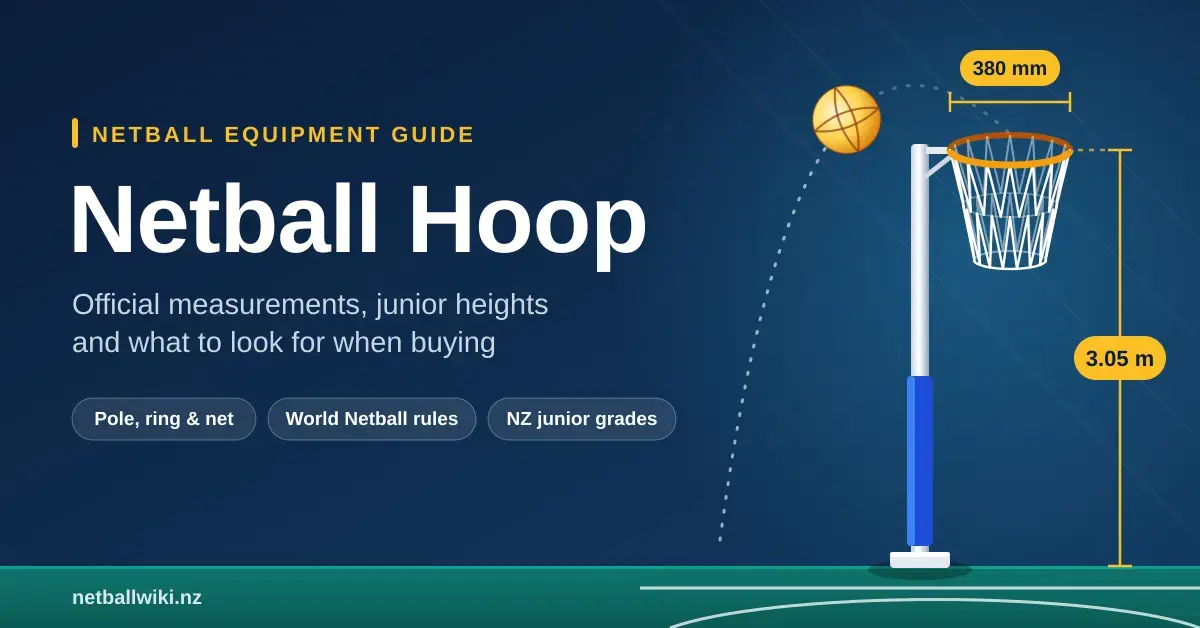
The ring attaches to a short horizontal metal bar, 150 mm long, that projects from the front edge at the top of the pole. That is the entire structure: pole, short arm, ring and net. For the fuller side-by-side, see our netball versus basketball comparison.
This is why netball shooters use a high, soft arc rather than a flat, powerful shot — there is no surface to rescue an inaccurate attempt, so the ball has to drop cleanly through. To work on that, see our netball shooting drills.
The parts of a netball goalpost
The specifications below come from the World Netball Rules of the Game and apply to senior competition worldwide. The full standards are published in World Netball’s facilities and equipment guidance.
Quick Facts
| Part | Specification |
|---|---|
| Post height | 3.05 m (10 ft) to the top of the ring |
| Post diameter | 65–100 mm, round or square |
| Ring internal diameter | 380 mm (15 in) |
| Ring material | Steel rod, 15 mm thick |
| Ring projection | 150 mm horizontally from the front of the post |
| Net | Open at top and bottom, 380–457 mm long, preferably white |
| Padding | No more than 50 mm thick, full length of the post |
| Backboard | None — netball posts have no backboard |
| Position | Mid-point of the goal line, back of post at the outer edge of the line |
| Mounting | Inserted in the ground or sleeved beneath the floor |
The post
The post is a vertical metal pole between 65 mm and 100 mm in diameter and 3.05 m high. It is inserted into the ground or sleeved beneath the floor so that when it is knocked there is minimal movement and it stays stable. Posts are usually painted white so they stand out against the court and the crowd.
The ring
The ring is a curved horizontal metal ring made of steel rod 15 mm in diameter, with an internal diameter of 380 mm. Two numbers matter here and they are easy to mix up:
- 380 mm is the internal diameter — the size of the gap the ball goes through.
- 15 mm is the thickness of the steel rod the ring itself is bent from.
For scale, a size 5 netball is roughly 220 mm across. The ring is a little under twice the width of the ball, which is a much tighter target than it looks from the sideline.
The net
A net, preferably white, is fitted to the ring. It must be clearly visible and open at both the top and the bottom, with a minimum length of 380 mm and a maximum of 457 mm. Being open at the bottom matters for pace of play — the ball drops straight through and back into play rather than being caught.
Official netball hoop measurements
Height and position
The ring sits 3.05 m above the floor, measured to the top of the ring, not the top of the post.
A goalpost is placed at the mid-point of each goal line so the back of the pole is at the outer edge of the goal line. Because court lines are 50 mm wide and posts are 65–100 mm in diameter, the pole ends up overlapping the court by 15–50 mm.
In other words, the post stands slightly inside the playing area, not behind it. Players work around it, and shooters routinely use the space directly under and behind the ring. On a regulation 15.25 m-wide court the centre of the pole sits 7.625 m from each sideline; full court measurements are in our netball court dimensions guide.
Padding and safety
The pole is covered with padding of uniform thickness, no more than 50 mm thick, extending the full length of the pole.
Padding is a genuine safety requirement rather than a cosmetic extra. Defenders and shooters contest the ball within a metre of the post at speed, and collisions with an unpadded pole cause avoidable injuries. Netball New Zealand’s NetballSmart injury-prevention programme promotes safe practice, and ACC injury data shows why reducing avoidable contact matters.
The base of a goalpost should not encroach onto the court itself, and on dedicated netball courts only socketed posts should be used.
Junior hoop heights in New Zealand
Full-height 3.05 m posts are not used across all junior grades here. Netball New Zealand’s Woolworths futureFERNS programme uses lower hoops and smaller balls so younger players can actually score.
| Year group | Hoop height | Ball | Format |
|---|---|---|---|
| Year 1–2 | Hula hoop or post no higher than 2.1 m | 20 cm grip ball | 4 v 4, one third of the court |
| Year 3–4 | 2.1–2.6 m (set for success) | Size 4 | 5 v 5, two thirds of the court |
| Year 5–6 | 2.6 m | Size 4 | 6 v 6, full court |
| Senior | 3.05 m | Size 5 | 7 v 7, full court |
Year 1 and 2 players use hula hoops held by parents, or goalposts set no higher than 2.1 m, to increase the likelihood of success. Year 3 and 4 play a modified 5 v 5 game over two-thirds of the court with a size 4 ball and goals set between 2.1 m and 2.6 m — whichever height best lets players score. Year 5 and 6 play 6 v 6 on a full court with 2.6 m goalposts.
Netball New Zealand has confirmed an update to the Year 5 and 6 game format taking effect from 2027, covering centre-pass flexibility and a gradual introduction of 7 v 7 from midway through Year 6. The hoop height stays at 2.6 m throughout Year 5 and Year 6, including when 7 v 7 begins. Nothing changes in 2026.
How scoring works at the hoop
A goal counts only when the ball passes completely through the ring, and only when the shot is taken by the goal shooter or goal attack with both feet inside the goal circle.
If the ball hits the ring and stays in play, it is live — any player allowed in that area can contest the rebound.
The two-point shot
Standard netball awards one point per goal. Several professional leagues now award two for long-range attempts.
Netball New Zealand introduced a two-point shot — branded the Summerset Super Shot — to the ANZ Premiership in 2025, active in the final five minutes of each quarter. In the ANZ Premiership the shooter must be at least 3.5 metres from the goalpost for the shot to count double, the same as Fast5, while Suncorp Super Netball and the UK competition set the zone at three metres.
This does not change the hoop itself — the equipment is identical. It is simply a marked zone on the court. Our netball rules guide covers the rest of the current rule set.
Choosing a netball hoop
Use the checklist below to tell a regulation post from a training or recreational one before you buy.
Buying Checklist
| Check | Why it matters |
|---|---|
| Ring size and gauge | 380 mm internal diameter in 15 mm steel is the regulation standard; undersized practice rings change how shots feel |
| Height | 3.05 m for seniors; adjustable posts suit clubs running several age groups |
| Mounting type | Socketed or in-ground for club courts; portable bases for driveways and training only |
| Stability | The post is contested at close range and must barely move when knocked |
| Padding | Required for match and training use, max 50 mm thick, full length of the post |
| Weather resistance | Outdoor posts need galvanised or treated steel to survive year-round NZ conditions |
| Net condition | Must be open at both ends and clearly visible; nets perish faster than posts and are cheap to replace |
There are a few broad mounting types, and the right one depends entirely on where the post is going.
- Socketed posts drop into a permanent ground socket and can be lifted out when the court is used for something else. This is the standard for club and school courts.
- In-ground posts are set permanently, usually in concrete. The most stable option, and the least flexible.
- Portable posts use a weighted or wheeled base. Practical for driveways, halls and training, but the base sits on the court surface, which is why they are not used for regulation matches.
- Adjustable-height posts let you lower the ring for junior players, which is useful if the same post serves several age groups.
For competition use, the ring must be 380 mm internal diameter in 15 mm steel, the post 65–100 mm in diameter, and the ring 3.05 m from the floor. Anything outside that is a training or recreational post, which is fine as long as you know that going in. If you are kitting out a team more broadly, our netball equipment guide covers balls, bibs and training gear.
Where to play on regulation posts in New Zealand
Regulation 3.05 m posts are set up at affiliated clubs, schools and netball centres across the country, so a local centre is the easiest place to get on court without buying your own equipment. The sport is run nationally by Netball New Zealand and locally by regional centres.
North Canterbury Netball Centre is one example of how a local centre is organised. Its official website sets out the season, and its grades, days and venues page explains how to join. Junior and youth players can check the Year 7 and 8 competition information and the Year 5 and 6 draw and court-duty requirements, while older players will find the open grade and senior representative fixtures. Centre contacts and committee details are listed separately.
Disclaimer: This article is provided for factual and informational purposes only and is not purchasing or safety advice. Specifications and junior formats are set by the governing bodies and can change between seasons — check the current rules at World Netball before buying equipment for competition use. Details on this page were verified in September 2026.
Sources
Frequently Asked Questions
How high is a netball hoop?
A senior netball hoop is 3.05 metres (10 feet) high, measured from the floor to the top of the ring. Junior grades in New Zealand use lower posts, commonly 2.1 m for Year 1 and 2 and up to 2.6 m for Years 3 to 6.
What size is a netball ring?
The ring has an internal diameter of 380 mm and is made from steel rod 15 mm thick. It projects 150 mm horizontally from the top of the post.
Does a netball hoop have a backboard?
No. There is no backboard in netball. The ring attaches to a short horizontal bar at the top of the post, with nothing behind it, which is why shooters rely on a high arc rather than bouncing the ball off a board.
Is a netball hoop the same as a basketball hoop?
They are the same height, but not the same equipment. A netball ring is smaller than a basketball ring, has no backboard, and is mounted on a padded pole standing at the edge of the court rather than on a frame set back from it.
Where is the netball post placed on the court?
At the mid-point of each goal line, positioned so the back of the pole is at the outer edge of the line. This means the post slightly overlaps the playing area, and players can move behind and around it.
Do netball posts have to be padded?
Yes, for match and training use. Padding must be of uniform thickness, no more than 50 mm thick, and must extend the full length of the pole.
What ball size goes with a junior hoop?
Junior grades using 2.6 m posts play with a size 4 netball. Year 1 and 2 players use a 20 cm textured grip ball. Size 5 is the adult match ball.