Central Pulse, based in Wellington, stands as one of the most decorated and resilient franchises in New Zealand netball history, having secured three ANZ Premiership titles (2019, 2020, 2022). Representing the Netball Central Zone—which spans the Hawke's Bay, Manawatū-Whanganui, Taranaki, and Wellington regions—the Pulse transitioned from a struggling start in the ANZ Championship to become a dominant high-performance force. This article explores the team's tactical evolution under legendary coaches like Yvette McCausland-Durie, the emergence of international stars such as Kelly Jackson and Maddy Gordon, and the 2025 roster changes that signal a new era for the yellow-and-black. We provide a comprehensive breakdown of their championship statistics, home court advantages at TSB Bank Arena, and the vital role of Central Manawa in their success pipeline. Whether you are a lifelong "Pulse fan" or an observer of elite sport, understanding the Central Pulse offers a blueprint for organizational excellence and athletic discipline.
The Founding and Early Struggle of Central Pulse
The Central Pulse was officially formed in 2007 as part of the launch of the trans-Tasman ANZ Championship. The franchise was created through a merger of two former National Bank Cup teams, the Capital Shakers and the Western Flyers. Despite the hype surrounding the new league, the early years were notoriously difficult for the Wellington-based side. In their inaugural 2008 season, they failed to win a single game, finishing with a 0-12 record. It took several years of restructuring and recruitment to move the Pulse out of the bottom tier of the ladder. This period of "building from the ground up" was essential for establishing the regional identity and fan base that now supports the team across the central North Island.
- Founded: 2007 (Inaugural season 2008).
- Predecessor Teams: Capital Shakers and Western Flyers.
- First Match: April 5, 2008, against Melbourne Vixens (Loss 33–50).
- Early Record: Only two wins in the first three seasons.
- Catchment Area: Wellington, Taranaki, Manawatū, and Hawke’s Bay.
Founded: 2007 (Inaugural season 2008).
Predecessor Teams: Capital Shakers and Western Flyers.
First Match: April 5, 2008, against Melbourne Vixens (Loss 33–50).
Early Record: Only two wins in the first three seasons.
Catchment Area: Wellington, Taranaki, Manawatū, and Hawke’s Bay.
| Season | Position | Wins | Highlights |
|---|---|---|---|
| 2008 | 10th | 0 | Inaugural season struggle |
| 2011 | 8th | 3 | First signs of improvement |
| 2013 | 5th | 8 | First winning record (8-5) |
| 2016 | 9th | 2 | Final year of ANZ Championship |
Overcoming the Bottom Seed Reputation
The early Pulse teams were often criticized for a lack of depth, but they were the birthplace of careers for future legends like Katrina Rore (née Grant). The struggle of these formative years fueled the "underdog" spirit that the team utilized when they eventually rose to the top of the New Zealand domestic scene.
The ANZ Premiership Resurrection
With the dissolution of the trans-Tasman league and the birth of the ANZ Premiership in 2017, the Central Pulse underwent a total transformation. Under the guidance of head coach Yvette McCausland-Durie, the team moved from being also-rans to consistent title contenders. Between 2017 and 2020, the Pulse played in four successive Grand Finals, a feat of consistency unmatched in the league's history. This era was defined by a ruthless defensive circle and a clinical midcourt. The breakthrough title in 2019, where they defeated the Northern Stars at Te Rauparaha Arena, marked the official beginning of the "Pulse Dynasty."
- Breakthrough Year: 2019 (First ANZ Premiership Title).
- Consecutive Finals: 2017, 2018, 2019, 2020.
- Home Fortress: Development of Te Rauparaha Arena as a "cauldron."
- Leadership: The tenure of Katrina Rore as captain (2011–2021).
Breakthrough Year: 2019 (First ANZ Premiership Title).
Consecutive Finals: 2017, 2018, 2019, 2020.
Home Fortress: Development of Te Rauparaha Arena as a "cauldron."
Leadership: The tenure of Katrina Rore as captain (2011–2021).
| Grand Final | Opponent | Result | Final Score |
|---|---|---|---|
| 2017 | Southern Steel | Loss | 53–69 |
| 2018 | Southern Steel | Loss | 53–54 |
| 2019 | Northern Stars | Win | 52–48 |
| 2020 | Mainland Tactix | Win | 43–31 |
Creating a High-Performance Culture
The Pulse’s success wasn't just about talent; it was about the implementation of the "Netball Central" way. This involved a heavy focus on sports science, video analysis, and a non-negotiable fitness standard. Read more in Wikipedia.
Tactical Mastery: The McCausland-Durie Era
Yvette McCausland-Durie is widely regarded as the architect of the Pulse's modern success. During her multiple stints as head coach, she implemented a "suffocating" defensive zone that became the envy of the league. Her ability to identify local talent and integrate them into a cohesive unit allowed the Pulse to remain competitive even after losing key players like Karin Burger or Sulu Fitzpatrick to other franchises. McCausland-Durie's coaching style emphasized player autonomy and tactical flexibility, allowing the Pulse to adjust their game plan mid-match—a skill that secured them many close victories.
- Coaching Philosophy: High-pressure "moving" zone defense.
- Succession: Developed current head coach Anna Andrews-Tasola.
- Awards: Named ANZ Premiership Coach of the Year multiple times.
- Longevity: Served as head coach in three separate periods (2009–11, 2017–20, 2021–23).
Coaching Philosophy: High-pressure "moving" zone defense.
Succession: Developed current head coach Anna Andrews-Tasola.
Awards: Named ANZ Premiership Coach of the Year multiple times.
Longevity: Served as head coach in three separate periods (2009–11, 2017–20, 2021–23).
| Metric | Impact of Coaching | Goal |
|---|---|---|
| Turnover Rate | Reduced by 15% under Durie | Possession maintenance |
| Goal Percentage | Consistent >88% | Efficiency in the circle |
| Interceptions | Lead the league 2018–2022 | Defensive disruption |
The "Diamond" Defense
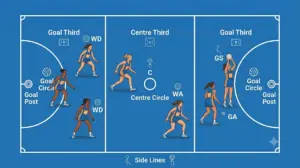
One of the tactical signatures of the McCausland-Durie era was the diamond formation in the defensive third. By positioning the Goal Keep (GK) and Goal Defense (GD) in a staggered line, they forced opposition feeders to throw high, looping balls that were easily intercepted by the Pulse's athletic defenders.
Current Roster and the 2025 Campaign
Entering the 2025 season, the Central Pulse has undergone a significant roster refresh under head coach Anna Andrews-Tasola. While the team remains anchored by world-class defender Kelly Jackson (formerly Jury) and midcourt dynamo Maddy Gordon, new faces have joined to fill the gaps left by departures and injuries. A key story for 2025 was the late addition of young defender Laura Balmer, who replaced Taneisha Tofa. The shooting circle remains one of the most accurate in the competition, featuring Amelia Walmsley, who achieved a staggering 96% shooting accuracy in recent matches.
- Head Coach: Anna Andrews-Tasola.
- Captain: Kelly Jackson.
- Shooters: Amelia Walmsley, Tiana Metuarau, Khiarna Williams.
- Midcourt: Maddy Gordon, Whitney Souness, Ainsleyana Puleiata.
- Defense: Kelly Jackson, Parris Mason, Laura Balmer.
Head Coach: Anna Andrews-Tasola.
Captain: Kelly Jackson.
Shooters: Amelia Walmsley, Tiana Metuarau, Khiarna Williams.
Midcourt: Maddy Gordon, Whitney Souness, Ainsleyana Puleiata.
Defense: Kelly Jackson, Parris Mason, Laura Balmer.
| Player | Position | Role | 2024 Highlight |
|---|---|---|---|
| Kelly Jackson | GK/GD | Captain & Stopper | Lead League in Deflections |
| Maddy Gordon | C/WA | Engine Room | Silver Ferns selection |
| Amelia Walmsley | GS | Primary Scorer | Record goal volume |
| Parris Mason | GD/WD | Disruptor | High interception count |
Integrating Youth and Experience
The 2025 strategy focuses on the "Midcourt Engine Room." With Whitney Souness and Maddy Gordon, the Pulse arguably possesses the fastest transition game in the league, allowing them to move the ball from a defensive rebound to a shot in under five seconds.
Home Grounds: TSB Bank Arena and Beyond
The Central Pulse is unique in its commitment to its wide regional catchment. While the TSB Bank Arena in Wellington's waterfront is their primary "Big Match" venue, they frequently take games to the regions. This includes regular fixtures at Te Rauparaha Arena in Porirua and Fly Palmy Arena in Palmerston North. The "Yellow Wall" of fans in Wellington provides a significant home-court advantage, often creating an atmosphere that intimidates visiting Australian or northern NZ teams. The franchise prides itself on being accessible to fans across the Manawatū and Taranaki regions, often hosting clinics and open training sessions in these areas.
- Main Venue: TSB Bank Arena, Wellington (Capacity 4,000+).
- Regional Hub: Fly Palmy Arena, Palmerston North.
- Atmosphere: Known for the "Pulse Drum Line" and vocal support.
- Attendance: Consistently among the highest in the ANZ Premiership.
Main Venue: TSB Bank Arena, Wellington (Capacity 4,000+).
Regional Hub: Fly Palmy Arena, Palmerston North.
Atmosphere: Known for the "Pulse Drum Line" and vocal support.
Attendance: Consistently among the highest in the ANZ Premiership.
| Venue | City | Frequency | Best Match |
|---|---|---|---|
| TSB Bank Arena | Wellington | Primary | 2022 Grand Final |
| Te Rauparaha Arena | Porirua | Regular | 2019 Grand Final |
| Fly Palmy Arena | Palmerston North | Special Events | Season Openers |
The "Pulse Roadshow"
By playing home games in Palmerston North and occasionally Napier, the Pulse ensures that netball remains the dominant women’s sport in the lower North Island, directly impacting participation rates in local clubs and schools.
Central Manawa: The Winning Pipeline
A major reason for the Pulse's sustained success is the strength of their reserve team, Central Manawa, which competes in the National Netball League (NNL). Central Manawa has been the most successful NNL team in the country, winning titles in 2017, 2018, 2019, and 2022. This team acts as a finishing school for elite talent, ensuring that when a Pulse player is injured or moves on, there is a replacement who is already familiar with the "Pulse Systems." Players like Parris Mason and Ainsleyana Puleiata are direct products of this successful developmental pathway.
- Affiliation: Official feeder team for the Central Pulse.
- Titles: 4 National Netball League Championships.
- Training Partners: Manawa players regularly train with the Pulse senior squad.
- Head Coach Influence: Coordinated coaching structures between Manawa and Pulse.
Affiliation: Official feeder team for the Central Pulse.
Titles: 4 National Netball League Championships.
Training Partners: Manawa players regularly train with the Pulse senior squad.
Head Coach Influence: Coordinated coaching structures between Manawa and Pulse.
| Manawa Graduate | Pulse Role | Success Metric |
|---|---|---|
| Parris Mason | Starting GD | National U21 Star |
| Ainsleyana Puleiata | Midcourt Cover | Rapid court speed |
| Amelia Walmsley | Lead GS | Premiership Top Scorer |
Bridging the Gap to Professionalism
The Manawa program is designed to mimic the professional environment of the Pulse. This includes access to the same strength and conditioning coaches and performance analysts, making the jump to the ANZ Premiership less daunting for young athletes.
Defensive Excellence: The Pulse Trademark
If there is one thing the Central Pulse is known for globally, it is their defensive prowess. From the early days of Katrina Rore to the current dominance of Kelly Jackson, the Pulse has consistently produced the league's best defenders. Their style is characterized by "hunting" the ball rather than just reacting to the shooter. This proactive defense forces turnovers in the midcourt, reducing the pressure on their own shooters. In 2024 and 2025, the combination of Jackson’s height and Parris Mason’s ground speed has made the Pulse circle the hardest to penetrate in the ANZ Premiership.
- Kelly Jackson (Jury): 1.92m frame, specialist in the "re-direct" block.
- Parris Mason: Known for "intercepting from behind" and athletic rebounds.
- Defensive Strategy: Force the ball wide to the sidelines.
- Statistical Lead: Pulse often leads the league in "Defensive Conversion Rate."
Kelly Jackson (Jury): 1.92m frame, specialist in the "re-direct" block.
Parris Mason: Known for "intercepting from behind" and athletic rebounds.
Defensive Strategy: Force the ball wide to the sidelines.
Statistical Lead: Pulse often leads the league in "Defensive Conversion Rate."
| Defensive Metric | Average (per game) | League Rank |
|---|---|---|
| Deflections | 14.2 | 1st |
| Intercepts | 8.1 | 2nd |
| Rebounds | 6.5 | 1st |
The "Jackson Effect"
Kelly Jackson’s ability to clean up missed shots is a cornerstone of the Pulse's game. Her vertical reach allows the Pulse to play a high-risk defensive game, knowing that she can often recover the ball if the initial intercept is missed.
Community Impact and Netball Central Zone
The Central Pulse is more than just a professional sports team; it is the pinnacle of a massive community network. The Netball Central Zone oversees thousands of players from grassroots to high performance. The Pulse players are active ambassadors, visiting schools from New Plymouth to Napier. This community connection ensures a steady stream of young athletes dreaming of wearing the yellow and black dress. The "Pulse Community Pulse" initiative provides funding and support for local netball centers, ensuring the sport remains affordable and accessible during economic downturns.
- Regions Supported: Taranaki, Manawatū, Whanganui, Hawke's Bay, Wellington.
- Ambassador Program: Players assigned to regional hubs.
- Grassroots Funding: Support for local coaching workshops.
- School Visits: Over 100 school visits conducted annually.
Regions Supported: Taranaki, Manawatū, Whanganui, Hawke's Bay, Wellington.
Ambassador Program: Players assigned to regional hubs.
Grassroots Funding: Support for local coaching workshops.
School Visits: Over 100 school visits conducted annually.
| Region | Engagement | Key Event |
|---|---|---|
| Taranaki | Satellite coaching | New Plymouth Clinics |
| Hawke’s Bay | Talent ID camps | Napier Pre-season games |
| Wellington | Primary venues | Capital City Clinics |
Fostering the Next Generation
The "Pulse Academy" provides specialist coaching to talented teenagers across the zone, ensuring that regional players don't have to move to Auckland to get elite-level training.
Challenges and Future Outlook
As the ANZ Premiership moves toward a new broadcasting era with TVNZ in 2026, the Pulse faces the challenge of maintaining their dominance against a resurgent Northern Mystics and a strong Mainland Tactix. The introduction of the two-point shot in 2025 was a tactical hurdle that the Pulse had to navigate, requiring their shooters to extend their range. Furthermore, the management of player workload in a condensed 10-week season is a priority for the medical staff. The long-term goal for the Pulse is not just domestic titles, but ensuring a high percentage of their roster continues to be selected for the Silver Ferns, maintaining the "Wellington hub" of international talent.
- Rule Changes: Adapting to the "Super Shot" in the final 5 minutes.
- Broadcasting: Transitioning to free-to-air coverage in 2026.
- Player Retention: Keeping stars in Wellington despite Australian interest.
- Innovation: Investing in new AI-driven performance analysis tools.
Rule Changes: Adapting to the "Super Shot" in the final 5 minutes.
Broadcasting: Transitioning to free-to-air coverage in 2026.
Player Retention: Keeping stars in Wellington despite Australian interest.
Innovation: Investing in new AI-driven performance analysis tools.
| Challenge | Mitigation Strategy |
|---|---|
| Long-range shooting | Specialized training for Metuarau and Williams |
| Season Intensity | Rotating Manawa players into the bench |
| Financial Sustainability | Increasing regional corporate sponsorships |
The 2026 Vision
The Pulse management has already begun scouting for the 2026 season, with a focus on securing the signatures of their "Core Four" players early. The goal is to build a roster that can withstand the physical demands of the new, faster league format.
Recognition and Individual Honors
The Central Pulse has been a "factory" for individual awards. In 2018, Katrina Rore was named ANZ Premiership Player of the Year, a title that Kelly Jury (Jackson) also secured in 2022. Maddy Gordon's rise was recognized in 2023 when she took home the top honor. These awards reflect the team's philosophy that individual brilliance is a byproduct of team systems. The franchise has also been a regular winner at the Wellington Sportsperson of the Year awards, cementing their status as the city's most successful professional sports team.
- MVP Winners: Katrina Rore, Kelly Jackson, Maddy Gordon.
- Coach of the Year: Yvette McCausland-Durie (Multiple).
- Silver Ferns Graduates: Ameliaranne Ekenasio, Aliyah Dunn, Claire Kersten.
- Wellington Sports Awards: Multiple "Team of the Year" titles.
MVP Winners: Katrina Rore, Kelly Jackson, Maddy Gordon.
Coach of the Year: Yvette McCausland-Durie (Multiple).
Silver Ferns Graduates: Ameliaranne Ekenasio, Aliyah Dunn, Claire Kersten.
Wellington Sports Awards: Multiple "Team of the Year" titles.
| Year | Award | Recipient |
|---|---|---|
| 2018 | Player of the Year | Katrina Rore |
| 2022 | Player of the Year | Kelly Jury |
| 2023 | Player of the Year | Maddy Gordon |
A Legacy of Leadership
The Pulse captains have always been leaders in the wider netball community. Katrina Rore’s 11-year tenure set a standard for loyalty and excellence that Kelly Jackson now continues, ensuring the "Pulse DNA" remains intact for years to come.
Final Thoughts
The Central Pulse is a testament to the power of regional identity and tactical innovation. From the winless days of 2008 to the championship glory of the 2020s, the franchise has consistently evolved to meet the demands of professional netball. Their commitment to the "Netball Central" pipeline ensures that the future of the team is in safe hands, with a steady stream of talent ready to step into the famous yellow-and-black dress. As the ANZ Premiership enters a new chapter, the Pulse remains the standard-bearer for how to build a sustainable, winning culture in New Zealand sport.
FAQ
Where is the Central Pulse based? The team is based in Wellington, New Zealand, but represents the wider Central Zone.
Who is the current coach of the Central Pulse? Anna Andrews-Tasola is the current head coach for the 2025 season.
How many ANZ Premiership titles have the Pulse won? They have won three titles: 2019, 2020, and 2022.
What is the name of their reserve team? Their reserve team is called Central Manawa, which competes in the National Netball League.
Who is the captain of the Pulse? Kelly Jackson (formerly Kelly Jury) is the captain of the team.
What are the team's primary colors? The Central Pulse plays in yellow and black.
Which arena is their main home ground? Their primary home ground is the TSB Bank Arena in Wellington.
Who was the Pulse coach during their first two title wins? Yvette McCausland-Durie was the head coach during the 2019 and 2020 championship seasons.
Does the Pulse play games outside of Wellington? Yes, they regularly play home matches in Palmerston North and Porirua.
What was the Pulse's record in the very first ANZ Championship season? They famously finished the 2008 season with 0 wins and 12 losses.