Netball is the most-played women’s sport in New Zealand, yet many people who played it at school never learned where the game came from or why some of its rules are so unusual.
Below are 30 netball facts, each checked against official sources, covering the sport’s origins, its rulebook, its equipment and its place in Aotearoa.
How netball began
From basketball to netball
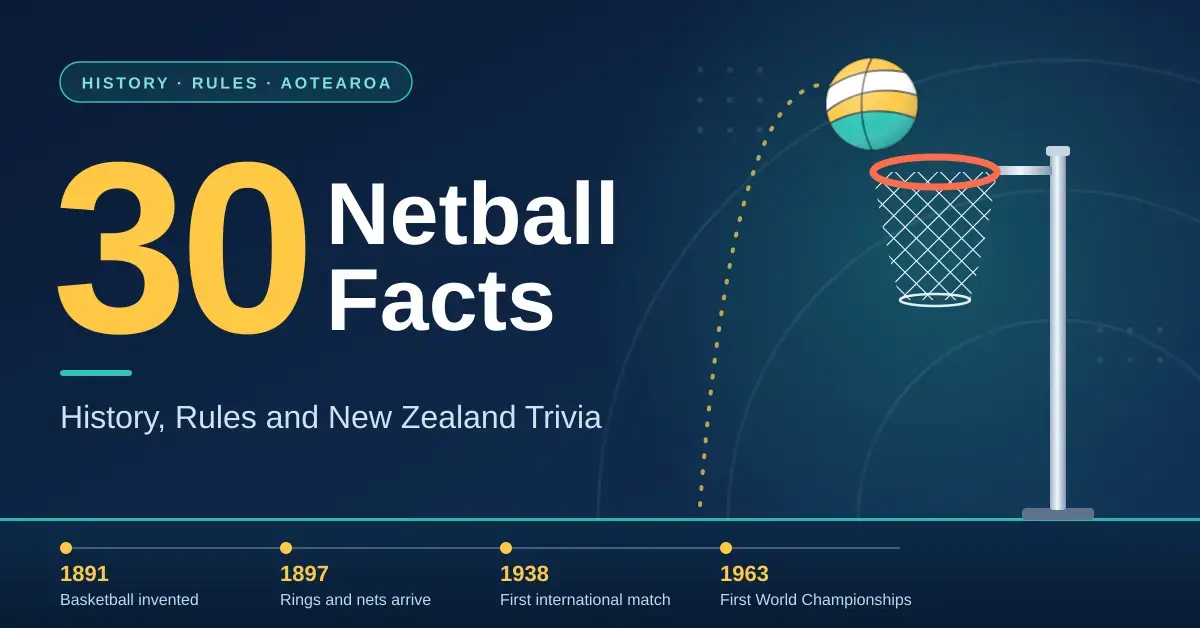
| Year | What happened |
|---|---|
| 1891 | James Naismith invents basketball in Springfield, Massachusetts |
| 1892 | Senda Berenson adapts the rules for women at Smith College |
| 1895 | Dr Justin Toles teaches the game at Madame Österberg’s college, using wastepaper baskets as goals |
| 1897 | Rings and nets replace baskets; the court is divided into thirds; the name “net ball” appears |
| 1901 | The first written rules are published in England |
| 1938 | The first international match: Australia 40, New Zealand 11, in Melbourne |
| 1960 | International federation founded to standardise the rules |
| 1963 | First World Championships, Eastbourne, England — Australia win |
| 1967 | New Zealand win their first world title in Perth, unbeaten |
| 1998 | Netball debuts as a Commonwealth Games medal sport in Kuala Lumpur |
| 2021 | The world governing body is renamed World Netball |
| 2026 | Silver Ferns win Commonwealth Games gold in Glasgow, beating Jamaica 56–48 |
1. Netball is a descendant of basketball. James Naismith invented basketball in Springfield, Massachusetts, in 1891, and within a year Senda Berenson had adapted it for women at Smith College.
2. In 1893 Martina Bergman-Österberg returned from a visit to the United States and informally introduced a version of basketball to her students at her physical training college in England.
3. In 1895 an American, Dr Justin Toles, visited Madame Österberg’s Physical Training College at Hampstead and taught the students basketball indoors. There were no printed rules and no lines, circles or boundaries — the goals were two wastepaper baskets hung on the walls.
4. Österberg’s own 1895 report records that the baskets were hung about seven or eight feet high, that play was entirely with the hands, and that no player could hold the ball for more than five seconds.
5. Substantial revisions followed a visit in 1897 from another American teacher, Miss Porter of Baltimore. By then the sport had acquired the name “net ball” to reflect the change from baskets to rings and nets, and it was played on outdoor grass courts divided into three parts with a larger ball.
The zoning myth, corrected
6. A popular story claims netball’s zones came from an Englishman misreading a diagram. The misreading did happen, but on the other side of the Atlantic. Clara Baer, a sports teacher in New Orleans, wrote to Naismith asking for a copy of the rules. The package contained a court drawing with lines pencilled across it, simply to show the areas various players could best patrol — but Baer thought players could not leave those areas, and in 1899 her mistake was written into the rules of women’s basketball as zones.
If you want the fuller story, our guide to who invented netball traces the sport’s separation from basketball in more detail.
Going international
7. During an Australian tour of England in 1957, discussions began about standardising the rules, leading to representatives from England, Australia, New Zealand, South Africa and the West Indies meeting in Sri Lanka in 1960 to establish the International Federation of Women’s Basketball and Netball.
8. That body, later the International Federation of Netball Associations, was rebranded as World Netball in 2021.
9. The first World Netball Championships were held in Eastbourne, England, from 2 to 14 August 1963, with eleven teams. Australia won all their matches to become the inaugural champions, ahead of New Zealand.
10. New Zealand’s test debut came much earlier — on 20 August 1938 against Australia at Royal Park, Melbourne. Australia won 40–11. It was the first netball test between the two countries and the world’s first international netball match.
The rules that set netball apart
Netball’s rulebook is what makes the sport look so different from basketball. Nobody dribbles, nobody runs with the ball, and every player is confined to part of the court.
11. Only two of the seven players on court may shoot: the goal shooter (GS) and the goal attack (GA), and only from inside the goal circle. Our guide to netball positions explains what each of the seven does.
12. A player holding the ball has three seconds to pass or shoot. Holding it longer gives the opposition a free pass.
13. A defender must be at least 0.9 metres (three feet) from the attacker’s landing foot before defending the ball. Any closer and it is obstruction.
14. There is no dribbling and no self-pass. You cannot bounce the ball to yourself to get past a defender.
15. Every player is restricted to certain thirds of the court. Straying into an area you are not allowed in is “offside” — and it counts even if you never touch the ball. A wing attack, for example, may work in the goal third but must stay out of the goal circle.
16. There is no backboard. Because nothing is there to deflect a near miss in, netball shooting rewards a soft, high arc rather than power.
17. Umpires check jewellery and fingernails before play for safety reasons. Nails must be short enough not to snag or scratch in a contest.
The two-point shot
18. Netball New Zealand introduced a two-point shot to the ANZ Premiership in 2025, active in the final five minutes of each quarter to reward long-range shooting.
19. In the ANZ Premiership a shooter must be at least 3.5 metres from the goalpost for the shot to count double — the same distance as Fast5 — while in Suncorp Super Netball and the UK competition the zone starts at three metres.
20. Australia’s Suncorp Super Netball introduced its version five years earlier, before the 2020 season.
Our full netball rules guide covers the rest of the rulebook in detail.
Court, ball and equipment
Netball by the numbers
| Goalpost height | 3.05 m (10 ft) |
| Ring internal diameter | 380 mm |
| Goal circle radius | 4.9 m |
| Court line width | 50 mm |
| Size 5 ball circumference | 690–710 mm |
| Size 5 ball weight | 400–450 g |
| Time allowed on the ball | 3 seconds |
| Minimum defending distance | 0.9 m (3 ft) |
| Players on court per team | 7 (only GS and GA may shoot) |
| ANZ Premiership two-point zone | From 3.5 m out, last 5 minutes of each quarter |
21. A senior goalpost stands 3.05 metres (10 feet) high, measured to the top of the ring — the same height as a basketball hoop, but with no backboard behind it.
22. The ring has an internal diameter of 380 mm, which is only about twice the diameter of the ball itself. There is far less margin for error than the numbers suggest.
23. The goal circle is a semi-circle with a 4.9-metre radius, marked from the midpoint of the goal line.
24. All court lines are 50 mm wide and count as part of the area they enclose.
25. A size 5 match ball measures 690–710 mm in circumference and weighs 400–450 grams.
For the full measurements, see our netball court dimensions guide. The complete specifications for posts, courts and balls are set out in World Netball’s facilities and equipment guidelines.
Netball in New Zealand
26. The Silver Ferns have been world champions five times and are regularly ranked number two in the World Netball rankings.
27. New Zealand’s first world title came in 1967. Coached by Taini Jamison and captained by Judy Blair, the team won all seven of its matches at the championships in Perth, sealing gold with a 40–34 win over Australia. Jamison was the first Māori coach of the New Zealand netball team, and the Taini Jamison Trophy was established in her honour in 2008.
28. Dame Lois Muir coached the Silver Ferns for 15 years from 1974 to 1988, winning World Championships gold in 1979 — shared with Australia and Trinidad and Tobago — and again in 1987. She finished with 91 wins, 10 losses and six draws from 107 tests.
29. Netball has a high rate of serious knee and ankle injuries, which prompted ACC and Netball New Zealand to develop the NetballSmart injury-prevention programme. ACC states that a good warm-up programme like NetballSmart can reduce ACL injuries by up to 50%. The official warm-up takes 15 to 20 minutes and is designed to be done two to three times a week.
Background on the national side is on our Silver Ferns page.
Commonwealth Games gold in 2026
30. On 2 August 2026 the Silver Ferns beat Jamaica 56–48 in Glasgow to win Commonwealth Games gold, ending a 16-year drought and finishing the tournament undefeated in seven games. It was New Zealand’s third Commonwealth title, one behind four-time champions Australia, who took the 2026 bronze after a shock semi-final loss to Jamaica.
Netball was played as a demonstration sport at Auckland 1990 before making its official Commonwealth Games debut at Kuala Lumpur in 1998, and has featured at every Games since. Jamaica’s runner-up finish in 2026 was their second in a row, extending their wait for a first gold.
Netball around the world
| Measure | Current position |
|---|---|
| Countries playing netball | More than 100 |
| National associations affiliated to World Netball | 76, across five regions |
| Teams at the Glasgow 2026 Commonwealth Games | Top 12 ranked nations, 38 matches |
| 2026 Commonwealth Games medallists | Gold: New Zealand · Silver: Jamaica · Bronze: Australia |
| Next Netball World Cup | Sydney, 2027 (16 teams) |
| Olympic status | IOC-recognised since 1995; campaigning for Brisbane 2032 |
Netball is played in more than 100 countries, with 76 national netball associations affiliated to World Netball, grouped into five regions.
Glasgow 2026 featured the top 12 ranked netball nations, determined by the World Netball rankings on 1 September 2025, across 38 matches at the Hydro. Tonga made a historic debut at those Games, having climbed as high as seventh in the world rankings by 2023.
World Netball has also launched a Brisbane 2032 Olympic campaign alongside Netball Australia, and the next Netball World Cup will be held in Sydney in 2027 with 16 teams. Our Netball World Cup guide covers the tournament’s history.
Men’s and mixed netball
The New Zealand men’s national team is nicknamed the Net Blacks and represents the New Zealand Men’s and Mixed Netball Association in competitions including the Trans-Tasman Cup and the Men’s Fast5 Netball World Series.
New Zealand won the inaugural Men’s Fast5 Netball World Series in Christchurch in 2022, beating Australia 29–25 in the final, and retained the title in 2023 with a 51–34 win over Australia.
Getting started in netball in New Zealand
Netball New Zealand runs an entry-level programme called Woolworths futureFERNS, a modified version of the game that introduces children to the sport in stages before they move up to the full seven-a-side format.
From there, most players join a local centre, which organises graded competitions by age and ability. The North Canterbury Netball Centre is one example: its want-to-play guide sets out grades, playing days and venues, while separate pages cover Year 7 and 8 competition information and season dates and the Year 5 and 6 draw and court-duty requirements. Older players can follow the open grade and senior representative fixtures, and each centre publishes its committee and contact details for anyone wanting to register a team.
This article is for factual and informational purposes only. Rules, competition formats and records change between seasons — for the current official rulebook and competition regulations, check World Netball and Netball New Zealand. The facts on this page were verified in September 2026.
Reference sources
- World Netball — regions and member associations
- Glasgow 2026 Commonwealth Games — netball
- 1News — Silver Ferns end Commonwealth Games gold drought
- NZ Herald — Silver Ferns crowned Commonwealth Games champions
- ANZ Premiership — 2025 rule innovations (two-point shot)
- ACC SportSmart — warm-up and injury prevention
- Silver Ferns — 2019 Netball World Cup win
- Netball World Cup Sydney 2027 — official site
- World Netball — Fast5 Netball World Series
Frequently Asked Questions (FAQ)
Who invented netball?
No single person did. Netball grew out of basketball, which James Naismith invented in 1891. Senda Berenson adapted it for women in 1892, Dr Justin Toles introduced it at Madame Österberg’s college in England in 1895, and further changes over the following years turned it into a separate sport called “net ball”.
Why can’t you run with the ball in netball?
The footwork rule was part of the early adaptations that made the game less physically demanding and less collision-heavy than basketball. It shifted the emphasis onto passing and positioning, and it is now the defining feature of how netball looks and flows.
How many countries play netball?
Netball is played in more than 100 countries, and 76 national associations are affiliated to World Netball across five regions.
How high is a netball hoop?
A senior netball goalpost is 3.05 metres high, measured to the top of the ring. The ring itself has an internal diameter of 380 mm and there is no backboard.
How many Netball World Cups have the Silver Ferns won?
Five. Their first came in 1967 in Perth under coach Taini Jamison, and their most recent was in 2019 in Liverpool.
Is netball an Olympic sport?
Not yet. Netball has been recognised by the International Olympic Committee since 1995 but has never been on the Olympic programme. World Netball and Netball Australia are campaigning for inclusion at the Brisbane 2032 Games.
What is the two-point shot in netball?
It is a rule used in some professional leagues where a goal scored from long range counts double. In the ANZ Premiership it applies in the final five minutes of each quarter, from at least 3.5 metres out from the post.