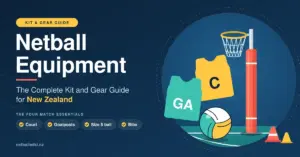
Netball asks for less gear than almost any comparable team sport. A marked court, two padded goalposts, one match ball and a set of positional bibs for each team is enough to run a full game. Everything beyond that is optional training kit.
The complications are in the detail: getting the specifications right, knowing what is genuinely worth buying, and looking after it so it lasts a season of New Zealand winter netball. This guide walks through the compulsory equipment, the regulation numbers, the age-appropriate gear for juniors, and the training and safety extras that actually earn their place in the kit bag.
What you actually need to play
To run an official match you need only four things: a court with regulation line markings, two padded goalposts, a compliant size 5 match ball, and a set of seven positional bibs for each team. Everything else — pumps, cones, ladders, first aid — is training or support equipment rather than a requirement to take the court.
It helps to split the kit into two groups. Fixed assets — the posts, ground sockets and painted court lines — are almost always the responsibility of the council, school or netball centre that owns the venue. The portable gear — balls, bibs, a pump, cones and a first aid kit — travels with the team and is the coach’s or manager’s responsibility. The table below sets out the regulation figures every buyer should check against.
Regulation Specifications
| Item | Specification |
|---|---|
| Match ball (size 5) | 690–710mm circumference, 400–450g |
| Ball inflation | About 10 psi (check the maker’s recommendation) |
| Goalpost height | 3.05m to the top of the ring |
| Post diameter | 65–100mm |
| Post padding | No more than 50mm thick, full length of the pole |
| Ring | 380mm internal diameter, 15mm steel rod |
| Ring projection | 150mm horizontal bar from the front of the post |
| Net | 380–457mm long, open at both ends |
| Bib lettering | 150mm high, front and back, above the waist |
| Court lines | 50mm wide |
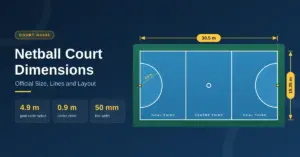
These numbers come straight from World Netball’s Rules of Netball, which govern the game in New Zealand. If you are fitting out a permanent court, our netball court dimensions guide covers the line markings and playing areas in full.
The match ball
A senior match ball is a size 5: between 690mm and 710mm in circumference and weighing 400 to 450 grams. That is the ball used across adult and senior competition worldwide, from club grades to the ANZ Premiership and the Silver Ferns.
Junior grades use smaller, lighter balls so young players can grip, pass and shoot without straining technique. The Woolworths futureFERNS pathway run by Netball New Zealand scales the ball, the goal height and the game format to each age band, as the table shows.
Netball Gear by Age Group
| Year group | Ball | Goal height | Format |
|---|---|---|---|
| Years 1–2 | 20cm grip ball | Up to 2.1m | 4 v 4, one third of the court |
| Years 3–4 | Size 4 | Up to 2.6m | 5 v 5, two thirds of the court |
| Years 5–6 | Size 4 | Up to 2.6m | 6 v 6, full court |
| Years 7–8 | Size 5 | 3.05m | 7 v 7, full court |
| Years 1–2 players get five seconds to pass or shoot, and passers and shooters are not defended. Netball New Zealand has confirmed changes to the Year 5–6 format from 2027, so treat this as the 2026 pathway. | |||
Because most New Zealand club netball is played outdoors through winter, durability and wet-weather grip matter more here than in countries where the game is mostly indoors. Match-grade balls hold their shape and surface grain far longer than budget training balls, which is why most clubs keep the two apart: cheaper training balls for high-volume drill work, and a dedicated match ball or two set aside for game day. Weighted training balls also exist for short-range passing work with senior squads, but they are specialist gear rather than a standard kit item.
Bibs and positional markers
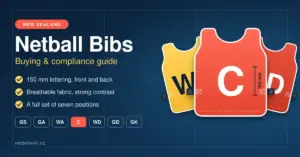
Every player wears a bib showing one of the seven positions: GS, GA, WA, C, WD, GD and GK. The lettering must be 150mm high, clearly visible, and worn above the waist on both the front and the back so umpires and opponents can read a player’s position from either side.
There are two common styles. Elasticated side-strap vests pull on over winter layers and cope well with changing rosters, since one set fits a range of body sizes. Hook-and-loop (Velcro) patches attach to fitted playing dresses for a tidier look at club and representative level. Reversible training pinnies are handy for intra-squad games but are not a legal substitute for compliant bibs in a graded match.
A practical tip: darker base colours hide court dirt, grass stains and sunscreen marks over a long season, and printed initials wear better than cheap iron-on letters. Our netball bibs buying guide covers sizing, colours and team sets in detail, and the netball rules guide explains how the seven positions move around the court.
Goalposts, rings and nets
A regulation goalpost is a vertical metal pole 65 to 100mm in diameter standing 3.05m high, wrapped in padding of uniform thickness no more than 50mm thick running the full length of the pole. The ring is steel rod 15mm in diameter with an internal diameter of 380mm, attached to a horizontal bar 150mm long that projects from the front edge at the top of the pole. The net must be clearly visible, open at both the top and the bottom, and between 380mm and 457mm long.
Unlike basketball, netball has no backboard — the shot has to drop cleanly through the ring. The post sits at the mid-point of each goal line with the back of the pole level with the outer edge of the line. Our netball hoop guide breaks down every part of the ring, post and net.
Portable posts, sockets and adjustable heights
For multi-use halls and school courts, ground sockets let posts be lifted out and stored when the space is needed for other sports. Freestanding posts with weighted bases are an alternative where you cannot cut sockets into the surface, though they take up more room behind the goal line. Adjustable-height posts are worth the extra outlay where one venue serves several junior grades, since a single post can be set at 2.1m for Years 1–2, 2.6m for Years 3–6, and 3.05m for full-size play.
Training equipment
Netball is built on acceleration, deceleration, changing direction and landing, so most training gear targets footwork and reaction speed rather than endurance. The useful items are inexpensive and portable:
- Agility ladders develop foot placement and quick-step patterns for evasion and repositioning.
- Cones and markers define drill pathways and, usefully with young teams, teach players to hold their court positions instead of swarming the ball.
- Mini hurdles train knee drive and clean, balanced landings — directly relevant to injury prevention.
- Rebound nets return the ball at unpredictable angles for reaction, catching and interception work when you are short of training partners.
None of this is essential. A ball, a wall and a handful of cones will run most sessions perfectly well. Our netball drills guide and passing drills guide set out session structures that need very little equipment at all.
Safety and injury-prevention gear
Netball carries a high rate of serious knee and ankle injuries, which is why ACC and Netball New Zealand developed the NetballSmart injury-prevention programme. ACC reports that a warm-up like NetballSmart, done two to three times a week, can reduce ACL (anterior cruciate ligament — a key knee ligament) injuries by up to 50%. No piece of equipment substitutes for that warm-up, but a few items do genuinely reduce risk:
- Court shoes. Netball-specific shoes are built for lateral movement, sudden stops and ankle support rather than forward running. On sealed outdoor courts this matters more, not less. Our netball shoes guide explains what to look for, and the kids’ netball shoes guide covers fitting for juniors.
- Post padding. Required for both match and training play, and one of the few genuinely non-negotiable safety items — players contest the ball at speed right under the post.
- Ankle support. Braces or strapping tape for players with a history of ankle injuries, ideally used on the advice of a physiotherapist rather than fitted by default.
- A stocked first aid kit. Ice packs, bandages, strapping tape and plasters at a minimum, kept in the manager’s bag.
- Nail clippers. Fingernails must be short and smooth, and jewellery is not permitted except a plain wedding ring or a medical-alert bracelet, which must be taped. A pair of clippers on hand saves a player being stood down at the pre-game check.
Caring for balls, nets and posts
Ball care is where most clubs quietly lose money. A little maintenance keeps a good ball performing for years, and the table below sums up the basics.
| Do | Don’t |
|---|---|
| Inflate to around 10 psi (check the maker’s figure on the ball) | Over-inflate — the ball may not return to shape |
| Use a hand or stirrup pump with a pressure gauge | Use a compressor or airline, which cause over-inflation |
| Moisten the needle with a drop of glycerine first | Force a dry or damaged needle into the valve |
| Pull the ball gently into shape before inserting the needle | Insert the needle while the ball is folded or flat |
| Check pressure before each use | Assume it held air — performance bladders lose pressure over about 5–7 days |
| Store in a ventilated bag, away from temperature extremes | Stack weight on balls or sit on them |
| Wipe clean with water | Use solvents or strong detergents, which strip the grip grain |
Netballs should sit at roughly 10 psi — much lower and the ball is too soft to perform, much higher and it risks going permanently out of shape. Manufacturers note that performance bladders hold air for only around five to seven days, so pressure needs topping up and checking before each use. Avoid leaning heavy objects against balls or storing inflated balls in an uninsulated shed through hot summers and cold winters, both of which shorten their life.
Nets are cheap and perish faster than posts, so keep spares. A frayed or knotted net makes it genuinely harder for scorers and umpires to confirm whether a shot dropped through cleanly, so replace them the moment they start to snag the ball.
Buying for a club or school
Bundled team packs from sports-equipment suppliers are usually more economical than buying items one by one. A typical pack combines a mesh ball sack, a set of training balls, one or two match balls, a full bib set, a pump with a gauge and a whistle — enough to kit out a single team for a season. When you are comparing suppliers, check the ball grade (match versus training), whether the bibs are a compliant lettered set rather than plain pinnies, and whether the pump includes a gauge.
Buying at centre or club scale often unlocks better pricing again, and lets you standardise ball brands and bib colours across grades. It is also worth confirming who is responsible for the fixed assets — councils, schools and netball centres generally own and maintain the posts, sockets and court lines, so a club’s budget can focus on the portable kit that wears out.
Sources
Frequently Asked Questions
What is the official size and weight of a netball?
A senior match ball is a size 5, measuring 690mm to 710mm in circumference and weighing 400 to 450 grams. Juniors use smaller balls: a 20cm textured grip ball in Years 1–2 and a size 4 through Years 3–6, before moving to size 5 from Year 7.
How high should a netball goalpost be?
A full-size regulation goalpost stands 3.05m to the top of the ring. Junior heights are lower under the futureFERNS pathway — set no higher than 2.1m for Years 1–2 and up to 2.6m for Years 3–6 — before players step up to the full 3.05m from Year 7.
What is the minimum equipment needed to play a netball match?
Four things: a court with regulation line markings, two padded goalposts, a compliant size 5 match ball, and a set of seven positional bibs for each team. The court and posts are usually provided by the venue, while balls and bibs travel with the team.
Do I need netball-specific shoes?
They are strongly recommended rather than compulsory. Netball shoes are built for the sudden stops, lateral movement and ankle support the game demands, which running shoes are not designed for. That support matters even more on hard outdoor courts.
How should I look after a netball?
Inflate it to around 10 psi using a hand pump with a gauge, moisten the needle before inserting it, and check the pressure before every use since bladders lose air over five to seven days. Store balls in a ventilated bag away from temperature extremes, keep weight off them, and clean them with water only.