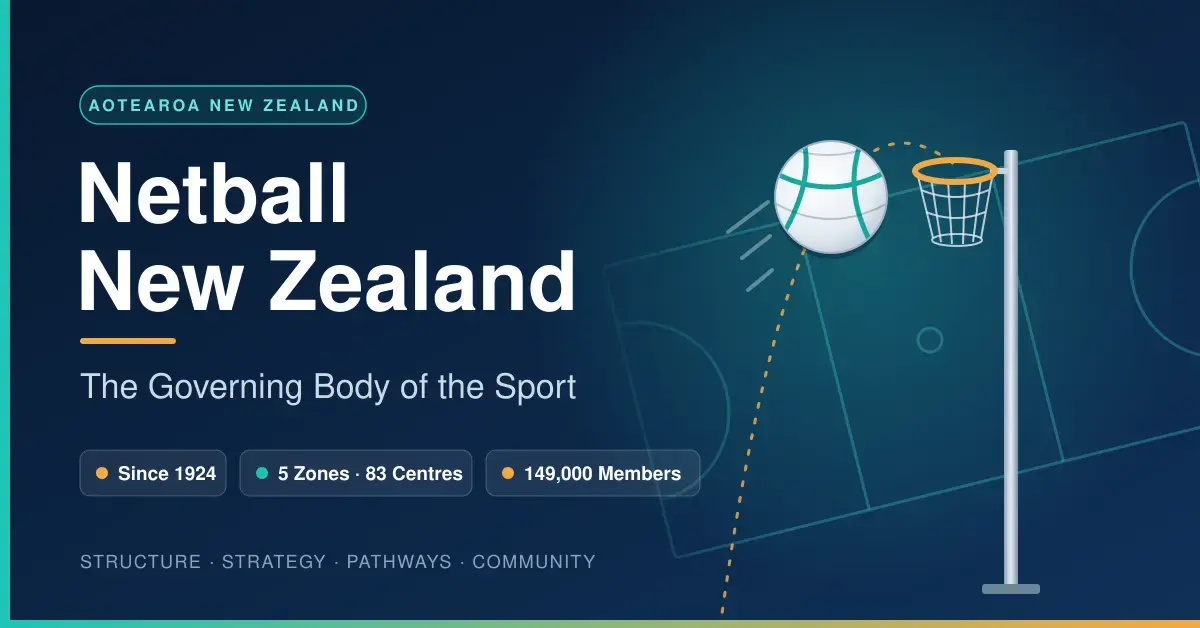
Netball New Zealand (NNZ) is the national governing body responsible for the growth, development, and high-performance success of netball across Aotearoa. Founded in 1924, the organization oversees a massive ecosystem that includes over 149,000 registered members and 300,000 annual participants, making it the most popular sport for women in the country. From the grassroots "futureFERNS" program to the world-champion Silver Ferns, Netball NZ manages the strategic direction of the game, including the elite ANZ Premiership and the National Netball League (NNL). This article provides an in-depth exploration of the organization’s history, its "Poipoiā" strategic framework, the high-performance pathways for athletes and coaches, and the community initiatives that keep the sport vibrant. We include comprehensive tables on national tournament structures, player development metrics, and a detailed look at the governance responsible for sustaining New Zealand’s global netball dominance.
The Founding and Legacy of Netball New Zealand
Netball New Zealand was established in 1924 as the New Zealand Basketball Association, reflecting the sport's early identity as "women's basketball." For decades, the game was played under varying local rules until 1961, when international rules were adopted and the sport was officially renamed Netball. This transition was a pivotal moment, allowing New Zealand to compete on the global stage and leading to the Silver Ferns' inaugural World Championship win in 1967. Over the past century, NNZ has evolved from a volunteer-led association into a sophisticated professional organization that balances elite performance with a deep commitment to community wellbeing. The organization’s headquarters in Auckland serves as the nerve center for five regional Zones (Northern, Waikato Bay of Plenty, Central, Mainland, and Southern) which execute NNZ’s national strategy at a local level.
- Founded: 1924 (Originally NZ Basketball Association).
- Official Name Change: 1970 (From Basketball to Netball).
- Current CEO: David Cooper (Acting, as of early 2026).
- Structure: 5 Zones and over 80 Netball Centres nationwide.
- Core Mission: Connecting and inspiring communities through Netball.
Founded: 1924 (Originally NZ Basketball Association).
Official Name Change: 1970 (From Basketball to Netball).
Current CEO: David Cooper (Acting, as of early 2026).
Structure: 5 Zones and over 80 Netball Centres nationwide.
Core Mission: Connecting and inspiring communities through Netball.
| Milestone | Year | Significance |
|---|---|---|
| First National Tournament | 1926 | Established competitive domestic netball |
| International Rules Adopted | 1961 | Synchronized NZ play with the world |
| First World Title | 1967 | Silver Ferns win Gold in Perth |
| ANZ Premiership Launch | 2017 | Created a purely domestic professional league |
Transition to Professionalism
The 1990s and 2000s saw a massive shift as Netball NZ moved toward a professional franchise model. This period introduced the National Bank Cup and later the trans-Tasman ANZ Championship, which professionalized the sport and increased media visibility. Read more in Wikipedia.
The Poipoiā Strategic Framework (2024–2027)
In late 2025, Netball New Zealand launched the "Poipoiā" Growth and Development Strategy, a multi-faceted plan designed to revitalize the sport in the post-pandemic era. The strategy focuses on four key pillars: strengthening the competitive edge of the Silver Ferns, fostering massive community participation, accelerating digital transformation, and ensuring cultural diversity through a genuine commitment to Te Tiriti o Waitangi. Poipoiā, which translates to "nurture" or "care for," reflects NNZ’s shift toward a more holistic view of the athlete, prioritizing mental health and wellbeing alongside physical performance. This strategy also aims to address the challenge of competing sports like women's rugby and cricket by modernizing the netball "product" for younger audiences.
- Strategic Goal 1: Increase participation in underrepresented and rural communities.
- Strategic Goal 2: Sustain world-class performance across all national squads.
- Strategic Goal 3: Elevate coaching and officiating through digital learning platforms.
- Strategic Goal 4: Deepen commercial partnerships to ensure financial sustainability.
Strategic Goal 1: Increase participation in underrepresented and rural communities.
Strategic Goal 2: Sustain world-class performance across all national squads.
Strategic Goal 3: Elevate coaching and officiating through digital learning platforms.
Strategic Goal 4: Deepen commercial partnerships to ensure financial sustainability.
| Pillar | Focus Area | Key Initiative |
|---|---|---|
| Participation | Grassroots | Expansion of the Mother Earth futureFERNS |
| Performance | Elite | Alignment with High Performance Sport NZ (HPSNZ) |
| Digital | Technology | Launch of the “Sport Tutor” online learning hub |
| Culture | Diversity | Integration of Te Reo Māori in national events |
Modernizing the Fan Experience
A major component of the Poipoiā strategy is "Netball 2.0," which explores shorter game formats and improved digital streaming options. By making the sport more accessible on mobile devices, NNZ hopes to maintain its status as the number one choice for young female athletes in New Zealand.
High Performance: The Silver Ferns and Development Squads
The Silver Ferns are the crown jewel of Netball New Zealand. As one of the most successful sports teams in Aotearoa’s history, their performance is a key metric for NNZ’s success. The organization manages a tiered high-performance system that begins with the National Development Camp (NDC) for Year 11 and 12 students and peaks with the Silver Ferns squad. Between these levels lies the Silver Ferns Development Squad (formerly the NZA team) and the New Zealand U21 squad. These teams ensure that there is a constant "conveyor belt" of talent ready to step onto the international court. NNZ provides these athletes with world-class support, including sports science, nutrition, and performance analysis, often in partnership with High Performance Sport NZ.
- National Teams: Silver Ferns, SF Development, NZ U21, NZ Secondary Schools.
- Talent ID: Regional spotters monitor every ANZ Premiership and NNL match.
- Fitness Standards: Non-negotiable levels (e.g., 14.5+ Yo-Yo test) for selection.
- Player Profiles: Detailed benchmarks for technical and tactical skill at every position.
National Teams: Silver Ferns, SF Development, NZ U21, NZ Secondary Schools.
Talent ID: Regional spotters monitor every ANZ Premiership and NNL match.
Fitness Standards: Non-negotiable levels (e.g., 14.5+ Yo-Yo test) for selection.
Player Profiles: Detailed benchmarks for technical and tactical skill at every position.
| Squad Tier | Target Age | Competition Focus |
|---|---|---|
| Silver Ferns | Open | Netball World Cup, Commonwealth Games |
| NZ Development | Open | International “A” Series, Fast5 |
| NZ U21 | Under 21 | World Youth Cup (Held every 4 years) |
| NZSS | Year 11–13 | International Secondary School Series |
The "Fit-for-Purpose" Mandate
Under current high-performance protocols, players must be "fit-for-purpose" to be eligible for the black dress. This means athletes are not only tested on their netball skills but also on their ability to handle the physiological demands of international play, which has become faster and more physical in the last decade.
Domestic Pathways: ANZ Premiership and NNL
Netball NZ oversees the two most important domestic leagues: the ANZ Premiership (the top professional tier) and the National Netball League (the feeder competition). The ANZ Premiership features six regional franchises (Mystics, Stars, Magic, Pulse, Tactix, and Steel) and is the primary showcase for talent. The NNL is vital for the development of "training partners" who can be called up to the Premiership at any time. This structure ensures that players are "battle-hardened" before they reach the international level. NNZ manages the salary caps, scheduling, and broadcast rights for these leagues, ensuring a balanced and competitive environment across all five zones.
- ANZ Premiership: 6 teams, 10-week regular season (starting 2025).
- NNL (National Netball League): 6 teams affiliated with Premiership franchises.
- Player Movement: Clear protocols for "Import" players and regional transfers.
- Broadcasting: Sky Sport NZ (Primary) with TVNZ (Free-to-Air from 2026).
ANZ Premiership: 6 teams, 10-week regular season (starting 2025).
NNL (National Netball League): 6 teams affiliated with Premiership franchises.
Player Movement: Clear protocols for "Import" players and regional transfers.
Broadcasting: Sky Sport NZ (Primary) with TVNZ (Free-to-Air from 2026).
| Franchise | Zone | NNL Affiliate | Home City |
|---|---|---|---|
| Northern Mystics | Northern | Northern Marvels | Auckland |
| Central Pulse | Central | Central Manawa | Wellington |
| Mainland Tactix | Mainland | Mainland Hellers | Christchurch |
| Southern Steel | Southern | Southern Blast | Invercargill |
Strengthening the Franchise System
NNZ works closely with the five Zone boards to ensure that each franchise is financially viable. By providing central funding and managing the "contracting window," NNZ prevents a single team from stockpiling all the national talent, which keeps the domestic league exciting for fans.
Community Netball: futureFERNS and Grassroots
The foundation of Netball NZ is the "Mother Earth futureFERNS" program, which is designed for children from Year 1 to Year 8. This program replaced traditional 7-a-side netball for younger ages with modified games (4v4, 5v5, and 6v6) to ensure higher engagement and skill development. By using smaller balls, lower hoops, and fewer players, children get more "touches" of the ball and develop better spatial awareness. NNZ provides comprehensive resources for volunteer coaches at this level, recognizing that the first experience a child has with netball will determine if they stay in the sport for life. In 2025, NNZ expanded this to include the "Social Netball" initiative for adults, focusing on fun and fitness over strict competition.
- Year 1–2: Focus on fundamental movement and 4v4 play.
- Year 3–4: Introduction to 5v5 with modified equipment.
- Year 5–6: Transition to 6v6 on a full-sized court.
- Year 7–8: 7v7 play with an emphasis on tactical positioning.
Year 1–2: Focus on fundamental movement and 4v4 play.
Year 3–4: Introduction to 5v5 with modified equipment.
Year 5–6: Transition to 6v6 on a full-sized court.
Year 7–8: 7v7 play with an emphasis on tactical positioning.
| Category | Age Group | Focus Area |
|---|---|---|
| Junior | Year 1–8 | Fun, engagement, and skill acquisition |
| Secondary | Year 9–13 | Competitive club and school play |
| Open | 18+ | Professional, social, and walking netball |
The Role of Volunteer Coaches
NNZ recognizes that without volunteers, the sport would collapse. They offer the "Community Coach Award" (CCA) levels 1 and 2, which are accessible online and through local workshops. These courses teach parents and teachers how to deliver a "player-centered" coaching approach.
Coaching and Officiating Pathways
Netball New Zealand is responsible for the accreditation of every coach and umpire in the country. The "NNZ Coaching Framework" provides a clear ladder from junior coaching to international high performance. Similarly, the umpiring pathway takes officials from their local "Centre Badge" to the prestigious "International Umpire Award" (IUA). NNZ invests heavily in "Coach Developers" and "Umpire Lead" roles within the five Zones to ensure that the quality of officiating matches the rising speed of the game. In 2025, new modules on "Game Analysis" and "Mental Skills" were added to the Community Coach Award Level 2 to better prepare coaches for the modern tactical environment.
- CCA Level 1: Focus on building effective relationships and team culture.
- CCA Level 2: Advanced tactical aspects, including centre pass and circle work.
- Performance Coach: For those working with NNL or Premiership teams.
- Officiating: Clear tiers from local center badges to NZ and International badges.
CCA Level 1: Focus on building effective relationships and team culture.
CCA Level 2: Advanced tactical aspects, including centre pass and circle work.
Performance Coach: For those working with NNL or Premiership teams.
Officiating: Clear tiers from local center badges to NZ and International badges.
| Level | Qualification | Requirements |
|---|---|---|
| Foundation | CCA1 | Completion of 7 modules and practicals |
| Tactical | CCA2 | Completion of 8 modules including NetballSmart |
| Elite | PCQ | Performance Coach Qualification (by invitation) |
Professionalizing the Whistle
Umpires in the ANZ Premiership are now recognized as elite athletes in their own right. NNZ provides them with fitness testing and video review sessions, mirroring the preparation of the players. This ensures that the most critical decisions in a Grand Final are made by officials at the peak of their game.
NetballSmart: Injury Prevention and Athlete Welfare
In partnership with ACC, Netball NZ developed "NetballSmart," a world-leading injury prevention program. Because netball involves frequent jumping, landing, and sudden changes of direction, the risk of ACL (knee) and ankle injuries is high. NetballSmart provides coaches and players with a specific "dynamic warm-up" that strengthens the muscles around the joints. The program also covers athlete welfare, nutrition, and "return to play" protocols following a concussion. NetballSmart is now a mandatory part of any NNZ-accredited coaching course, and its success has seen injury rates in junior netball drop significantly since its inception.
- Dynamic Warm-Up: A 15-minute routine proven to reduce ACL injuries by 50%.
- Smart Movement: Teaching correct landing and jumping techniques.
- Smart Preparation: Focus on hydration, sleep, and mental wellbeing.
- UmpireSmart: Specialized physical prep for match officials.
Dynamic Warm-Up: A 15-minute routine proven to reduce ACL injuries by 50%.
Smart Movement: Teaching correct landing and jumping techniques.
Smart Preparation: Focus on hydration, sleep, and mental wellbeing.
UmpireSmart: Specialized physical prep for match officials.
| Principle | Focus | Example Resource |
|---|---|---|
| Smart Training | Load management | Season starter program for Year 9s |
| Smart Recovery | Physical repair | Stretches and roller recovery guides |
| Smart Wellbeing | Mental health | Pelvic health and female athlete handbooks |
Reducing the "ACL Epidemic"
By embedding NetballSmart into every school and club program, NNZ is tackling the high rate of knee injuries that often force young women out of the sport prematurely. The data shows that teams who consistently use the NetballSmart warm-up have significantly fewer "season-ending" injuries.
Governance, Board, and Leadership
Netball New Zealand is governed by a Board of Directors, which includes a Chair and several appointed members with expertise in finance, high performance, and digital media. In March 2026, NNZ announced a search for a new Chair and three Directors to lead the organization through its next phase of transformation. The board is responsible for ensuring that the sport remains relevant in a crowded commercial landscape and for managing the relationship with major sponsors like ANZ, Cadbury, and Mother Earth. They also oversee the "Netball NZ National Awards," which celebrate the achievements of players, coaches, and volunteers from across the country.
- Board Composition: Mixed gender and diverse professional backgrounds.
- Key Focus: Strategic agenda, organizational complexity, and public representation.
- Funding: Derived from sponsorships, government grants (Sport NZ), and membership fees.
- Cultural Commitment: Ensuring Te Tiriti o Waitangi principles are embedded in governance.
Board Composition: Mixed gender and diverse professional backgrounds.
Key Focus: Strategic agenda, organizational complexity, and public representation.
Funding: Derived from sponsorships, government grants (Sport NZ), and membership fees.
Cultural Commitment: Ensuring Te Tiriti o Waitangi principles are embedded in governance.
| Role | Responsibility | Current Focus |
|---|---|---|
| Chair | Governance Leadership | Strategic reset and national networks |
| Director (Performance) | HPSNZ Alignment | Sustaining Silver Ferns excellence |
| Director (Commercial) | Value Creation | Negotiating 2026+ broadcast deals |
Navigating Organizational Complexity
The incoming board for 2026 faces the challenge of managing a "sport in transition." This includes balancing the needs of high-performance athletes with the financial realities of 80+ regional netball centers that require infrastructure support.
National Tournaments and Competitions
Every year, Netball NZ hosts a series of national tournaments that act as the primary scouting grounds for the next generation of stars. The most prestigious are the New Zealand Secondary School (NZSS) Championships and the Netball NZ Open Champs. In 2020, NNZ restructured its age-group tournaments, replacing U19 and U17 championships with the U18 Champs to better align with school cycles and reduce player burnout. These tournaments are often held in different cities, from Invercargill to Whangārei, ensuring that netball remains a truly national event that brings communities together.
- NZSS Champs: The top 16 secondary school teams in the country.
- Open Champs: Representative teams from various Netball Centres.
- U18 Champs: A massive outdoor tournament featuring up to 40 teams.
- National Netball League: The bridge between age-group and professional play.
NZSS Champs: The top 16 secondary school teams in the country.
Open Champs: Representative teams from various Netball Centres.
U18 Champs: A massive outdoor tournament featuring up to 40 teams.
National Netball League: The bridge between age-group and professional play.
| Tournament | Timing | Participants | Format |
|---|---|---|---|
| NZSS Champs | October | Top 16 Schools | Indoor Tournament |
| U18 Champs | July | 30–40 Centres | Outdoor Tournament |
| Open Champs | September | Regional Representative | Elite Indoor |
The "Battle of the Schools"
The NZ Secondary School Championships is one of the most hotly contested events on the calendar. Schools like St Peter's Cambridge, Epsom Girls Grammar, and Mount Albert Grammar have legendary rivalries that draw massive crowds and professional scouts.
Future Challenges: Diversity and Digital Transformation
As Netball New Zealand looks toward 2030, the organization must navigate a rapidly changing demographic. New Zealand is becoming more diverse, and NNZ is focused on ensuring that netball is a "sport for all," including Pacific, Asian, and Māori communities. This involves translating resources into multiple languages and ensuring that the "cost of play" doesn't become a barrier. Furthermore, the digital transformation of the sport—from how fans buy tickets to how coaches learn modules online—is a top priority. The goal is to create a "frictionless" experience for everyone involved in the game, from the parent on the sideline to the athlete on the world stage.
- Inclusivity: Programs targeting underrepresented urban communities.
- Digital Hub: Continued investment in the "Sport Tutor" platform.
- Sustainability: Reducing the environmental footprint of national tournaments.
- Global Voice: Maintaining NZ's influence on the World Netball board.
Inclusivity: Programs targeting underrepresented urban communities.
Digital Hub: Continued investment in the "Sport Tutor" platform.
Sustainability: Reducing the environmental footprint of national tournaments.
Global Voice: Maintaining NZ's influence on the World Netball board.
| Challenge | Strategic Response |
|---|---|
| Competing Sports | Innovation in game speed and broadcasting |
| Cost of Living | Subsidies for junior membership in rural areas |
| Infrastructure | Partnering with local councils for indoor court builds |
Embracing Te Tiriti o Waitangi
NNZ is committed to a partnership model that respects Māori as tangata whenua. This is visible in the organization's governance, the naming of national teams (e.g., Central Manawa), and the cultural protocols integrated into the Silver Ferns' international tours.
Final Thoughts
Netball New Zealand remains the standard-bearer for women’s sport in the Southern Hemisphere. Through a century of evolution, the organization has successfully balanced the weight of national expectation with a genuine care for the grassroots player. Whether it is through the innovative NetballSmart program, the highly successful ANZ Premiership, or the legendary Silver Ferns, Netball NZ continues to prove that netball is more than just a game—it is a vital part of the New Zealand social fabric. As the organization moves into its next century, its commitment to "Poipoiā" ensures that the future of the game is brighter, more inclusive, and more professional than ever before.
FAQ
What is the role of Netball New Zealand? It is the national governing body that oversees and promotes netball at all levels, from grassroots to the Silver Ferns.
How many netball zones are there in New Zealand? There are five zones: Northern, Waikato Bay of Plenty, Central, Mainland, and Southern.
What is the futureFERNS program? It is the official junior netball program for children in Year 1 to Year 8, using modified rules to enhance skill development.
Who are the Silver Ferns? The Silver Ferns are the New Zealand national netball team, representing the country in international competitions.
What is the ANZ Premiership? It is New Zealand’s premier professional netball league, featuring six elite franchises.
What is NetballSmart? An injury prevention program developed by Netball NZ and ACC to reduce netball-related injuries.
How can I become a netball coach in NZ? You can start by completing the Community Coach Award (CCA) modules through your local Netball Centre or online via Sport Tutor.
What is the National Netball League (NNL)? The NNL is the tier below the ANZ Premiership, designed to develop talent for the professional level.
Where is Netball New Zealand’s head office? The head office is located in Auckland, New Zealand.
How many people play netball in New Zealand? Over 149,000 people are registered members, with over 300,000 participating annually.