Silver Ferns vs England: The Rising Rivalry in Modern Netball

Auckland Netball Center​

The international netball rivalry between the Silver Ferns and the England Roses has evolved from a predictable pairing into one of the most physically demanding and tactically nuanced matchups in world sport. Historically dominated by New Zealand, the last decade has seen the Vitality Roses bridge the gap, leading to a series of high-stakes encounters including the 2023 World Cup semi-final and the dramatic 2025 Northern Tour decider. This article explores the shift in power dynamics between the two Commonwealth giants, the importance of the Taini Jamison Trophy, and the "midcourt grind" that often decides their matches. We provide a detailed analysis of the 2024–2025 series results, key player matchups like Grace Nweke versus Fran Williams, and the strategic impact of coaching philosophies from Dame Noeline Taurua and Jess Thirlby. For fans of the "black and red" battle, this is the definitive breakdown of the rivalry's current trajectory.

The Historic Shift in the Trans-Atlantic Duel

For much of the 20th century, the Silver Ferns viewed England as a secondary rival compared to Australia. Between 1963 and 2010, New Zealand held a commanding winning percentage, rarely dropping matches to the Roses on the world stage. However, the professionalization of the English Superleague and the migration of top English players to the ANZ Championship (and later Suncorp Super Netball) transformed the Roses into a legitimate global threat. The turning point is often cited as the 2018 Commonwealth Games, where England’s success galvanized their belief, and the subsequent 2023 Netball World Cup where they ended New Zealand's title defense in a crushing semi-final. Today, every test between these two nations is a coin-flip, characterized by a grueling defensive style and a battle for midcourt supremacy.

  • First World Cup Meeting: 1963 (New Zealand win).
  • Total Titles (NZ): 5 World Cups, 2 Commonwealth Golds.
  • Total Titles (ENG): 1 Commonwealth Gold (2018).
  • Modern Era Trend: Goal margins have shrunk to an average of fewer than 6 goals per game.
  • Ranking Impact: Matches frequently decide the world #2 and #3 spots.

First World Cup Meeting: 1963 (New Zealand win).

Total Titles (NZ): 5 World Cups, 2 Commonwealth Golds.

Total Titles (ENG): 1 Commonwealth Gold (2018).

Modern Era Trend: Goal margins have shrunk to an average of fewer than 6 goals per game.

Ranking Impact: Matches frequently decide the world #2 and #3 spots.

EraDominant ForceKey Feature
1963–2000Silver FernsHigh-volume shooting and technical superiority
2001–2017TransitionEngland begins winning occasional home tests
2018–PresentParityPhysical, defensive games decided in the final quarter

The "Aussie Influence" on England

The Roses' rise can be traced back to their players competing in the Southern Hemisphere. By facing the Silver Ferns’ zonal defense and Australia’s man-on-man style weekly in professional leagues, English stars like Geva Mentor and Helen Housby developed the tactical versatility needed to dismantle the "Kiwi style" on the international stage.

The 2023 World Cup Semi-Final: A Dethroning in Cape Town

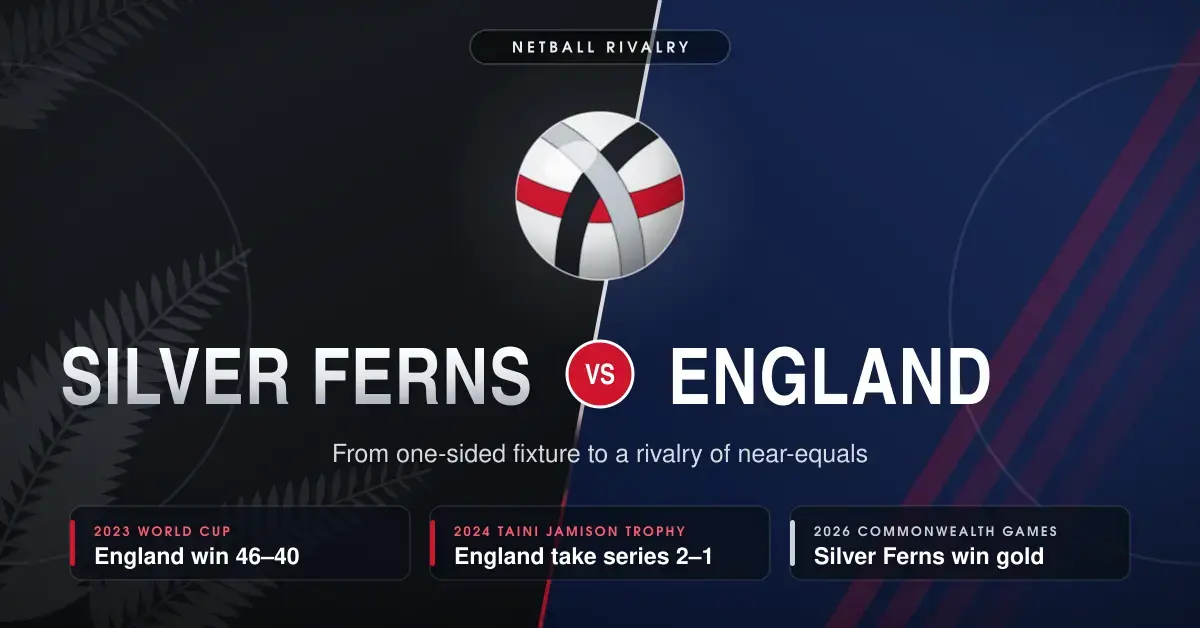
The most significant recent meeting occurred on August 5, 2023, during the Netball World Cup semi-final in Cape Town. Entering as the defending champions, the Silver Ferns were favored to reach the final. However, a masterclass in defensive pressure from England’s Fran Williams and Imogen Allison saw the Roses stay level at 32-32 heading into the final quarter. In a clinical final ten minutes, England capitalized on uncharacteristic Silver Ferns turnovers to win 46-40. This victory not only sent England to their first-ever World Cup final but also signaled the end of New Zealand's four-year reign at the top. The match remains a blueprint for how England utilizes a "suffocating" midcourt press to disrupt the Silver Ferns' rhythm.

  • Final Score: England 46, New Zealand 40.
  • Key Turning Point: A 6-0 run by England in the final four minutes.
  • Defensive Standout: Fran Williams (Vital late-game interceptions).
  • NZ Struggle: Inability to find Grace Nweke under extreme circle pressure.

Final Score: England 46, New Zealand 40.

Key Turning Point: A 6-0 run by England in the final four minutes.

Defensive Standout: Fran Williams (Vital late-game interceptions).

NZ Struggle: Inability to find Grace Nweke under extreme circle pressure.

QuarterNZ ScoreENG ScoreRunning Total
Q1999–9
Q2111120–20
Q3121232–32
Q481440–46

Tactical Lessons from Cape Town

Post-match analysis highlighted that England successfully "bracketed" the New Zealand shooters, forcing the Silver Ferns midcourt to play a high-risk long-ball game. This forced-error strategy has become a recurring theme in how Jess Thirlby approaches the Silver Ferns' tactical setup. Read more in Wikipedia.

The Taini Jamison Trophy: New Zealand’s Home Ground Defence

The Taini Jamison Trophy is the primary trophy contested when England tours New Zealand. Named after the legendary Silver Ferns coach who led the team to their first world title in 1967, the series is a focal point of the New Zealand netball calendar. In 2023 and 2024, these series were marked by controversy and intense competition. In 2023, England faced criticism for sending a "development" squad, yet they stunned the Ferns by winning the opening test. In 2024, the Silver Ferns reclaimed the trophy, but only after a series of physical encounters that tested the depth of both benches. The trophy serves as a vital preparation tool for both nations, allowing coaches to blood new talent in a high-pressure environment.

  • Trophy Name: Honoring Dame Taini Jamison.
  • 2024 Series Result: Silver Ferns won 2–1.
  • 2025 Controversy: Interim coach Yvette McCausland-Durie leading the Ferns during the home leg.
  • Venue Rotation: Matches held in major hubs like Auckland, Wellington, and Christchurch.

Trophy Name: Honoring Dame Taini Jamison.

2024 Series Result: Silver Ferns won 2–1.

2025 Controversy: Interim coach Yvette McCausland-Durie leading the Ferns during the home leg.

Venue Rotation: Matches held in major hubs like Auckland, Wellington, and Christchurch.

YearWinnerSeries ScoreCaptain (NZ)
2021England2–1Gina Crampton
2022New Zealand3–0Ameliaranne Ekenasio
2023New Zealand2–1Ameliaranne Ekenasio
2024New Zealand2–1Ameliaranne Ekenasio

The "B-Team" Motivation

The 2023 controversy regarding England's squad selection actually served as a motivation for the Roses. The younger players, eager to prove they belonged at the elite level, played with a "nothing to lose" attitude that caught the Silver Ferns off-guard, proving that England’s depth is now a major factor in the rivalry.

The 2025 Northern Tour: Manchester’s Decider

In November 2025, the Silver Ferns traveled to England for a three-test International Series that many analysts called the "series of the year." With the two teams having traded wins in the first two matches (both ending in 61-58 scorelines), the decider in Manchester on November 19, 2025, was a high-stakes finale. Despite losing the opening quarter 11-14, the Silver Ferns showed immense resilience. Under interim coach Yvette McCausland-Durie, the Ferns stuck with their starting seven throughout the entire 60 minutes. Behind 27-25 at halftime, a massive defensive effort from Kelly Jackson and the clinical shooting of Grace Nweke saw the Ferns pull away in the fourth quarter to win 55-49, securing a 2-1 series victory on foreign soil.

  • Decider Location: AO Arena, Manchester.
  • Final Result: Silver Ferns won 55–49.
  • Iron-woman Effort: NZ made zero substitutions during the final match.
  • Series Outcome: New Zealand 2, England 1.

Decider Location: AO Arena, Manchester.

Final Result: Silver Ferns won 55–49.

Iron-woman Effort: NZ made zero substitutions during the final match.

Series Outcome: New Zealand 2, England 1.

PlayerPositionGoals/StatsImpact
Grace NwekeGS48/51Dominant target in the air
Kelly JacksonGK5 InterceptsNeutralized England’s Tchine
Maddy GordonC24 AssistsRelentless engine in midcourt
Liv TchineGS39/42England’s primary scoring source

Overcoming the "Third Quarter Nemesis"

For much of 2024 and early 2025, the Silver Ferns struggled in the third quarter—often referred to as the "Premiership Quarter." In the Manchester decider, however, they won the third term 15-13, a psychological breakthrough that allowed them to enter the final period with the momentum needed to suppress the Roses' home crowd.

Tactical Profile: The Midcourt Grind

When New Zealand plays England, the game is almost always won or lost in the "transitional third." England employs a "denial of space" midcourt strategy, often using players like Beth Cobden or Amy Carter to tag the Silver Ferns' Wing Attack (WA). This slows down the ball delivery to Grace Nweke. New Zealand counters this with a "triangle" passing game, involving the Goal Attack (GA) and Center (C) to create short-pass options. The rivalry has seen a significant increase in physical contact, with both teams now matching each other for "contested balls." The tactical evolution has moved toward a game of patience, where the team that can sustain their defensive intensity for the full 60 minutes eventually prevails.

  • England Tactic: Full-court press and forcing the lateral pass.
  • New Zealand Tactic: Zonal "intersections" to create turnovers in the pockets.
  • Key Battle: The Wing Attack (NZ) vs the Wing Defense (ENG).
  • Shooting Styles: England’s "moving circle" vs NZ’s "holding post."

England Tactic: Full-court press and forcing the lateral pass.

New Zealand Tactic: Zonal "intersections" to create turnovers in the pockets.

Key Battle: The Wing Attack (NZ) vs the Wing Defense (ENG).

Shooting Styles: England’s "moving circle" vs NZ’s "holding post."

Strategic ElementNew Zealand FocusEngland Focus
Ball MovementPatient, short passingRapid, direct transitions
Defensive Look3-foot marking and zonal leanTight man-on-man tagging
Shooting CircleFeed to the high postPlaymaking from Goal Attack

Disrupting the Feed

England’s success against New Zealand often relies on their ability to get a "hand to ball" before it reaches the shooting circle. By disrupting the Silver Ferns' feeders (Souness or Gordon), they prevent the Ferns from utilizing their height advantage under the post.

Key Player Matchups: Nweke vs the Roses Defense

The most compelling individual matchup in modern netball is New Zealand’s Grace Nweke against the English defensive duo of Fran Williams and Razia Quashie. Nweke is arguably the most dominant aerial target in the history of the game, but England has developed a specific "double-team" strategy to counter her. By having one defender front the ball and another contest the high lob, they force Nweke into a physical battle for position. On the other end of the court, the matchup between NZ’s Kelly Jackson and England’s Helen Housby is equally critical. Jackson’s reach against Housby’s long-range accuracy and playmaking ability often dictates the scoring rhythm of the match.

  • Grace Nweke (NZ): Strength, height, and unmatched rebounding.
  • Fran Williams (ENG): Anticipation and "clutch" interceptions.
  • Helen Housby (ENG): Tactical IQ and high-pressure shooting.
  • Kate Heffernan (NZ): Height in the midcourt and defensive pressure on the feed.

Grace Nweke (NZ): Strength, height, and unmatched rebounding.

Fran Williams (ENG): Anticipation and "clutch" interceptions.

Helen Housby (ENG): Tactical IQ and high-pressure shooting.

Kate Heffernan (NZ): Height in the midcourt and defensive pressure on the feed.

Player RivalryKey Stat to WatchPredicted Edge
Nweke vs WilliamsOffensive ReboundsNweke (Power)
Housby vs JacksonShooting % from DistanceHousby (Skill)
Gordon vs CarterCenter Pass ReceivesGordon (Speed)

The "Housby Factor"

Helen Housby is often the "barometer" for England. When she is allowed to roam freely and play a creative Goal Attack role, England's scoring flow is difficult to stop. New Zealand’s Goal Defense (GD) must play a high-interception game to keep Housby occupied and away from the top of the circle.

Coaching Philosophies: Taurua vs Thirlby

The rivalry is also a battle of wits between two of the game’s most respected coaches. Dame Noeline Taurua (NZ) is known for her "mana-based" leadership and tactical innovation, often making bold substitutions to change the game's momentum. Jess Thirlby (ENG) has focused on building a "relentless" culture, emphasizing fitness and a deep bench. While Taurua’s teams often play with a structured "Kiwi" flair, Thirlby’s Roses have become masters of the "grind," happy to stay in a goal-for-goal battle until the opponent cracks. The 2025 series saw Yvette McCausland-Durie bring a more traditional, stable approach to the Ferns, which contrasted with Thirlby’s frequent tactical rotations.

  • Noeline Taurua: Focus on "fit-for-purpose" and cultural identity.
  • Jess Thirlby: Emphasis on squad depth and professional standards.
  • McCausland-Durie (Interim): Known for tactical stability and player trust.
  • Strategic Timeouts: Used effectively by both to break "runs" of goals.

Noeline Taurua: Focus on "fit-for-purpose" and cultural identity.

Jess Thirlby: Emphasis on squad depth and professional standards.

McCausland-Durie (Interim): Known for tactical stability and player trust.

Strategic Timeouts: Used effectively by both to break "runs" of goals.

CoachWinning Percentage (H2H)Primary Tactic
Noeline TauruaHigh (Major Finals)Zonal pressure and elite fitness
Jess ThirlbyImproving (Series)Full-court press and bench depth

The "Bench" Strategy

England often uses all 12 players in a test match, rotating their shooters to provide different "looks" for the NZ defenders. In contrast, the Silver Ferns (especially in late 2025) have moved toward a more settled starting seven, trusting their core players to weather the storm for the full 60 minutes.

The Impact of International Leagues

The relationship between the Silver Ferns and England is unique because so many players have shared locker rooms in domestic leagues. Players like Geva Mentor (who has played extensively in NZ and Australia) have provided England with "insider" knowledge of the New Zealand defensive systems. Conversely, New Zealand’s exposure to English imports in the ANZ Premiership has helped Kiwi defenders learn how to handle the "moving" English shooting style. This cross-pollination of talent has elevated the standard of both national teams, making the international tests a showcase of the world’s best professional habits.

  • ANZ Premiership Imports: Players like George Fisher (Magic) have influenced NZ play.
  • Suncorp Super Netball: The primary meeting ground for the "Big Three" nations' stars.
  • Tactical Sharing: Coaches often study footage from these leagues to find weaknesses.
  • Professionalism: Both nations now operate full-time high-performance programs.

ANZ Premiership Imports: Players like George Fisher (Magic) have influenced NZ play.

Suncorp Super Netball: The primary meeting ground for the "Big Three" nations' stars.

Tactical Sharing: Coaches often study footage from these leagues to find weaknesses.

Professionalism: Both nations now operate full-time high-performance programs.

LeagueRole in RivalryKey Example
ANZ PremiershipDeveloping NZ defendersKelly Jackson vs English Shooters
Super NetballTesting English starsHelen Housby vs International Defense
Netball Super LeagueBuilding English depthDevelopment of the “Next Gen” Roses

Knowledge Exchange

The "mental book" that players keep on each other from domestic leagues is a major factor in international play. A defender like Karin Burger knows exactly which way an English attacker prefers to turn, having played against them multiple times in professional seasons.

Future Outlook: The Path to 2027

As both nations look toward the 2027 Netball World Cup in Sydney, the rivalry is expected to intensify. England is desperate to turn their 2023 silver into gold, while the Silver Ferns are in a rebuilding phase, seeking a permanent head coach to lead them through the next four-year cycle. The emergence of young talents like Mila Reuelu-Buchanan (NZ) and Lois Pearson (ENG) suggests that the speed of the game will only increase. With free-to-air broadcasting coming to New Zealand in 2026, the public profile of the "Ferns vs Roses" series is set to explode, potentially rivaling the Constellation Cup in terms of viewership and commercial value.

  • Next Major Goal: 2026 Commonwealth Games and 2027 World Cup.
  • NZ Search: Finding a permanent successor to Dame Noeline Taurua.
  • England Goal: Maintaining their top-three ranking amid rising African nations.
  • Innovation: Further use of data analytics to "solve" defensive zones.

Next Major Goal: 2026 Commonwealth Games and 2027 World Cup.

NZ Search: Finding a permanent successor to Dame Noeline Taurua.

England Goal: Maintaining their top-three ranking amid rising African nations.

Innovation: Further use of data analytics to "solve" defensive zones.

GoalNew ZealandEngland
2026Consolidate midcourt combinationsExpand defensive depth
2027Reclaim the World TitleWin first-ever World Cup Gold

The Rise of the "Global Four"

With Jamaica also in the mix, the New Zealand-England rivalry is no longer just about third place. It is a battle to determine who will challenge Australia for the world #1 ranking. Every series win between these two provides a massive boost in ranking points and international prestige.

Final Thoughts

The Silver Ferns vs England rivalry has become the "thinking fan’s" netball match. It is a contest of patience, tactical adjustments, and extreme physical endurance. From the heartbreak of Cape Town to the glory of Manchester, these two nations have shown that the gap between the Northern and Southern Hemispheres has officially closed. As the Silver Ferns enter a new coaching era and England continues to professionalize their pathway, the "black and red" clashes will remain a highlight of the sporting world. It is a rivalry built on mutual respect, shared history, and a relentless pursuit of netball perfection.

FAQ

Who won the most recent series between the Silver Ferns and England? The Silver Ferns won the most recent three-test series in November 2025, winning 2–1 after a deciding victory in Manchester.

What is the Taini Jamison Trophy? It is the trophy contested when England tours New Zealand, named after the legendary Silver Ferns coach Taini Jamison.

Who is the current coach of the England Roses? Jess Thirlby is the head coach of the Vitality Roses.

Who won the 2023 Netball World Cup semi-final? England won the semi-final 46–40, knocking the defending champion Silver Ferns out of the tournament.

How many World Cups has England won? England has never won a Netball World Cup, with their best finish being Silver in 2023.

Is there a height difference between the teams? Generally, New Zealand has a height advantage in the shooting circle with Grace Nweke (1.93m), while England often utilizes more mobile, "moving" shooters.

Where was the 2025 series decider played? The series decider was played at the AO Arena in Manchester, England.

Who is the Silver Ferns' top scorer against England? In recent series, Grace Nweke has consistently been the top scorer, often netting over 45 goals per match.

How often do the Silver Ferns play England? They typically meet 1–2 times per year, either in a dedicated series or during a major tournament like the World Cup.

What are the primary colors of the two teams? The Silver Ferns play in black, while the England Roses play in red.