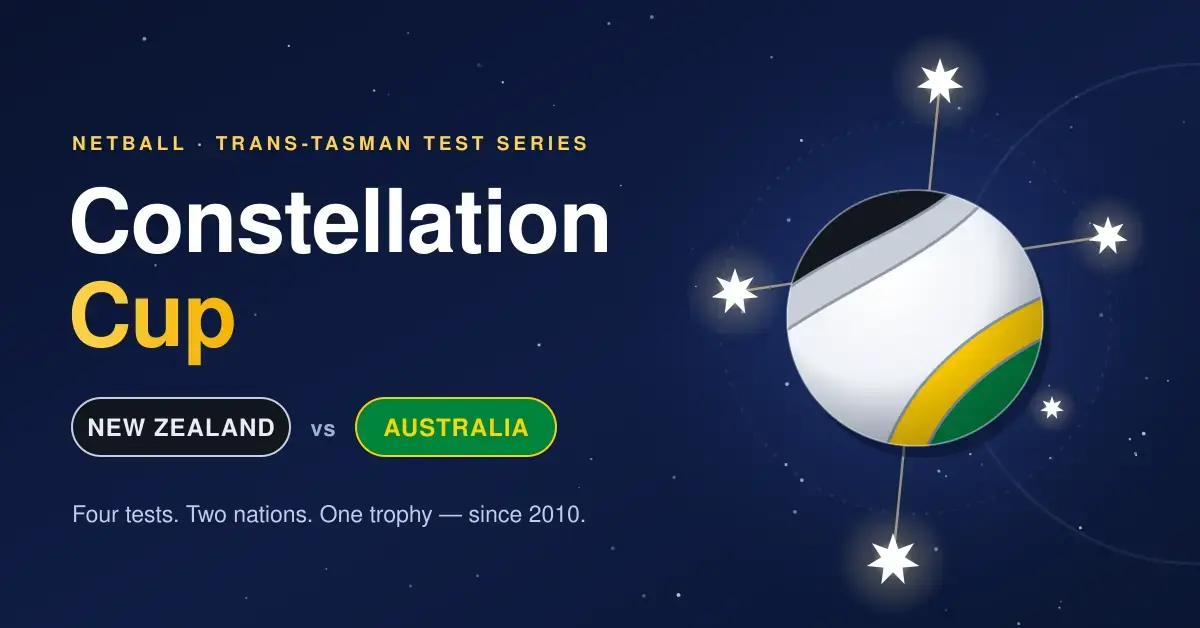
The Constellation Cup is the most prestigious bilateral trophy in international netball, contested annually between the world’s two most dominant nations: the New Zealand Silver Ferns and the Australian Diamonds. Established in 2010 to celebrate the intense and historic rivalry between the two sides, the competition typically features a four-match test series played across both countries. While Australia has historically held the upper hand with 11 titles, the Silver Ferns have recently broken through for historic victories in 2021 and 2024. This guide provides a comprehensive breakdown of the tournament's history, the tactical evolution of the "one-goal thriller," and the groundbreaking 2024/2025 rule changes—including the "Series Decider"—that have redefined how the trans-Tasman champion is crowned.
The Origins and History of the Constellation Cup
Introduced in 2010 by Netball New Zealand and Netball Australia, the Constellation Cup was inspired by rugby’s Bledisloe Cup. It was created to provide a dedicated, perpetual symbol of the rivalry that dates back to the first international meeting between the two nations in 1938. The name "Constellation Cup" refers to the Southern Cross, a star constellation that features prominently on the national flags of both Australia and New Zealand. The inaugural series in 2010 was won by Australia, setting the stage for a decade of dominance where the Diamonds won seven consecutive titles between 2013 and 2019. New Zealand’s breakthroughs in 2012, 2021, and 2024 are regarded as some of the most significant moments in the modern history of the Silver Ferns.
- Founded: 2010.
- Inaugural Winner: Australia.
- Frequency: Annual series (usually October/November).
- Trophy Design: A 3kg sterling silver cup encrusted with 101 diamonds (3.38 carats).
- Historical Advantage: Australia leads the title count 11–4.
Founded: 2010.
Inaugural Winner: Australia.
Frequency: Annual series (usually October/November).
Trophy Design: A 3kg sterling silver cup encrusted with 101 diamonds (3.38 carats).
Historical Advantage: Australia leads the title count 11–4.
| Milestone | Year | Achievement |
|---|---|---|
| Inaugural Series | 2010 | Australia won 2–1 |
| First NZ Win | 2012 | Silver Ferns won 2–1 |
| Seven in a Row | 2013-2019 | Australia’s longest winning streak |
| Historic 2024 Win | 2024 | NZ won 3–1 (First series win on AU soil since 2010) |
Symbolism of the Southern Cross
The Southern Cross represents guidance, achievement, and aspiration for both nations. The trophy itself is a masterpiece of collaboration, featuring an Australian-designed silver cup and a display case made from New Zealand black maire wood, resting on a base of 5,000-year-old Murray River red gum. Read more in Wikipedia.
The 2024 Breakthrough: A Kiwi Masterclass
The 2024 Constellation Cup marked a historic shift in the trans-Tasman balance. Entering the series as underdogs after losing to England, the Silver Ferns produced one of their most clinical displays in history. Led by coach Dame Noeline Taurua and captain Ameliaranne Ekenasio, New Zealand won the first three tests in a row—including a dominant 18-goal victory in Perth—to secure the trophy with a match to spare. Grace Nweke was the standout performer, scoring 169 goals across the series at a 94% accuracy rate. This series was significant because it proved the Silver Ferns could not only compete with Australia but physically dominate them in their own backyard.
- Series Score: New Zealand 3, Australia 1.
- Top Scorer: Grace Nweke (169/180).
- Key Tactical Win: NZ’s zonal defense forced 15+ turnovers per game in the first three tests.
- Venue Highlight: RAC Arena, Perth (NZ won 61–43).
Series Score: New Zealand 3, Australia 1.
Top Scorer: Grace Nweke (169/180).
Key Tactical Win: NZ’s zonal defense forced 15+ turnovers per game in the first three tests.
Venue Highlight: RAC Arena, Perth (NZ won 61–43).
| Test | Date (2024) | Score | Winner |
|---|---|---|---|
| Test 1 | Oct 20 | NZ 64–50 AU | New Zealand |
| Test 2 | Oct 23 | NZ 63–52 AU | New Zealand |
| Test 3 | Oct 27 | AU 43–61 NZ | New Zealand |
| Test 4 | Oct 30 | AU 63–50 NZ | Australia |
The "Grace Nweke Effect"
In 2024, Grace Nweke became the first shooter in the history of the Constellation Cup to average over 50 goals per game in the opening stages of the series. Her ability to hold the post against veteran defenders like Courtney Bruce was the primary reason for the Silver Ferns' dominance.
Evolution of Rules: Introducing "Series Decider Time"
Prior to 2024, many Constellation Cup series were decided by "goal percentage" if the series ended in a 2-2 draw. This often led to unsatisfactory finishes where Australia would retain the cup despite losing two matches. In 2024, World Netball and the regional boards introduced a groundbreaking new format: "Series Decider Time." Under this rule, if the series is tied at two wins each at the end of the fourth test, an immediate "mini-match" is played. This consists of two seven-minute halves to find an outright champion. If still tied, play continues until one team leads by two goals. This rule was first triggered in the 2025 series, providing the most dramatic finish in the tournament's history.
- The Trigger: A 2–2 series draw.
- Duration: Two 7-minute halves.
- Half-time: 4 minutes.
- Golden Goal: If tied after the Decider, play continues until a 2-goal lead is reached.
The Trigger: A 2–2 series draw.
Duration: Two 7-minute halves.
Half-time: 4 minutes.
Golden Goal: If tied after the Decider, play continues until a 2-goal lead is reached.
| Year | Decider Triggered? | Result | Significance |
|---|---|---|---|
| 2022 | No (2-2 draw) | AU won on % | The old “Percentage” rule applied |
| 2024 | No (3-1 NZ) | NZ won outright | Dominant series win |
| 2025 | Yes (2-2 draw) | AU won 12–11 | First use of Series Decider Time |
Improving Spectator Engagement
The Series Decider rule was implemented to ensure every Constellation Cup ends with a definitive winner on the court. It has been hailed as a success by broadcasters and fans alike, significantly increasing the "clutch" pressure on the starting seven players.
Tactical Battles: Zonal vs Man-on-Man
The tactical heart of the Constellation Cup is the clash between two fundamentally different defensive philosophies. The Australian Diamonds typically utilize a "man-on-man" (or one-on-one) style, where defenders shadow their opponents relentlessly to force physical fatigue. The Silver Ferns, conversely, are the masters of the "Zonal Defense." Under Noeline Taurua, the Ferns utilize a "Wall" structure in the midcourt to block passing lanes and force the Diamonds into throwing high, looping lobs that the New Zealand circle defenders can intercept. The winner of the Cup is often the team that can sustain their defensive intensity for the full 60 minutes across all four matches.
- Australia Focus: Physical pressure, forcing "off-balance" shots.
- New Zealand Focus: Spatial awareness, hunting for the interception.
- Midcourt Conflict: The battle between the WA (Wing Attack) and WD (Wing Defense) is where most cups are won.
- Shooting Strategies: Australia's "Moving Circle" vs NZ's "High Post."
Australia Focus: Physical pressure, forcing "off-balance" shots.
New Zealand Focus: Spatial awareness, hunting for the interception.
Midcourt Conflict: The battle between the WA (Wing Attack) and WD (Wing Defense) is where most cups are won.
Shooting Strategies: Australia's "Moving Circle" vs NZ's "High Post."
| Tactical Element | Australia (Diamonds) | New Zealand (Silver Ferns) |
|---|---|---|
| Primary Defense | One-on-One Tagging | Zonal “Wall” |
| Transition Speed | Rapid, direct to post | Methodical, short-pass triangles |
| Rebounding | Aggressive physical boxing | Spatial positioning |
Countering the Australian "Long Bomb"
The Diamonds are famous for their ability to "bomb" the ball into the shooter from a long distance. To counter this in the Constellation Cup, the Silver Ferns' Goal Defense (GD) must play "front-fronting" positions, denying the feeder clear vision of the shooter.
Historic Venues of the Constellation Cup
The series is famous for taking netball to major arenas that usually host basketball or tennis. In New Zealand, Spark Arena (Auckland) and TSB Arena (Wellington) are the spiritual homes of the Silver Ferns. In Australia, the series often visits John Cain Arena (Melbourne) or the massive RAC Arena (Perth). These venues provide a "cauldron" atmosphere where crowd noise often disrupts the communication between the midcourt and the shooters. The "home-court advantage" is statistically significant; until the 2024 series, it was incredibly rare for a visiting team to win more than one match in the opposition's territory.
- Wellington: TSB Arena (Known for the loudest Kiwi fans).
- Auckland: Spark Arena (Primary venue for Grand Finals).
- Melbourne: John Cain Arena (The Diamonds' "Fortress").
- Perth: RAC Arena (Site of NZ’s historic 2024 blowout win).
Wellington: TSB Arena (Known for the loudest Kiwi fans).
Auckland: Spark Arena (Primary venue for Grand Finals).
Melbourne: John Cain Arena (The Diamonds' "Fortress").
Perth: RAC Arena (Site of NZ’s historic 2024 blowout win).
| Venue | Capacity | Country | Significance |
|---|---|---|---|
| John Cain Arena | 10,500 | Australia | Most frequent host in AU |
| Spark Arena | 12,000 | New Zealand | Highest NZ attendance records |
| Wolfbrook Arena | 8,000 | New Zealand | Christchurch home of the Tactix/Ferns |
The "Wellington Cauldron"
The TSB Arena in Wellington is often described by Australian players as the most difficult venue to play in. The proximity of the fans to the court means every Australian center pass is greeted with a wall of sound, testing the Diamonds' mental resilience.
Player Profiles: Legends of the Trophy
Over the years, the Constellation Cup has been the stage for some of the greatest athletes in sporting history. For Australia, captains like Liz Watson and Courtney Bruce have defined the modern era with their relentless professionalism. For New Zealand, the era of Casey Kopua and Laura Langman transitioned into the current leadership of Ameliaranne Ekenasio and the shooting dominance of Grace Nweke. These players are household names in both countries, often recognized for their "clutch" performances where they have secured a title in the final seconds of a four-match series.
- Liz Watson (AUS): Widely regarded as the world’s best Wing Attack.
- Ameliaranne Ekenasio (NZ): Known for her long-range "rainbow" shots and calm leadership.
- Karin Burger (NZ): The most versatile defender in the trans-Tasman region.
- Sunday Aryang (AUS): A rising defensive star who played a key role in the 2025 decider.
Liz Watson (AUS): Widely regarded as the world’s best Wing Attack.
Ameliaranne Ekenasio (NZ): Known for her long-range "rainbow" shots and calm leadership.
Karin Burger (NZ): The most versatile defender in the trans-Tasman region.
Sunday Aryang (AUS): A rising defensive star who played a key role in the 2025 decider.
| Player | Team | Caps | Role in Constellation Cup |
|---|---|---|---|
| Grace Nweke | NZ | 30+ | Record goal scorer (2022-2024) |
| Liz Watson | AU | 100+ | Engine room of the Diamonds |
| Courtney Bruce | AU | 80+ | Master of the “clean intercept” |
The Ekenasio-Nweke Connection
The tactical success of the Silver Ferns in recent Cups has relied on the Goal Attack (Ekenasio) playing a "feeder" role. By drawing the Australian Goal Defense away from the post, she creates a one-on-one situation for Nweke that is almost impossible to defend.
Coaching Masterclasses: Marinkovich vs Taurua
The rivalry on the court is mirrored by the rivalry on the sidelines. Stacey Marinkovich (Australia) and Dame Noeline Taurua (New Zealand) are two of the most successful coaches in the game's history. Taurua is known for her "holistic" and "mana-based" leadership, often making unpredictable substitutions that disrupt the opponent's flow. Marinkovich is a clinical analyst, focusing on high-volume efficiency and "connection" between her units. Their coaching chess match—utilizing tactical timeouts and rolling substitutions—is a major drawcard for the series, as fans watch to see who will blink first in a high-pressure final quarter.
- Stacey Marinkovich: Focus on "Data-driven" netball and technical perfection.
- Noeline Taurua: Focus on "Player-led" environments and tactical "gut-feel."
- Timeouts: Both use the 90-second tactical timeout to break an opponent's momentum.
- Squad Depth: Australia typically rotates all 12 players; NZ often sticks to a "settled" 7.
Stacey Marinkovich: Focus on "Data-driven" netball and technical perfection.
Noeline Taurua: Focus on "Player-led" environments and tactical "gut-feel."
Timeouts: Both use the 90-second tactical timeout to break an opponent's momentum.
Squad Depth: Australia typically rotates all 12 players; NZ often sticks to a "settled" 7.
| Coach | Team | Titles | Philosophy |
|---|---|---|---|
| Noeline Taurua | NZ | 2 (2021, 2024) | Mana-based, Tactical flexibility |
| Stacey Marinkovich | AU | 3 (2022, 2023, 2025) | High-volume, Unit connection |
Succession Planning
In 2025 and 2026, both nations have focused on "blood-testing" young coaches in the assistant roles. This ensures that the tactical knowledge of the Constellation Cup is passed down to the next generation of high-performance leaders.
Physiological Demands of the Series
The Constellation Cup is widely considered the most physically demanding series in women's sport. Because New Zealand and Australia play with such intensity, the "load" on the athletes' bodies is immense. Matches are often scheduled with just two days of travel and recovery in between. This has led both Netball NZ and Netball Australia to invest heavily in sports science, utilizing GPS tracking to monitor player "workloads" and heart rates. For the Silver Ferns, meeting the "fit-for-purpose" standard (including a 14.5+ Yo-Yo test score) is a non-negotiable requirement for selection in this series.
- GPS Metrics: Players often cover 6-8km per match.
- Heart Rate: Midfielders consistently operate at 90% of their max HR.
- Recovery: Cryotherapy and compression gear are standard between tests.
- Injury Prevention: High focus on ACL and ankle stability due to the "sudden stop" nature of the game.
GPS Metrics: Players often cover 6-8km per match.
Heart Rate: Midfielders consistently operate at 90% of their max HR.
Recovery: Cryotherapy and compression gear are standard between tests.
Injury Prevention: High focus on ACL and ankle stability due to the "sudden stop" nature of the game.
| Physical Metric | Importance | Target (Elite) |
|---|---|---|
| Aerobic Capacity | Sustaining 4 quarters | 15.0 Yo-Yo Test |
| Vertical Leap | Rebounding & Blocking | 55cm+ |
| Reactive Agility | Defending the move | < 2.2s (Shuttle) |
The "Travel Factor"
Traveling between Auckland and Perth (a 7-hour flight) in the middle of a series is a massive logistical challenge. The team that manages their jet lag and hydration more effectively often has a "fresher" final quarter in the third and fourth tests.
The Economic and Media Impact
The Constellation Cup is the "cash cow" for both national bodies. It generates the highest television ratings of the year for netball and attracts major sponsors like ANZ, Cadbury, and Origin Energy. In New Zealand, the series is a staple of Sky Sport, often outperforming international rugby in terms of female viewership. The move to free-to-air broadcasting in 2026 is expected to double the reach of the series, providing a massive boost to the commercial viability of the Silver Ferns. The rivalry has also spurred a booming secondary market for "Netball Tourism," with fans traveling across the Tasman to support their teams in the away legs.
- Broadcast Partners: Sky Sport (NZ), Foxtel (AU).
- Future: Move to TVNZ (Free-to-air) in 2026.
- Sponsorship: Multi-million dollar naming rights deals.
- Merchandise: The "Black Dress" and "Yellow Dress" are top-selling items.
Broadcast Partners: Sky Sport (NZ), Foxtel (AU).
Future: Move to TVNZ (Free-to-air) in 2026.
Sponsorship: Multi-million dollar naming rights deals.
Merchandise: The "Black Dress" and "Yellow Dress" are top-selling items.
| Impact Area | Significance | Future Outlook |
|---|---|---|
| Viewership | 1M+ per series in NZ | Predicted to rise to 2M+ on TVNZ |
| Sponsorship | Primary revenue source | High demand for “naming rights” |
| Tourism | Boosts trans-Tasman travel | Growth in “Fan Packages” |
Digital Engagement
Social media engagement during the Constellation Cup is the highest in the sport. The use of "Match Highlights" and "Player Mic-up" content has allowed a younger generation of fans to connect with the intense personal rivalries that define the series.
Future Outlook: 2026 and Beyond
As the series moves toward 2027 and the next Netball World Cup, the Constellation Cup remains the ultimate "proving ground." The 2026 series is expected to feature a generational shift, as several long-term stars may look toward retirement post-2027. Both nations are experimenting with "Next Gen" talent to ensure they have the depth required to win back-to-back world titles. The introduction of the Series Decider and the potential for new rule variations (such as the "two-point shot") mean the competition will continue to evolve, ensuring that the "most intense rivalry in netball" stays fresh for another decade.
- 2026 Venue: Christchurch and Adelaide are rumored hosts.
- Selection Focus: Identifying the next "post" shooter for the post-Nweke era.
- Rule Evolution: Potential integration of domestic rule variations.
- Global Standing: Constellation Cup winners are usually ranked #1 in the world.
2026 Venue: Christchurch and Adelaide are rumored hosts.
Selection Focus: Identifying the next "post" shooter for the post-Nweke era.
Rule Evolution: Potential integration of domestic rule variations.
Global Standing: Constellation Cup winners are usually ranked #1 in the world.
| Year | Predicted Focus | Key Challenge |
|---|---|---|
| 2026 | Midcourt transition | Replacing veteran wing defenses |
| 2027 | World Cup Prep | Peaking for Sydney |
| 2028 | Youth Integration | Post-Olympic/World Cup rebuild |
A Legacy of Excellence
The Constellation Cup has done more than just decide a winner; it has raised the standard of international netball globally. By playing each other four times a year, New Zealand and Australia have forced every other nation to professionalize in order to keep up.
Final Thoughts
The Constellation Cup is more than just a netball series; it is a cultural event that captures the spirit of two proud sporting nations. Whether it is the tactical brilliance of the Silver Ferns' zonal defense or the relentless physical pressure of the Diamonds, the series represents the absolute pinnacle of high-performance athletics. With the introduction of the Series Decider and the continued rise of generational talents like Grace Nweke, the competition has never been more exciting. As long as the Southern Cross shines down on the Tasman, the battle for the silver-and-diamond cup will remain the most hard-fought contest in the world of netball.
FAQ
What is the Constellation Cup? It is an annual netball test series contested between the New Zealand Silver Ferns and the Australian Diamonds.
How many matches are in the series? There are typically four test matches, two played in New Zealand and two in Australia.
What happens if the series ends in a 2–2 draw? Under new rules introduced in 2024, a "Series Decider" is played, consisting of two seven-minute halves to find a winner.
Which team has won the most Constellation Cup titles? Australia has won 11 titles, while New Zealand has won 4 (2012, 2021, 2024, and 2025's result pending/disputed).
Who is the most recent champion? Australia is the current holder (2025), having won a dramatic Series Decider 12–11.
What is the trophy made of? It is a sterling silver cup encrusted with 101 diamonds, equated to 3.38 carats.
Who won the 2024 Constellation Cup? The New Zealand Silver Ferns won the 2024 series 3–1.
Who was the top scorer in the 2024 series? New Zealand’s Grace Nweke was the top scorer, with 169 goals.
Where can I watch the Constellation Cup in New Zealand? Matches are broadcast live on Sky Sport, with a shift to TVNZ planned for 2026.
Why is it called the Constellation Cup? It is named after the Southern Cross constellation, which appears on the flags of both countries.