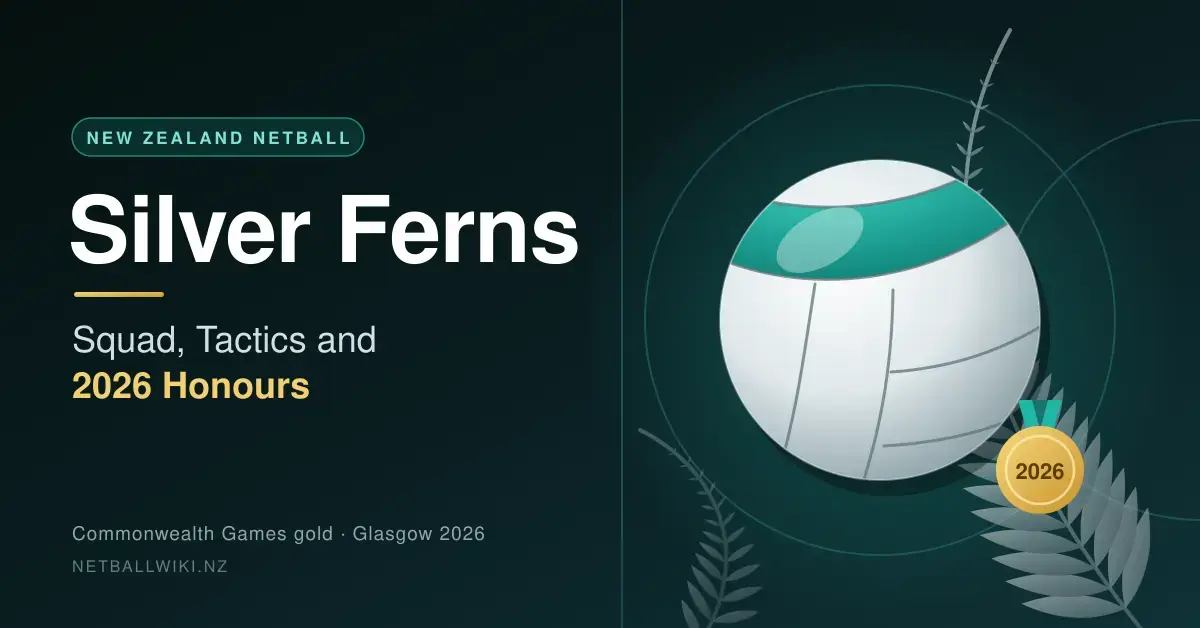
The New Zealand netball team, known around the world as the Silver Ferns, is one of the most successful sides in the sport’s history and the standard-bearer for women’s team sport in Aotearoa. In August 2026 the team capped a turbulent two-year rebuild by winning Commonwealth Games gold in Glasgow — their first Games title in 16 years. This guide explains who the Silver Ferns are, how the 2026 squad was built, the tactics and culture that define them, and where the team sits in world netball as it looks ahead to the 2027 World Cup. Every figure here has been checked against official and reported sources.
A National Institution of New Zealand Sport
Netball is the leading participation and spectator sport for women and girls in New Zealand, and the Silver Ferns are its highest expression. The team is run by Netball New Zealand, the sport’s national governing body, which selects the squad, employs the coaching staff and funds the high-performance programme. On the current World Netball Rankings the Silver Ferns sit second in the world, behind the Australian Diamonds and ahead of England and Jamaica.
What sets the team apart is less any single player than a system: a national pathway, a demanding conditioning culture and a clear tactical identity that have kept a country of around five million competitive with far larger netball nations for almost a century. The 2026 season was a stern test of that system, following a medal-less 2023 World Cup and a year of off-court upheaval in 2025.
Key Facts
| Team | New Zealand national netball team (Silver Ferns) |
|---|---|
| Governing body | Netball New Zealand |
| World ranking | 2nd (behind Australia) |
| Head coach | Dame Noeline Taurua (through 2027) |
| 2026 captain | Karin Burger (vice-captain Kate Heffernan) |
| Latest result | Commonwealth Games gold, Glasgow 2026 (beat Jamaica 56–48) |
| World Cup titles | 5 (1967, 1979, 1987, 2003, 2019) |
| Next major event | Netball World Cup, Sydney 2027 |
The 2026 Silver Ferns Squad
Netball New Zealand named a 12-strong squad for the Glasgow campaign, blending a small core of experienced internationals with a wave of debutants. Karin Burger captained the side, with midcourter Kate Heffernan as vice-captain, while goal shooter Grace Nweke — one of the most dominant aerial targets in the world game — anchored the attacking end. For a fuller breakdown of personnel and how selections are made, see our guide to the 2026–27 Silver Ferns squad.
Nine of the twelve made their Commonwealth Games debut in Glasgow, among them Burger, Maddy Gordon, Catherine Hall, Georgia Heffernan, Kimiora Poi, Mila Reuelu-Buchanan, Martina Salmon, Carys Stythe and Amelia Walmsley. Defender Kelly Jackson was the most experienced, appearing at her third Games, while Nweke and Kate Heffernan attended their second.
- Captain: Karin Burger (Mainland Tactix)
- Vice-captain: Kate Heffernan (Southern Steel)
- Shooters: Grace Nweke, Georgia Heffernan, Martina Salmon, Amelia Walmsley
- Midcourt: Maddy Gordon, Kate Heffernan, Kimiora Poi, Mila Reuelu-Buchanan
- Defenders: Karin Burger, Kelly Jackson, Catherine Hall, Carys Stythe
| Player | Position | Franchise | Known for |
|---|---|---|---|
| Grace Nweke | GS | NSW Swifts | Aerial dominance and a towering hold in the circle |
| Karin Burger | GD/WD | Mainland Tactix | Versatile, high-energy one-on-one pressure |
| Kate Heffernan | WD/C | Southern Steel | Midcourt height and interceptions |
| Maddy Gordon | C/WA | Central Pulse | Explosive drive and feeding vision |
| Kelly Jackson | GK/GD | Central Pulse | Experience and aerial defence |
The eligibility change that kept Grace Nweke
For years, Netball New Zealand required players to compete in the domestic ANZ Premiership to be eligible for the Silver Ferns. That changed in 2025, when the governing body relaxed its criteria to allow overseas-based players to be considered through a formal exemption process. The shift was prompted by Nweke’s move to the NSW Swifts in Australia’s Suncorp Super Netball, widely regarded as the toughest domestic league in the world. Nweke was granted an exemption keeping her available for the Silver Ferns, and the change lets selectors draw on Kiwi stars wherever they are based.
Coaching Leadership: Dame Noeline Taurua
Dame Noeline Taurua is the Silver Ferns head coach and one of the most decorated tactical minds in the sport. She guided New Zealand to the 2019 World Cup title in Liverpool and, in September 2026, was confirmed in the role through to the 2027 World Cup. Her coaching philosophy leans heavily on culture and the Māori concept of mana — valuing the person behind the athlete — alongside uncompromising physical and tactical standards.
The 2025 coaching saga and governance reset
Taurua’s position was not always secure. During 2025 she was temporarily stood down while the organisation reviewed its high-performance practices, before being reinstated. The episode coincided with wider upheaval at Netball New Zealand: long-serving chief executive Jennie Wyllie departed in December 2025, Jane Patterson was appointed interim chief executive in January 2026, and the board chair stepped back as a recruitment process began for new leadership. The reset was intended to steady the organisation and let the athletes focus on Glasgow rather than off-court politics.
How the Silver Ferns Play: Tactics and Defensive Identity
Netball is played by seven players a side in fixed positions, and the “Silver Ferns Way” is built around structure and defensive pressure rather than relying on any one match-up. Where the Australian Diamonds have traditionally favoured relentless one-on-one “tagging”, New Zealand often uses a zonal approach in the midcourt: the wing defence and centre position to block passing lanes, forcing opponents to throw higher, looping passes that athletic circle defenders can attack. Under Taurua this has become a more hybrid system, switching between zone and tight marking off a set of cues, which opponents frequently describe as suffocating.
| Phase of play | New Zealand approach | Intended outcome |
|---|---|---|
| Centre pass | Zonal interception in the midcourt | Early turnover or forced reset |
| Attacking circle | Movement and screens to free the shooter | Space for a strong hold under the post |
| Circle defence | Splitting and “sandwiching” the shooter | Forcing a long shot or an aerial error |
| Transition | Fast, backed-up ball movement | Safe retention and quick scoring |
Neutralising the tall holding shooter
The rise of tall Caribbean and African shooters has pushed the Silver Ferns to refine a split-circle defence. One defender stays tight to the shooter’s body to disrupt the hold, while the second plays off to hunt the aerial feed. It is a tactic designed for exactly the kind of opponent New Zealand faced on the way to the 2026 final.
Glasgow 2026: How New Zealand Won Commonwealth Gold
Netball featured on the programme of the Glasgow 2026 Commonwealth Games as a 12-nation event staged at the OVO Hydro from 25 July to 2 August 2026. New Zealand came through the pool and knockout rounds to reach the final, where the pressure was heightened by the opponent: Jamaica had stunned world No.1 Australia in the semi-finals to book their place. In the final on 2 August, the Silver Ferns beat Jamaica’s Sunshine Girls 56–48 to take gold — their first Commonwealth netball title since the 2010 Delhi Games. Grace Nweke was dominant with 48 goals, and the win was sealed with the team’s trademark haka.
The result was significant beyond the medal. After finishing out of the medals at the 2023 World Cup and weathering a destabilising 2025, a gold at a major championship validated the rebuild and the decision to keep faith with Taurua and a largely new-look squad.
A History of Dominance: Five-Time World Champions
New Zealand holds a prestigious place in netball history as five-time World Cup winners, in 1967, 1979, 1987, 2003 and 2019. The rivalry with the Australian Diamonds is the fiercest in the sport, the two nations having contested the overwhelming majority of major finals since international netball began. The 2019 Liverpool final, won by a single goal over Australia, is remembered as one of the great matches, and the 2026 Commonwealth gold added a third Games title to go with golds in 2006 and 2010.
Major Honours
| Competition | Gold medals | Years won |
|---|---|---|
| Netball World Cup | 5 | 1967, 1979, 1987, 2003, 2019 |
| Commonwealth Games | 3 | 2006, 2010, 2026 |
From 1938 to the modern game
New Zealand’s first international was played against Australia in 1938, in an era when the sport was a nine-a-side game often called women’s basketball. The transition to the international seven-a-side format laid the foundations for the tactical identity that defines the modern Kiwi style, and generations of players — from Irene van Dyk to Laura Langman and Casey Kopua — have carried it forward.
The High-Performance Pathway
Success for the Silver Ferns is fuelled by a structured development pathway. At the top sits the ANZ Premiership, the six-team domestic league that supplies most of the national squad. Below it, the National Netball League and age-group programmes develop emerging talent, while a Silver Ferns development squad gives capped and fringe players international-standard training and the chance to step up when injuries strike. This “shadow squad” approach helped several debutants transition smoothly into the senior side in 2026.
- ANZ Premiership: six franchises; the primary feeder for the national team
- National Netball League: development competition linked to the franchises
- Age-group squads: under-21 and secondary-school pathways feeding the system
- Development squad: capped and fringe players training alongside the Silver Ferns
Culture and the Black Dress
The Silver Ferns’ identity is rooted in Aotearoa’s cultural fabric. The black dress carries a legacy comparable to the All Blacks’ jersey, representing national pride and a long history of women’s achievement in sport. The team incorporates Māori values and protocol, including the haka on the international stage, and reflects the strong Pasifika heritage within New Zealand netball. Coaches and players often describe this grounding as a genuine emotional edge in high-pressure tests.
What Comes Next: The Road to Sydney 2027
With Commonwealth gold secured, attention turns to the 2027 Netball World Cup, to be hosted in Sydney in 2027. The challenges are real: the world’s leading teams are faster and more professional every cycle, and New Zealand must keep developing depth so that an injury to a key player such as Nweke does not derail a campaign. The annual Constellation Cup against Australia remains the yardstick between major tournaments. With settled coaching, a renewed board and a squad that has now tasted success together, the Silver Ferns are well placed for the next chapter.
Sources
Frequently Asked Questions (FAQ)
What is the New Zealand netball team called?
The national team is known as the Silver Ferns, named after the silver fern that is a long-standing emblem of New Zealand sport.
Did the Silver Ferns win the 2026 Commonwealth Games?
Yes. New Zealand beat Jamaica 56–48 in the final at Glasgow on 2 August 2026, winning their first Commonwealth netball gold since the 2010 Delhi Games.
Who is the head coach of the Silver Ferns?
Dame Noeline Taurua is the head coach. She was reinstated after being temporarily stood down in 2025 and, in September 2026, was retained in the role through to the 2027 World Cup.
How many Netball World Cups has New Zealand won?
Five, in 1967, 1979, 1987, 2003 and 2019. New Zealand and Australia are the two most successful nations in the tournament’s history.
Who is the most capped Silver Fern?
Laura Langman holds the record with 163 test caps for New Zealand, having overtaken Irene van Dyk’s previous mark in 2018.