New Zealand netball has rarely seen as much change at the top as it did across 2025 and 2026. For almost a decade, Jennie Wyllie led Netball New Zealand (NNZ), the sport’s national governing body, through professionalisation, a World Cup title and mounting financial strain. Her resignation in December 2025, an interim period, and the arrival of a new chief executive in 2026 marked the end of one era and the uncertain start of another. This guide explains who Jennie Wyllie is, what she achieved, why she stepped down, and who leads the sport now — with every date and figure checked against current reporting.
Who Jennie Wyllie Is and How She Led Netball New Zealand
Jennie Wyllie became chief executive of Netball New Zealand in 2016, having already spent about seven years with the organisation in other roles. She came to the job with a background in finance and commercial management rather than high-performance sport, and that financial lens shaped how she ran the game. Her stated approach was a “whole-of-game” one: trying to connect the elite end of the sport — the Silver Ferns and the professional league — with the regional centres, clubs and schools where most people actually play.
In practice, the chief executive of a national sporting body is responsible for strategy, budgets, commercial partnerships, broadcasting deals and the relationship with government funder Sport New Zealand, while an elected board sets overall direction. Wyllie’s tenure covered a period when women’s sport was growing fast but competition for sponsors, broadcast slots and participants was growing just as quickly.
Her leadership can be grouped around a few recurring priorities:
- Financial sustainability: protecting the organisation’s balance sheet and reducing reliance on any single income source.
- Commercial growth: building sponsorship and broadcast revenue to fund the professional game.
- Participation: keeping netball the most-played team sport for women and girls in Aotearoa.
- High performance: resourcing the Silver Ferns to stay competitive with Australia, England, Jamaica and South Africa.
Key Facts
- Role: Chief Executive, Netball New Zealand (NNZ)
- Tenure as CEO: 2016 to December 2025 (with NNZ about seven years before that)
- Background: Finance and commercial management
- Key successes: 2019 Netball World Cup title; Constellation Cup wins over Australia in 2021 and 2024
- Resignation announced: 18 December 2025
- Interim CEO: Jane Patterson (from 19 January 2026)
- New permanent CEO: Jennah Wootten (started 12 August 2026)
- Board chair from 2026: Alastair Carruthers CNZM (three-year term)
The Poipoiā Strategy and the Grassroots Game
A central theme of Wyllie’s time at NNZ was the Poipoiā strategy — a framework whose name draws on the idea of nurturing or cherishing. Rather than funnelling resources only into elite representative teams, Poipoiā pushed quality experiences for young participants: age-appropriate formats, more game time and a focus on enjoyment so children stay in the sport for longer. The logic is that a broad, happy participation base eventually produces a deeper talent pool for the Silver Ferns.
Regional Centres and futureFERNS
Most netball in New Zealand is delivered not by NNZ directly but by regional netball centres staffed heavily by volunteers. The national body sets the framework and provides resources; the centres run the Saturday draws, coaching and umpiring on the ground. Under Wyllie, NNZ continued to promote the futureFERNS programme for roughly ages 5–12, which modifies the game — smaller teams, rotating positions and lower hoops for the youngest players — so children develop a range of skills before specialising.
Diversity and Inclusion
Netball’s playing base in New Zealand is strongly shaped by Māori and Pasifika communities, and inclusion was framed as both a values issue and a performance one. Work in this area included cultural competency programmes, support for Māori netball, and efforts to lower cost and access barriers for under-represented groups. Service to the sport is also regularly acknowledged through the New Zealand royal honours system, such as the annual King’s and Queen’s Birthday Honours lists (Wikipedia).
Wins of the Wyllie Era
Wyllie’s years at the helm included some of the brightest moments in recent New Zealand netball history. The headline achievement was the Silver Ferns’ victory at the 2019 Netball World Cup in Liverpool, a one-goal final win over Australia that ended a long title drought and reset expectations for the team. On the trans-Tasman front, New Zealand reclaimed the Constellation Cup against Australia in 2021 and again in 2024 — the annual four-test series that is the fiercest regular contest in world netball.
These results mattered commercially as well as competitively. A winning national team strengthens sponsorship value, broadcast interest and the pipeline of young players, all of which feed back into the sport’s finances. Maintaining the Silver Ferns brand was, for Wyllie, inseparable from the business of running netball.
The ANZ Premiership Under Financial Strain
The ANZ Premiership is New Zealand’s top domestic league — six franchises (the Central Pulse, Mainland Tactix, Northern Mystics, Northern Stars, Southern Steel and Waikato Bay of Plenty Magic) competing each year. It was created in 2017 when the former trans-Tasman competition split into separate New Zealand and Australian leagues, and keeping six professional teams viable in a small market has been a persistent challenge.
Broadcasting, Pay and a Clouded Future
By 2026 the financial pressure was impossible to hide. Key developments, all confirmed in reporting:
- The 2026 season moved to public broadcaster TVNZ (on TVNZ 2 and the TVNZ+ streaming platform), ending a broadcast relationship with Sky that had run since 2008.
- Players accepted a pay cut of roughly 20% for the 2026 season amid the competition’s financial difficulties.
- NNZ indicated the league was heading for a loss of around NZ$3.7 million in 2026, with its board stating there was no clear long-term solution yet.
- NNZ opened talks with at least one private investor about a new, privately backed franchise league from 2028, while also weighing options such as pausing the competition for a season or reverting to an amateur model.
In other words, the professional domestic game that earlier leadership had worked to build was, by 2026, openly described as being at a crossroads.
A Turbulent 2025 and Wyllie’s Resignation
The final year of Wyllie’s tenure was dominated by off-court turmoil rather than results.
The Dame Noeline Taurua Saga
In September 2025, long-serving Silver Ferns coach Dame Noeline Taurua was stood down amid a player-led employment investigation connected to a training camp in Sydney. After protracted negotiations she was reinstated in late October 2025, reportedly taking back control of the team only about three weeks before a major pinnacle event. The public standoff between the coach, players and governing body became the defining story of the netball year.
Culture Concerns and Stepping Down
Around the same time, current and former NNZ staff raised concerns publicly about the organisation’s workplace culture and called for changes at board level. Against that backdrop, Jennie Wyllie announced her resignation, communicated to staff on 18 December 2025. NNZ said she planned to take time with family and explore other opportunities. Her departure closed a tenure that had delivered major on-court success but ended in financial strain and internal unrest.
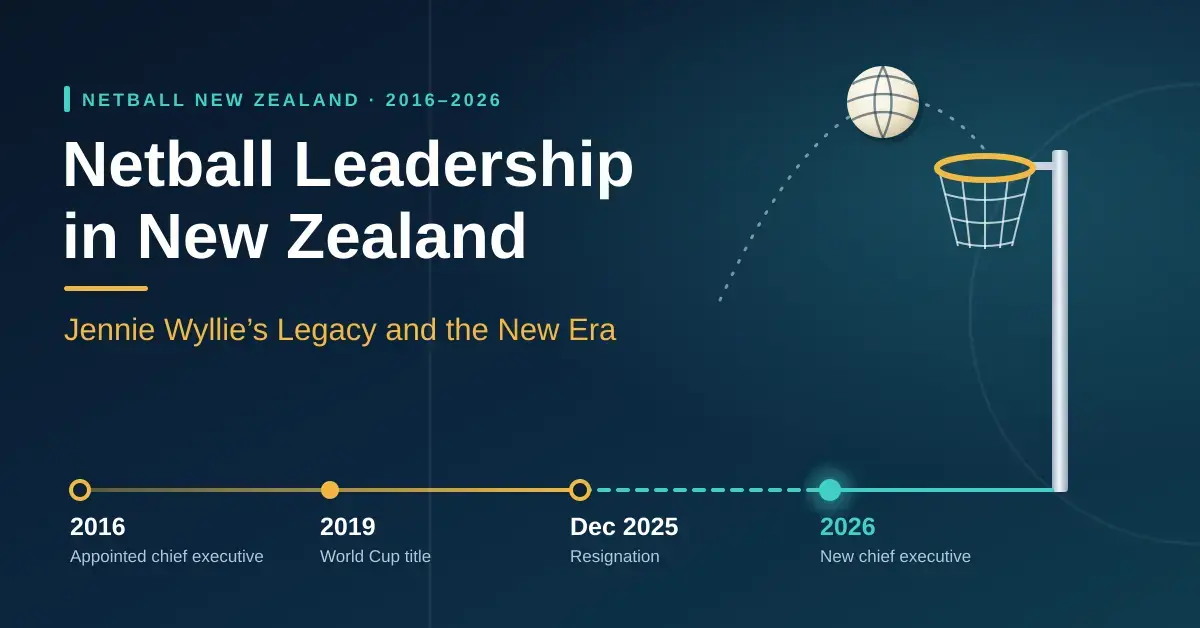
Leadership Timeline
| Date | Event |
|---|---|
| 2016 | Jennie Wyllie appointed CEO of Netball New Zealand |
| 2019 | Silver Ferns win the Netball World Cup |
| Sep 2025 | Coach Dame Noeline Taurua stood down amid a player-led investigation |
| Oct 2025 | Taurua reinstated as Silver Ferns head coach |
| 18 Dec 2025 | Jennie Wyllie announces her resignation as CEO |
| 19 Jan 2026 | Jane Patterson begins as interim CEO |
| May 2026 | Jennah Wootten named permanent CEO; Alastair Carruthers confirmed as board chair |
| Aug 2026 | Silver Ferns win Commonwealth Games gold; Wootten starts as CEO on 12 August |
A New Era: Wootten, Patterson and a Board Reset
The transition that followed reshaped the top of New Zealand netball. Chief commercial officer David Cooper steadied the organisation as acting chief executive, before Jane Patterson — a highly experienced administrator who had been chief operating officer for the 2023 FIFA Women’s World Cup — stepped in as interim CEO from 19 January 2026.
In May 2026, NNZ named Jennah Wootten as its permanent chief executive, with a start date of 12 August 2026. Wootten had been chief executive of Aktive — Auckland’s regional sport and recreation trust — since 2021, and her background includes leadership of the World Masters Games 2017, a senior role delivering the ICC Women’s Cricket World Cup 2021, and work on the Rugby World Cup 2011 programme in Auckland. She has signalled that modernising the domestic league is a priority.
The board was also reset. Alastair Carruthers CNZM — a governance veteran and former chair of TVNZ — was appointed board chair in 2026 for a three-year term, joined by new directors bringing governance, Māori development and financial expertise. For a fuller rundown of these appointments and the wider season, see our coverage of the latest New Zealand netball news.
The reset coincided with a rare bright spot: the Silver Ferns, back under Taurua, won Commonwealth Games netball gold in Glasgow in 2026, beating Jamaica 56–48 for the country’s first Commonwealth netball title since 2010. Taurua was subsequently reappointed as head coach through to the 2027 World Cup.
The Challenges Facing Netball’s Next Leaders
The new leadership inherits a sport that is strong on the court but fragile off it. The immediate tasks are clear from the public record:
- Securing the league: deciding the future of the ANZ Premiership — fix the current model, pause it, or move to a new privately backed competition from 2028.
- Stabilising finances: closing the gap behind a projected multi-million-dollar loss and rebuilding commercial and broadcast income.
- Rebuilding trust: repairing relationships with players and staff after the culture concerns and the coaching saga.
- Protecting participation: keeping grassroots netball affordable and accessible so the base stays broad.
- Backing high performance: resourcing the Silver Ferns toward the 2027 Netball World Cup in Sydney.
Jennie Wyllie’s legacy is therefore mixed and best stated plainly: real competitive and commercial gains across most of her tenure, followed by a difficult final year that left her successors with hard decisions. How Jennah Wootten, Jane Patterson’s groundwork and the new board respond will shape the next chapter of netball leadership in New Zealand.
Sources
- RNZ — Netball New Zealand boss Jennie Wyllie resigns
- Stuff — Jennie Wyllie resigns after Dame Noeline Taurua saga
- RNZ — Jennah Wootten named new boss of Netball NZ
- 1News — Netball NZ boss appointed, acknowledges ‘tough’ 12 months
- RNZ — Alastair Carruthers appointed to lead Netball NZ board
- Sportcal — ANZ Premiership returns to TVNZ for 2026
- 1News — ANZ Premiership to post $3.7m loss as future clouded in doubt
- RNZ — Netball NZ in talks with private investor over new league for 2028
- 1News — Silver Ferns end Commonwealth Games gold drought
- RNZ — Dame Noeline Taurua reappointed through to 2027 World Cup
- Netball New Zealand — Board members
Frequently Asked Questions
Is Jennie Wyllie still the CEO of Netball New Zealand?
No. Jennie Wyllie resigned as chief executive of Netball New Zealand, with her resignation communicated to staff on 18 December 2025. She had held the role since 2016.
Who is the new CEO of Netball New Zealand?
Jennah Wootten was appointed permanent chief executive in 2026 and took up the role on 12 August 2026. Jane Patterson served as interim CEO during the transition after Wyllie’s departure.
Why did Jennie Wyllie resign?
Her resignation followed a turbulent 2025 that included the stand-down and reinstatement of Silver Ferns coach Dame Noeline Taurua and staff concerns about workplace culture. Netball NZ said she planned to spend time with family and explore other opportunities.
What happened to the Silver Ferns and Noeline Taurua in 2025 and 2026?
Taurua was stood down in September 2025 during a player-led investigation, then reinstated in late October 2025. She went on to coach the Silver Ferns to Commonwealth Games gold in Glasgow in 2026 and was reappointed through to the 2027 World Cup.
What is happening with the ANZ Premiership?
The league moved to TVNZ for 2026, players took about a 20% pay cut, and Netball NZ flagged a projected loss near NZ$3.7 million. Its long-term future is uncertain, with talks under way about a privately backed league from 2028.