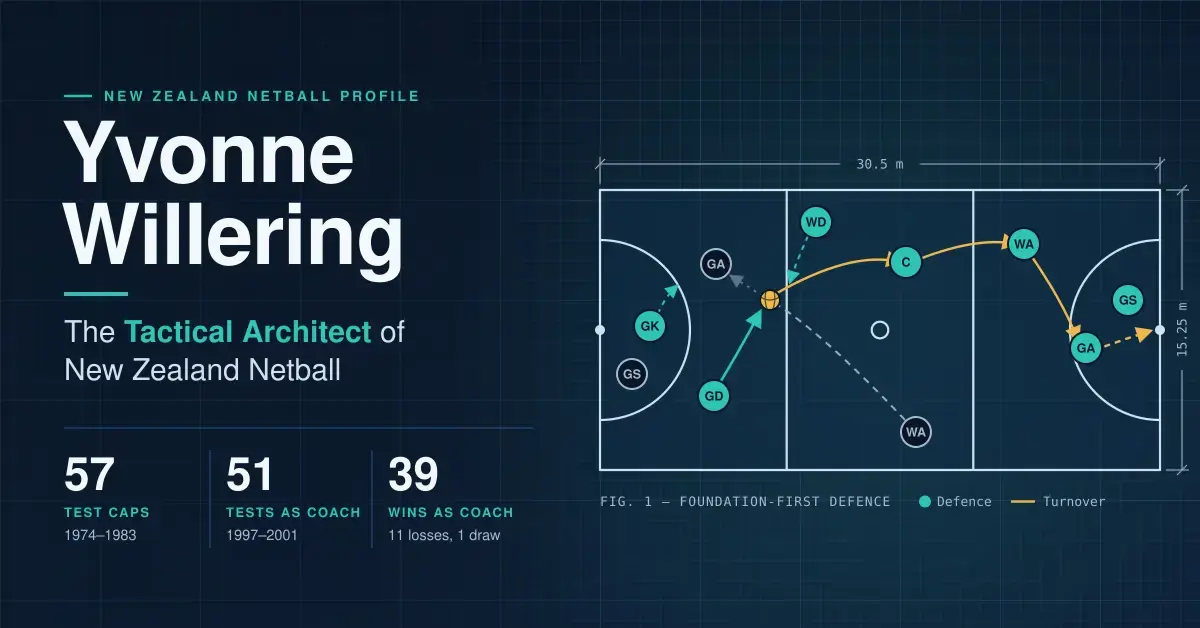
Yvonne Willering CNZM is one of the most respected and influential figures in the history of New Zealand netball, having excelled as a world-class defender, a championship-winning coach, and a prominent tactical analyst. Born in the Netherlands and emigrating to New Zealand as a child, she represented the Silver Ferns from 1974 to 1983, participating in three World Championships. Her coaching tenure from 1997 to 2001 was marked by a clinical, defensive-minded approach that yielded a 78% win record across 55 tests. This article provides a comprehensive breakdown of her career trajectory, her "foundation-first" coaching philosophy, and her enduring legacy as a mentor and commentator in the Oceania sporting landscape. We examine her domestic success with Auckland and the Northern Force, her international contributions to Fiji netball, and her recent involvement in high-level reviews of the Silver Ferns’ performance environment.
The Dutch-Kiwi Journey to Netball Stardom
Yvonne Mignon Willering was born in the Netherlands on January 15, 1950, and immigrated to New Zealand with her family in 1958. Growing up in a new country, netball became the vehicle through which she integrated into Kiwi culture. Initially reluctant to attend school due to the language barrier, she found her voice on the netball court, eventually training as a microbiologist while rising through the regional representative ranks. Her playing career was defined by her tenacity and height as a defender, specifically in the Goal Keep (GK) and Goal Defense (GD) positions. Between 1974 and 1983, she earned 41 caps for the Silver Ferns, a significant tally in an era with fewer international fixtures. She was a core member of the 1979 squad that famously shared the World Championship title in a three-way tie with Australia and Trinidad & Tobago.
- Full Name: Yvonne Mignon Willering CNZM.
- Playing Years: 1974–1983.
- Caps: 41 tests for the Silver Ferns.
- World Championships (Player): 1975 (Auckland), 1979 (Port of Spain), 1983 (Singapore).
- Early Career: Trained as a microbiologist while playing elite netball.
Full Name: Yvonne Mignon Willering CNZM.
Playing Years: 1974–1983.
Caps: 41 tests for the Silver Ferns.
World Championships (Player): 1975 (Auckland), 1979 (Port of Spain), 1983 (Singapore).
Early Career: Trained as a microbiologist while playing elite netball.
| Milestone | Year | Role | Result |
|---|---|---|---|
| International Debut | 1974 | Player | First cap vs England |
| World Title | 1979 | Player | Joint Gold Medal |
| Retirement (Playing) | 1983 | Player | Final World Championship appearance |
| Coaching Debut | 1986 | Coach | Auckland Provincial title |
Foundations of Defensive Excellence
Willering’s playing days were marked by the "Dutch grit" she brought to the circle. She was known for her exceptional reach and her ability to read the flight of the ball, traits that would later form the basis of her "zonal" defensive coaching theories. Her transition from player to coach was seamless, as she sought to apply the analytical precision of her microbiology background to the court.
Coaching the Silver Ferns: The Era of Clinical Discipline
In 1997, Yvonne Willering was appointed head coach of the Silver Ferns, taking over during a period of intense trans-Tasman rivalry. Her coaching tenure is remembered for its strict adherence to technical fundamentals and a "defense-first" mentality. Over 55 games, she guided the team to 43 victories, including a silver medal at the 1998 Commonwealth Games (the first time netball was included in the Games) and a heart-breaking one-goal silver at the 1999 World Championships in Christchurch. Willering was known for her tactical "chess matches" with Australian coach Jill McIntosh, often utilizing defensive blocks to neutralize the Diamonds' shooters. Despite her high winning percentage, she was controversially replaced by Ruth Aitken in late 2001, a decision that remains a point of debate in New Zealand netball history.
- Coaching Tenure: 1997–2001.
- Record: 43 wins, 11 losses, 1 draw (78% win rate).
- Major Medals: 1998 Commonwealth Games (Silver), 1999 World Championships (Silver).
- Signature Tactic: The "Willering Wall" (Zonal circle defense).
- Legacy: Professionalized the Silver Ferns' defensive structures.
Coaching Tenure: 1997–2001.
Record: 43 wins, 11 losses, 1 draw (78% win rate).
Major Medals: 1998 Commonwealth Games (Silver), 1999 World Championships (Silver).
Signature Tactic: The "Willering Wall" (Zonal circle defense).
Legacy: Professionalized the Silver Ferns' defensive structures.
| Event | Location | Result | Significance |
|---|---|---|---|
| 1998 Comm Games | Kuala Lumpur | Silver | First official Games medal |
| 1999 World Cup | Christchurch | Silver | Lost by 1 goal in the final seconds |
| 2000 Tri-Series | Australia/NZ | Winners | Dominance over world rankings |
The 1999 Final Heartbreak
The 1999 World Championship final in Christchurch is one of the most iconic matches in Willering’s career. Leading for much of the game, the Silver Ferns lost to Australia 42-41 after a last-second shot by Sharelle McMahon. Willering’s composure in the face of such a high-stakes defeat solidified her reputation as a leader of immense integrity and class. Read more in Wikipedia.
Domestic Dominance: Auckland and the Northern Force
Willering’s coaching success was forged in the fires of New Zealand’s domestic provincial competition. She began her coaching career with Auckland in 1986, leading them to a win in her very first game and eventually securing multiple national titles. In the early 2000s, she moved into the semi-professional National Bank Cup era as the head coach of the Northern Force. Her teams were notoriously difficult to score against, reflecting her belief that "champions are the ones who make fewer errors." Her ability to identify and develop young Auckland talent led to the rise of several future Silver Ferns, and she is credited with maintaining Auckland’s status as the powerhouse of New Zealand netball for over two decades.
- Provincial Success: Multiple National titles with Auckland.
- National Bank Cup: Led the Northern Force (predecessor to the Northern Mystics).
- Talent Development: Instrumental in the early careers of Temepara Bailey and Anna Harrison.
- Coaching Philosophy: "Netball is about doing the simple things well, over and over again."
- Retirement from Domestic: Signed off her 20-year provincial career with a win in 2005.
Provincial Success: Multiple National titles with Auckland.
National Bank Cup: Led the Northern Force (predecessor to the Northern Mystics).
Talent Development: Instrumental in the early careers of Temepara Bailey and Anna Harrison.
Coaching Philosophy: "Netball is about doing the simple things well, over and over again."
Retirement from Domestic: Signed off her 20-year provincial career with a win in 2005.
| Team | Era | Primary Achievement |
|---|---|---|
| Auckland | 1980s–1990s | Sustained national provincial dominance |
| Northern Force | 1998–2005 | Consistent finalists in the National Bank Cup |
| North Region | 2005 | Final provincial win before stepping back |
Teaching the "Minor" Aspects
Willering often criticized modern coaches for making drills too intricate. She advocated for a return to "fault detection and correction" in basic skills like footwork and ball release. Her philosophy centered on the idea that an intricate play is useless if the player cannot catch the ball under pressure.
International Contributions: Coaching Fiji
Following her departure from the Silver Ferns, Willering’s expertise was sought on the global stage. In 2002, she took on the role of head coach for the Fiji national team, the "Pearls." Her mission was to modernize Fiji’s tactical play and prepare them for the 2003 World Championships. Under her guidance, Fiji achieved significant technical improvements, moving away from a traditional "aerial" style to a more structured, New Zealand-influenced defensive system. Her time in Fiji is remembered for her efforts to build coaching capacity within the Pacific, ensuring that her impact lasted long after her contract ended.
- Role: Head Coach of Fiji (2002–2003).
- Achievement: Guided Fiji through the 2003 World Championships.
- Impact: Introduced professional conditioning and defensive structures to Fiji netball.
- Legacy: Mentored local Fijian coaches to ensure sustainability.
- Global Influence: Proved her systems worked with varying athletic styles.
Role: Head Coach of Fiji (2002–2003).
Achievement: Guided Fiji through the 2003 World Championships.
Impact: Introduced professional conditioning and defensive structures to Fiji netball.
Legacy: Mentored local Fijian coaches to ensure sustainability.
Global Influence: Proved her systems worked with varying athletic styles.
| Goal | Strategy | Outcome |
|---|---|---|
| Fitness | Introduction of “Yo-Yo” testing | Increased 60-minute intensity |
| Defense | Implementation of zonal interceptions | Reduced opposition scoring efficiency |
| Technical | Focus on ball security | Fewer unforced errors in midcourt |
Elevating the Pacific Game
Willering’s tenure in Fiji helped bridge the gap between the "Big Four" and the emerging Pacific nations. She was a vocal advocate for more international fixtures for Fiji, recognizing that exposure to New Zealand and Australian styles was the only way to improve their world ranking.
The Willering Coaching Philosophy: Foundation First
Yvonne Willering is a staunch advocate for teaching foundation skills. Her coaching manual, which has influenced generations of New Zealand coaches, emphasizes that netball is a "simple game" of throwing, catching, and moving. She believes that coaches often "trick themselves" by overcomplicating strategies, which leads to unforced errors. Her method involves constant fault detection and correction, specifically focusing on "minor" aspects like the pivot and the three-foot marking distance. She views a coach as a teacher first and foremost, wielding a powerful influence over an athlete’s sporting and personal life.
- Core Tenet: Netball is about doing the simple things well.
- Error Management: "The team that makes the least amount of unforced errors will succeed."
- Fault Detection: Continuous checking of catching, throwing, and footwork.
- Leadership Style: Leading through integrity and clear communication rather than mere authority.
- Motivation: Believes that "enjoyment" must be the core reason for both playing and coaching.
Core Tenet: Netball is about doing the simple things well.
Error Management: "The team that makes the least amount of unforced errors will succeed."
Fault Detection: Continuous checking of catching, throwing, and footwork.
Leadership Style: Leading through integrity and clear communication rather than mere authority.
Motivation: Believes that "enjoyment" must be the core reason for both playing and coaching.
| Attribute of a Good Coach | Application |
|---|---|
| Patience | Not expecting too much too soon |
| Clarity | Thinking clearly under match pressure |
| Consistency | Enthusiastic approach every session |
| Honesty | Sincerity in every phase of the program |
The "Fault Detection" Process
Willering’s sessions were famous for their "stop-and-start" nature. If she saw a footwork error, the drill stopped immediately. This rigorous attention to detail ensured that her players possessed a "muscle memory" for technical perfection, which held up under the immense pressure of international test matches.
Advocacy and Recent Involvement in NZ Netball
In recent years, Willering has remained a vital voice in the New Zealand netball landscape, often acting as a high-level mentor and critic. In 2024 and 2025, she was vocal regarding the administrative handling of the Silver Ferns' performance reviews. She criticized the "silence" and lack of transparency during the standing-down of Dame Noeline Taurua, advocating for better support structures for coaches. She remains a regular commentator and "mentor coach," recently participating in the "Game On" series to showcase netball legends. Her commitment to the sport remains unwavering, as she continues to push for a "player-centered" governance model that respects the history of the black dress.
- Mentorship: Involved in "Game On" (2024/2025) as a co-coach and mentor.
- Commentary: Frequent expert analyst for RNZ and Sky Sport.
- Advocacy: Vocal supporter of coaching welfare and transparency in governance.
- Integrity: Highly respected for her "no-nonsense" approach to netball administration.
- Community: Regularly attends provincial and grassroots tournaments to support youth development.
Mentorship: Involved in "Game On" (2024/2025) as a co-coach and mentor.
Commentary: Frequent expert analyst for RNZ and Sky Sport.
Advocacy: Vocal supporter of coaching welfare and transparency in governance.
Integrity: Highly respected for her "no-nonsense" approach to netball administration.
Community: Regularly attends provincial and grassroots tournaments to support youth development.
| Recent Activity | Role | Impact |
|---|---|---|
| Game On (2024) | Co-coach / Mentor | Revitalizing interest in netball legends |
| 2025 RNZ Interview | Critic / Advocate | Pushed for resolution in coaching sagas |
| Umpire Mentorship | Advisor | Improving official-coach relations |
Protecting the Coaching Profession
Willering has often highlighted that national coaches like Dame Noeline Taurua work in relative isolation. She has called for Netball New Zealand to implement "Coaching Support Hubs" where elite coaches can share insights and receive psychological support, preventing the burnout that affected her own era.
Recognition and Honors
Yvonne Willering’s services to netball have been officially recognized by the New Zealand government on multiple occasions. In 2002, she was appointed an Officer of the New Zealand Order of Merit (ONZM). In 2019, she was elevated to a Companion of the New Zealand Order of Merit (CNZM), reflecting her lifetime of dedication to the sport. These honors celebrate not just her winning record, but her role as a cultural ambassador for the Dutch-New Zealand community and her influence on the professionalization of women’s sport in Aotearoa.
- CNZM (2019): For services to netball.
- ONZM (2002): For services to netball.
- Inductee: New Zealand Netball Hall of Fame.
- Role Model: Symbol of successful migrant integration through sport.
- Academic Honors: Recognized for her professional background in microbiology.
CNZM (2019): For services to netball.
ONZM (2002): For services to netball.
Inductee: New Zealand Netball Hall of Fame.
Role Model: Symbol of successful migrant integration through sport.
Academic Honors: Recognized for her professional background in microbiology.
| Honor | Year | Significance |
|---|---|---|
| ONZM | 2002 | Initial recognition after Silver Ferns tenure |
| CNZM | 2019 | Lifetime achievement and elevated status |
| Sport NZ Awards | Various | Recognition for tactical innovation |
A Symbol of Integration
Willering’s story is often cited by the National Library of New Zealand as a primary example of the migrant experience. Her journey from a non-English speaking child on a "typhoid-stricken ship" to receiving a Royal Honor is a powerful narrative of resilience that inspires athletes across all codes.
The Willering Legacy: Tactical and Technical
The "Willering Legacy" is most visible in the way New Zealand defends. The modern Silver Ferns’ zonal "Wall" is an evolution of the structures Willering pioneered in the late 1990s. She taught New Zealand netballers that you don’t have to be the fastest player to win; you have to be the smartest. Her focus on "closing the space" and "working as a unit" moved netball away from individual tagging toward a sophisticated collective effort. Today, many ANZ Premiership coaches still utilize her drills and philosophies, ensuring that the "Auckland style" of netball she built remains the standard for the domestic game.
- Zonal Innovation: Pioneered the "interception-based" zonal defense.
- Technical Mastery: Made footwork and ball handling the priority of NZ coaching.
- Analytical Approach: Applied scientific observation to match analysis.
- Mentorship: Trained many of the current high-performance coaches in NZ.
Zonal Innovation: Pioneered the "interception-based" zonal defense.
Technical Mastery: Made footwork and ball handling the priority of NZ coaching.
Analytical Approach: Applied scientific observation to match analysis.
Mentorship: Trained many of the current high-performance coaches in NZ.
| Legacy Area | Contribution | Current Status |
|---|---|---|
| Defense | Zonal systems | Standard practice for Silver Ferns |
| Coaching | Foundation-first manual | Used in NZ coaching certifications |
| Media | Expert Analysis | Sets the tone for netball discussion |
The "Willering Way" in the ANZ Premiership
Even in 2026, when watching the Northern Mystics or the Central Pulse, one can see the fingerprints of Willering’s coaching. The way defenders position themselves "off the body" to hunt the ball is a direct descendant of the defensive revolution she started in the provincial Auckland teams.
Challenges Faced as a Trailblazer
Yvonne Willering’s career was not without its challenges. As a woman of Dutch heritage in a predominantly Anglo-New Zealand sport, she faced early criticism and cultural barriers. She has been open about her father’s struggle to have his Dutch qualifications recognized, a hardship that fueled her own determination to succeed in science and sport. Her controversial exit from the Silver Ferns in 2001 also highlighted the sometimes-harsh nature of high-performance administration. However, her ability to maintain her Dutch language skills and identity while becoming a quintessential New Zealand icon is a testament to her strong sense of self.
- Cultural Barrier: Emigrating to a "New Zealand-first" sporting culture.
- Administrative Turmoil: Controversial 2001 coaching replacement.
- Professional Balance: Juggling a scientific career with elite sports leadership.
- Gender Equity: Advocated for better funding in netball's early semi-pro years.
Cultural Barrier: Emigrating to a "New Zealand-first" sporting culture.
Administrative Turmoil: Controversial 2001 coaching replacement.
Professional Balance: Juggling a scientific career with elite sports leadership.
Gender Equity: Advocated for better funding in netball's early semi-pro years.
| Challenge | Response | Outcome |
|---|---|---|
| Language Barrier | Focused on on-court success | Built confidence through netball |
| 2001 “Dumping” | Took coaching to Fiji | Proved her value on the global stage |
| Funding Gaps | Pushed for National Bank Cup | Professionalized the domestic league |
Sincerity and Honesty
Throughout her career, Willering was known for her "no-frills" honesty. She never "tricked" her players with false praise, believing that sincerity was the only way to build a championship team. This integrity is why she remains one of the most trusted voices in the sport today.
Future Outlook: Mentoring the 2027 World Cup Cycle
As New Zealand prepares for the 2027 Netball World Cup in Sydney, Yvonne Willering continues to play a role in the shadows. She acts as a sounding board for many of the current international players and provides expert analysis that keeps the national body accountable. Her recent work in the "Game On" series suggests that she is focused on preserving the "history and mana" of the sport, ensuring that the legendary players of the past are used to inspire the stars of tomorrow. Her vision for the future involves a return to the "brutal basics"—ensuring that New Zealand netballers are the most technically proficient athletes in the world.
- Current Focus: Mentoring and preserve-heritage projects.
- Vision: Improving the technical standard of the ANZ Premiership.
- Goal: Supporting a successful 2027 World Cup campaign.
- Role: Elder stateswoman and "integrity guardian" of the sport.
Current Focus: Mentoring and preserve-heritage projects.
Vision: Improving the technical standard of the ANZ Premiership.
Goal: Supporting a successful 2027 World Cup campaign.
Role: Elder stateswoman and "integrity guardian" of the sport.
| Target | Desired Outcome |
|---|---|
| ANZ Premiership | Reduction in unforced handling errors |
| Silver Ferns | Return to clinical defensive dominance |
| Coaching | Better professional support networks |
The Elder Stateswoman
Willering’s presence at Spark Arena during international tests is a reminder of the standards required to wear the black dress. She remains a symbol of the "uncompromising pursuit of excellence" that defined New Zealand netball’s golden eras.
Final Thoughts
Yvonne Willering CNZM is a titan of New Zealand netball whose influence spans half a century. From her arrival as a Dutch migrant to her elevation as a Companion of the New Zealand Order of Merit, she has exemplified the power of technical discipline and intellectual rigor in sport. Her "foundation-first" philosophy continues to shape how the game is taught, played, and analyzed across Oceania. Whether as a player who refused to be beaten or a coach who demanded technical perfection, Willering’s legacy is woven into the very fabric of the Silver Ferns. She remains the conscience of the sport, a leader whose integrity and passion continue to ensure that New Zealand netball stays true to its fundamental roots.
FAQ
Who is Yvonne Willering? She is a former Silver Ferns player and coach, widely regarded as one of New Zealand’s greatest defensive tactical minds.
When did she coach the Silver Ferns? She coached the national team from 1997 to 2001.
What is her heritage? She was born in the Netherlands and immigrated to New Zealand in 1958.
What honors has she received? She is a Companion of the New Zealand Order of Merit (CNZM) and an Officer of the New Zealand Order of Merit (ONZM).
Did she play for the Silver Ferns? Yes, she played 41 tests for New Zealand between 1974 and 1983.
Which teams did she coach domestically? She famously coached Auckland and the Northern Force in the National Bank Cup.
What is her coaching philosophy? She emphasizes technical fundamentals, fault correction, and "doing the simple things well."
Did she coach international teams other than New Zealand? Yes, she was the head coach of the Fiji national team from 2002 to 2003.
What was her professional career outside of netball? She trained and worked as a microbiologist.
What is her role in netball today? She is an expert commentator, mentor, and advocate for transparency in netball governance.