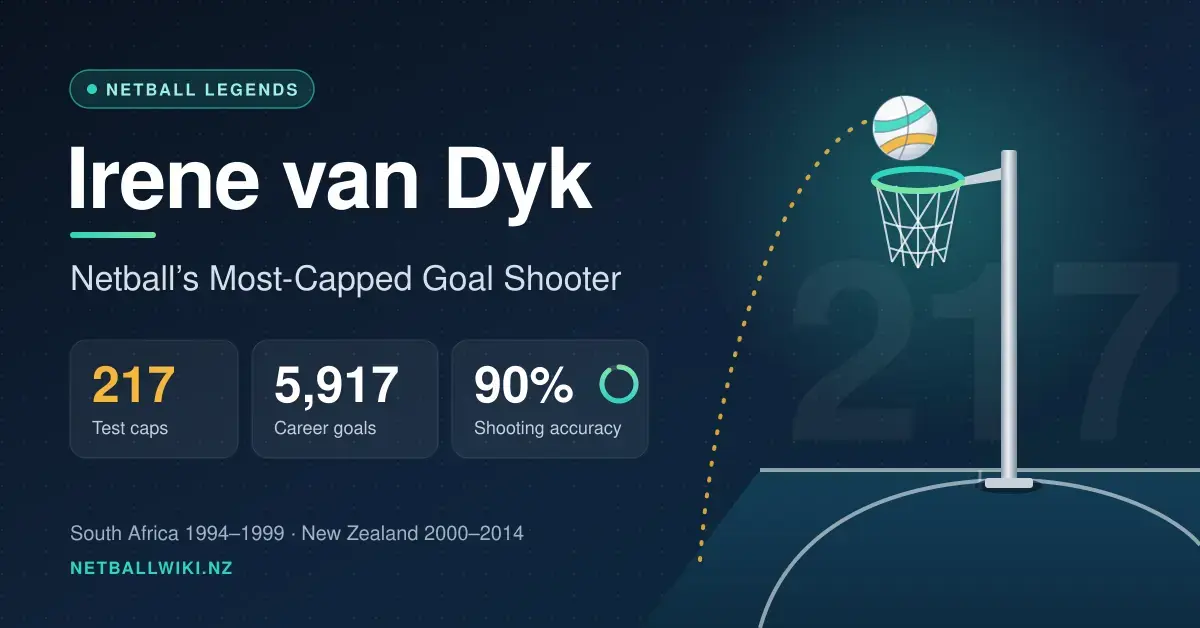
Irene van Dyk is a retired goal shooter who became the most-capped international in the history of netball, playing a record 217 Test matches across two countries. She first represented her native South Africa and then, after moving south in 2000, became one of the defining players of New Zealand’s Silver Ferns. Famed for metronomic shooting accuracy that hovered around 90% for two decades, she remains a reference point for how the goal-shooter position can be played at the highest level.
Quick Facts
| Full name | Irene van Dyk (née Viljoen) |
|---|---|
| Born | 21 June 1972, Vereeniging, Gauteng, South Africa |
| Height | 1.90 m (6 ft 3 in) |
| Position | Goal shooter (GS); also goal attack (GA) |
| Countries | South Africa (1994–1999); New Zealand / Silver Ferns (2000–2014) |
| Total caps | 217 — the most-capped netball international |
| Career goals | 5,917 from 6,572 attempts (≈90%) |
| NZ clubs | Capital Shakers (2000–2002), Waikato Bay of Plenty Magic (2003–2013), Central Pulse (2014–2015) |
Who is Irene van Dyk?
Born Irene Viljoen on 21 June 1972 in Vereeniging, in what is now South Africa’s Gauteng province, she stands 1.90 m (6 ft 3 in) tall. That height, paired with a soft shooting touch, made her a natural goal shooter (GS) — the attacking position that takes most of a team’s shots from inside the shooting circle — though she also played goal attack (GA), a position that combines shooting with feeding the ball into the circle. You can read more about how these roles work in our guide to netball positions and court areas.
What set Van Dyk apart was not flair but consistency. She shot in high volume and converted at a rate most shooters never sustain across a single season, let alone a 20-year career spanning two national teams. That reliability turned her into the focal point of every attacking line she played in.
Early career in South Africa
Van Dyk’s international career began at home. She made her debut for South Africa in 1994 — the same year the country returned to international sport after the end of apartheid-era isolation — and went on to earn 72 caps for the national side through to 1999. In that period she scored 1,121 goals from 1,284 attempts, a success rate of about 87%.
Her form quickly drew attention beyond South Africa. In 1996 she received the State President’s Merit Award, presented by Nelson Mandela, in recognition of her sporting contribution. By the end of the decade she was widely regarded as one of the best shooters in the world, and a move abroad opened the next chapter of her career.
Move to New Zealand and the Silver Ferns
In 2000 Van Dyk relocated to New Zealand. Under the eligibility rules of the time she became available for the Silver Ferns, New Zealand’s national netball team, and made her debut that year. The transfer was significant: it strengthened an already powerful side and gave her a platform in a country where netball is the leading women’s sport.
Over the next 14 seasons she amassed 145 caps for New Zealand, scoring 4,796 goals from 5,288 attempts at a 91% conversion rate — slightly better than her overall career average. Combined with her South African record, that gave her 217 international caps in total, more than any other netball player, and 5,917 goals from 6,572 attempts at an overall 90%.
The switch was not without controversy. A player of Van Dyk’s standing moving from one leading nation to a rival inevitably prompted debate about netball’s eligibility rules, and about whether South Africa had lost its best player at the moment it was rebuilding. Those discussions eventually fed into tighter international eligibility criteria. For Van Dyk herself, though, New Zealand quickly became home, and she went on to spend far longer in black than she ever did in South African green.
Major international honours
Van Dyk’s silverware with the Silver Ferns reflects a sustained run at the top of the world game:
- World Netball Championships: gold in 2003 (Jamaica), with runner-up finishes in 2007 and 2011.
- Commonwealth Games: gold at Melbourne 2006 and Delhi 2010, following a silver with South Africa’s generation and then New Zealand at Manchester 2002.
- World Netball Series (the former Fast5 short-format event): titles in 2009 and 2012.
- Taini Jamison Trophy and Constellation Cup: multiple series wins against England and Australia through her Silver Ferns years.
The 2003 world title was the standout. New Zealand won the championship in Jamaica with Van Dyk a central figure in attack, and that squad is still remembered as one of the country’s finest — among her teammates were players such as Silver Ferns captain Adine Wilson. For a fuller view of how netball’s global showpiece has evolved, see our overview of the Netball World Cup and its winners.
Club career in New Zealand
Van Dyk’s domestic career in New Zealand ran across three clubs and two league eras. She first played for the Capital Shakers in Wellington (2000–2002) in the National Bank Cup, the trans-provincial competition that preceded today’s professional leagues.
In 2003 she joined the Waikato Bay of Plenty Magic, the Hamilton-based side she would be most associated with. As the team’s primary scorer she helped the Magic win back-to-back National Bank Cup titles in 2005 and 2006. When the trans-Tasman ANZ Championship launched in 2008, she remained the club’s attacking cornerstone.
The crowning moment came in 2012. The Magic, coached at the time by Dame Noeline Taurua, defeated the Melbourne Vixens 41–38 in the grand final after overturning a six-goal deficit, becoming the first and only New Zealand franchise to win the ANZ Championship. Van Dyk finished her Magic tenure in 2013, then played two further seasons for the Central Pulse (2014–2015) before retiring from club netball.
Playing style and shooting accuracy
Van Dyk’s game was built on positioning and a repeatable shooting routine rather than athleticism. She used her height and strong hold to win front-of-circle position, took the ball close to the post, and released a high, soft shot with a consistent arc. Because her technique varied so little from attempt to attempt, her accuracy stayed remarkably stable even under finals pressure.
That dependability shaped how teams played around her. Mid-courters could feed early, knowing a high percentage of those passes would convert, which in turn drew defenders out of position and created space for the goal attack. Coaches and juniors still study that economy of movement; our netball shooting drills guide covers the arc, backspin and accuracy benchmarks that underpin the same fundamentals.
Her longevity was just as striking as her accuracy. Goal shooting is a physically demanding role — holding position against tall, strong defenders for 60 minutes — yet Van Dyk competed at the top level into her forties. She managed her body carefully, adapting her movement as she aged and relying increasingly on reading the play rather than outrunning opponents. That ability to evolve her game is one reason she was still a first-choice Silver Fern long after most contemporaries had retired.
She is often discussed alongside other great Silver Ferns shooters such as Maria Folau, with whom she formed one of New Zealand’s most productive shooting partnerships. Where Folau offered long-range threat and movement, Van Dyk provided the close, high-percentage option under the post — a contrast that gave the Ferns two very different ways to attack the circle.
Career statistics and honours
Across 20 seasons of international netball, Van Dyk’s numbers underline both her longevity and her precision. The key figures and titles are summarised below.
Career Honours
- World Netball Championships: gold 2003; runner-up 2007, 2011
- Commonwealth Games: gold 2006 and 2010; silver 2002
- World Netball Series: winner 2009 and 2012
- ANZ Championship: winner 2012 with Waikato Bay of Plenty Magic
- National Bank Cup: winner 2005 and 2006
- Individual: NZ Sportswoman of the Year (Halberg, for 2003); MNZM (2009); Netball NZ Hall of Fame (2024)
Individually, she was named New Zealand Sportswoman of the Year at the Halberg Awards for her 2003 season, and in 2009 she was appointed a Member of the New Zealand Order of Merit (MNZM) for services to netball. In 2024 she was inducted into the Netball New Zealand Hall of Fame, formal recognition of a career that reshaped expectations of the shooting circle.
Life after netball
Van Dyk retired from international netball in June 2014, aged 41, and from club netball after the 2015 season. She married Christie van Dyk in 1994 and has a daughter, Bianca; the family’s relocation to New Zealand in 2000 was a decisive moment in both her career and her life.
Since retiring she has stayed close to the sport. She has worked in coaching and development roles — including specialist coaching with the Central Pulse — and has taken up positions with Netball New Zealand, while also contributing to the broader women’s-sport community. Her continued involvement keeps her visible to the generation of shooters who grew up watching her play.
Legacy in New Zealand netball
Few imports have had the impact on a national sport that Van Dyk had on New Zealand netball. Her caps record still stands, her shooting percentages remain a benchmark, and her move from South Africa is often cited when the game debates player eligibility and movement between nations. She also arrived at a time when netball was professionalising in New Zealand and Australia, and her profile helped lift crowd and broadcast interest through the National Bank Cup and early ANZ Championship years.
For younger shooters she offers a clear model: dominate position, keep technique simple, and convert at a high rate rather than chase spectacular play. That template still shapes how goal shooters are coached in New Zealand. For a deeper look at her influence on the Silver Ferns and the wider game, see our article on the legacy and influence of Irene van Dyk in New Zealand netball.
Sources
Frequently Asked Questions (FAQ)
How many caps did Irene van Dyk win?
She played 217 international Test matches in total — 72 for South Africa between 1994 and 1999 and 145 for New Zealand’s Silver Ferns between 2000 and 2014. That remains the most by any netball international.
Why did Irene van Dyk play for both South Africa and New Zealand?
She was born and began her career in South Africa, earning 72 caps for the Proteas. After relocating to New Zealand in 2000 she became eligible for the Silver Ferns under the eligibility rules of the time and represented her adopted country for the rest of her career.
What position did Irene van Dyk play?
She was primarily a goal shooter (GS), the position that takes most of a team’s shots from inside the circle. She also played goal attack (GA), which combines shooting with feeding the ball into the shooting circle.
How accurate was Irene van Dyk at shooting?
Across her international career she scored 5,917 goals from 6,572 attempts, an overall success rate of about 90%. Her Silver Ferns accuracy was even higher, at roughly 91%.
When did Irene van Dyk retire?
She retired from international netball in June 2014 at the age of 41 and played her final club netball for the Central Pulse in the 2015 season.