Netball is a fast, seven-a-side team sport built around passing, movement and accurate shooting. It is played by millions of people across more than 80 countries and is one of the most popular team sports for women and girls in New Zealand. This guide explains what netball is, how the game works, the seven court positions, the rules that most often confuse newcomers, the main tactics, the benefits of playing, and how to get started — all in plain language, with the official figures checked against current sources.
Key Points
- Players per team: 7 on court, each in a set position
- Court: 30.5 m long by 15.25 m wide, divided into three thirds
- Ball: size 5, 690–710 mm around, 400–450 g
- Goal: a 380 mm ring on a 3.05 m post, with no backboard
- Who can shoot: only the Goal Shooter and Goal Attack, from inside the goal circle
- Scoring: 1 point per goal in standard netball
- Match length: 60 minutes — four 15-minute quarters
- Key rules: no running with the ball; pass or shoot within 3 seconds; defend from 0.9 m
- Global body: World Netball, with 80+ member nations
What Is Netball?
Netball is an invasion game: two teams of seven try to move a ball into their shooting area and score by throwing it through a ring, while the other team defends and tries to win the ball back. What makes netball distinctive is a set of restrictions that force teamwork. Players cannot run with the ball, cannot hold it for more than a few seconds, and are each limited to a defined area of the court depending on their position. The result is a game of constant movement, sharp passing and quick decisions rather than individual dribbling.
A match is usually played over four quarters and is officiated by two umpires. Because contact is heavily restricted, netball rewards timing, footwork and positioning over physical strength, which is a large part of why it is accessible to players of so many ages and body types.
The Origins and Evolution of Netball
Netball grew out of early versions of basketball in the 1890s. When the game was introduced to women in England and then exported across the British Empire, local adaptations — different court markings, no backboards, set positions and no running with the ball — gradually hardened into a separate sport. Because it developed through many hands in several countries, there is no single inventor; if you are curious about that story, see our explainer on who invented netball.
The sport took deep root in Commonwealth countries, especially Australia and New Zealand. In 1960 an international governing body was formed — originally the International Federation of Netball Associations — which standardised the rules so that countries could compete against one another. That body is known today as World Netball and has more than 80 member nations, which is why the modern game looks broadly the same whether you are watching a club match in Auckland or an international in Cape Town.
How the Game Works: Court, Ball and Scoring
Before the positions and rules make sense, it helps to picture the playing area and equipment.
The court
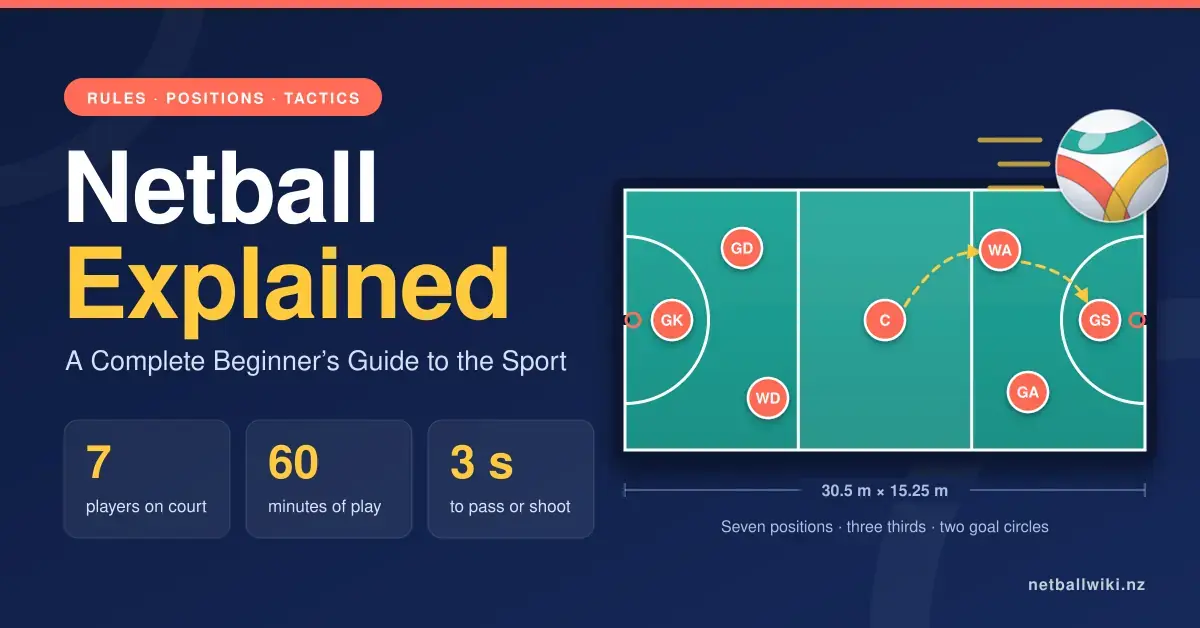
A full-size netball court is a hard rectangle measuring 30.5 metres long and 15.25 metres wide. It is divided across its length into three equal thirds — two goal thirds and a centre third — by two transverse lines. At each end sits a semi-circular shooting area called the goal circle, with a radius of 4.9 metres, and in the middle of the court is a small centre circle 0.9 metres across where play restarts after every goal. For the full breakdown of lines and markings, see our guide to official netball court dimensions.
The ball and the goalposts
Netball is played with a size 5 ball, similar in size to a football but usually made of rubber or a leather-like composite. It measures 690 to 710 millimetres around and weighs roughly 400 to 450 grams. The ring sits at the top of a 3.05-metre-high post — the same height as a basketball ring — but with one key difference: a netball ring has no backboard. The ring itself is 380 millimetres in diameter, so a clean shot leaves little margin for error.
How scoring works
A goal counts as one point and can only be scored from inside the goal circle. Crucially, only two players on each team are allowed to shoot: the Goal Shooter and the Goal Attack. Every other player exists to win, protect and deliver the ball to those two. In some competitions, such as the shortened Fast5 format, longer-range shots can be worth two or three points, but in standard netball every goal is worth one.
The Seven Positions
Each of the seven players wears a bib showing a position code, and each position may only enter certain areas of the court. Learning these zones is the single most useful thing a beginner can do, because stepping outside your area gives the ball straight to the other team. The table below summarises each role; for a deeper look at responsibilities and combinations, read our full breakdown of all seven netball positions.
Positions at a Glance
| Position | Code | Main job | Where they can go |
|---|---|---|---|
| Goal Shooter | GS | Score goals | Attacking goal third and goal circle |
| Goal Attack | GA | Score and feed the circle | Centre third, attacking goal third and goal circle |
| Wing Attack | WA | Feed the ball to the shooters | Centre third and attacking goal third (not the circle) |
| Centre | C | Link defence and attack; take the centre pass | All three thirds, but not either goal circle |
| Wing Defence | WD | Mark the opposing Wing Attack | Centre third and defensive goal third (not the circle) |
| Goal Defence | GD | Defend and win turnovers | Centre third, defensive goal third and goal circle |
| Goal Keeper | GK | Defend the shooters | Defensive goal third and goal circle |
The Centre is the only player allowed in all three thirds (though never inside either goal circle) and is usually the engine of the team, linking defence to attack. The two shooters and the Goal Keeper and Goal Defence do most of the circle work at either end, while the two wings feed the ball in and shut down the opposition’s feeders.
The Core Rules Every Beginner Should Know
Netball has a reputation for strict, precise rules. A handful of them account for the large majority of whistles in a beginner’s first season. Our complete guide to netball rules covers every situation, but these are the essentials.
Footwork
You cannot run with the ball. When you catch it, the first foot to land becomes your landing foot. You may pivot on that foot and step with the other, but if the landing foot lifts and is re-grounded before you pass or shoot, the umpire calls a footwork infringement and the ball goes to the opposition.
The three-second rule
Once you have the ball you must pass or shoot it within three seconds. Holding on longer results in a “held ball” call. This rule is what keeps netball moving so quickly and forces players to find passing options before they receive the ball.
Defending and the 0.9 metre rule
A defender marking the player with the ball must stand at least 0.9 metres away, measured from that player’s landing foot. From there the defender may jump, reach and try to intercept or block the pass or shot. Standing closer than 0.9 metres is “obstruction” and is penalised.
Offside and zones
Every player must stay within the court areas allowed for their position. Entering an area you are not permitted in — even without the ball — is an offside infringement and hands a free pass to the other team.
Contact
Netball is often called a non-contact sport; more precisely, contact that interferes with an opponent is not allowed. Players cannot push, bump, trip or hold, and a defender cannot touch the player with the ball. Accidental, momentary contact is usually played on, but anything that affects an opponent’s play is penalised.
Strategies and Tactics
Because individual players are confined to zones, netball is a genuinely collective game. Good teams win through patterns and timing rather than solo brilliance.
- Driving and leading: attackers make sharp, timed runs into space to receive a pass, then quickly reposition — a constant cycle of movement to pull defenders out of shape.
- The centre pass: play restarts from the centre after every goal, with the two teams alternating. Set moves off the centre pass are a major source of scoring, and losing your own centre pass is a costly turnover.
- Feeding the circle: the Wing Attack, Goal Attack and Centre work to deliver accurate passes into the shooters inside the goal circle, often using the baseline and short, angled balls rather than risky lobs.
- Defensive pressure: defenders use one-on-one marking, zone defence and the interception to force errors. A well-timed intercept near your own goal can swing a game instantly.
Benefits of Playing Netball
Netball delivers a well-rounded mix of physical and social benefits, which is a large part of its appeal across all ages.
- Fitness: the stop-start sprinting, jumping and quick changes of direction build cardiovascular fitness, leg strength and agility.
- Coordination: catching, passing and shooting sharpen hand-eye coordination, balance and body control.
- Teamwork and communication: the zoned positions make constant talking and trust essential, which builds strong social skills on and off the court.
- Decision-making: the three-second limit trains players to read the game and make fast, accurate choices under pressure.
- Accessibility: because strength matters less than timing, netball suits a wide range of ages and abilities, and low-impact social versions make it easy to pick up as an adult.
Netball on the World Stage
Internationally, netball is dominated by a small group of powerhouse nations. Australia (the Diamonds) and New Zealand (the Silver Ferns) have one of the fiercest rivalries in women’s sport, with Jamaica, England and South Africa close behind. The pinnacle event is the Netball World Cup, held every four years. Australia has won it a record 12 times, most recently in 2023, while New Zealand has won it five times.
New Zealand’s most recent major success came at the 2026 Commonwealth Games in Glasgow, where the Silver Ferns beat Jamaica 56-48 to claim gold — their first Commonwealth title since 2010. The sport is governed at home by Netball New Zealand, which runs the national team pathway and the domestic league that feeds it.
Getting Started in New Zealand
Netball is one of the easiest sports to take up in Aotearoa, with clubs, school teams and casual social leagues in almost every town. Here is a simple path in:
- Find a local centre or club: most regions run winter competitions from around April to August, plus shorter twilight and social grades through summer.
- Start with the junior pathway if you are young: New Zealand’s futureFERNS programme introduces children to the game with modified rules, smaller courts and lower hoops that grow with the player.
- Get the basics: comfortable court shoes with good grip and lateral support, plus a size 5 ball, are enough to begin. Clubs usually provide bibs.
- Practise the fundamentals: catching, pivoting and accurate passing matter more than anything at the start. A few simple beginner netball drills will cover most of what a new player needs.
Common Mistakes Beginners Make
Most early penalties come from a short list of habits that are easy to fix once you know them:
- Taking extra steps: forgetting which foot is the landing foot and dragging or re-grounding it. Practising a clean stop and pivot solves most footwork calls.
- Standing too close when defending: creeping inside the 0.9 metre distance gives away an obstruction penalty. Mark at arm’s length and use timing instead.
- Holding the ball too long: searching for the perfect pass past three seconds. Look for options before you catch, not after.
- Straying out of your zone: an attacker drifting into the goal circle when their position does not allow it, or a wing stepping into the circle, both hand over possession.
Sources
Frequently Asked Questions (FAQ)
How many players are on a netball team?
Seven players from each team are on the court at once, each in a fixed position with its own area of the court. Teams also carry substitutes who can be rotated in at intervals or for injury.
Who is allowed to shoot in netball?
Only the Goal Shooter (GS) and Goal Attack (GA) can score, and they must shoot from inside the semi-circular goal circle. Every other position is restricted from shooting, even if they are standing in the circle’s area.
Can you run with the ball in netball?
No. Once you catch the ball you must keep your landing foot grounded, and you have three seconds to pass or shoot. You may pivot on the landing foot but cannot take steps that carry the ball up the court.
How long does a netball game last?
A standard match is 60 minutes of play, split into four 15-minute quarters with short breaks between them. Junior, school and social formats often use shorter quarters, and you can read more about how long a netball game lasts in our dedicated guide.
Is netball a contact sport?
Netball is classed as a limited-contact sport. Players cannot push, hold, trip or obstruct an opponent, and a defender must stay 0.9 metres from the player with the ball. Only incidental, non-interfering contact is allowed.