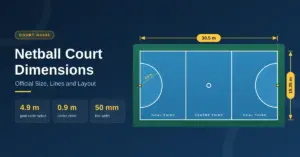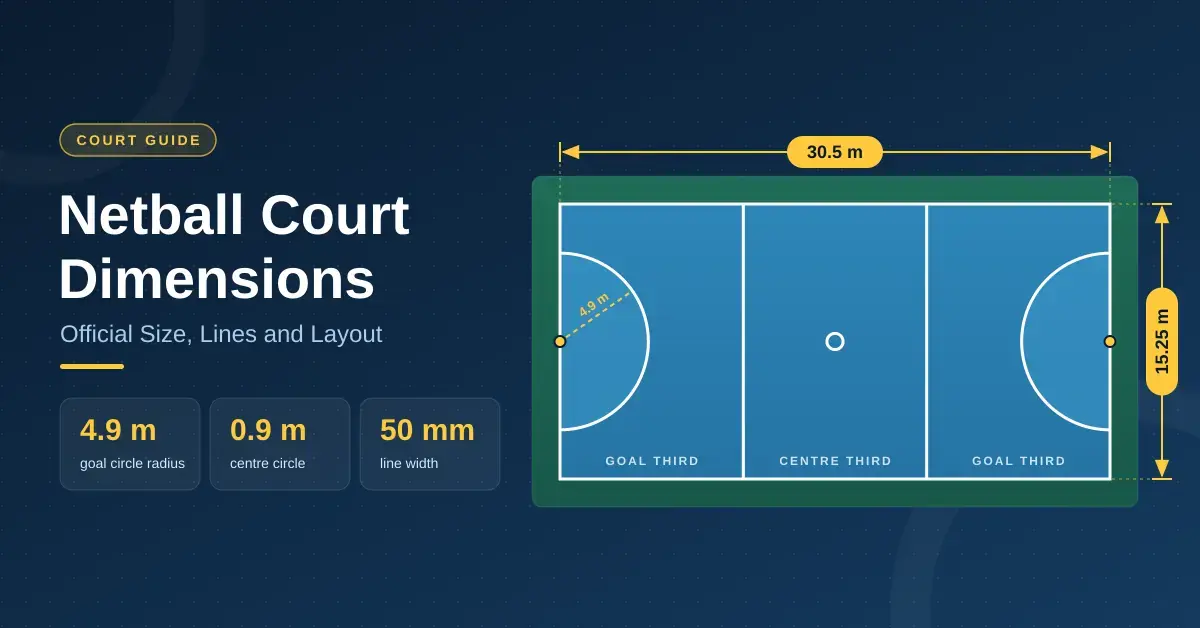
A full-size netball court is 30.5 metres long and 15.25 metres wide, divided into three equal thirds with a semi-circular goal circle at each end. Those are the headline numbers most people come looking for — but if you are marking out a court, planning a build or working out whether a hall or paddock will actually fit one, the surrounding detail matters just as much. This guide sets out every official measurement, the run-off space that catches most projects out, and how the New Zealand junior game changes the picture.
The standard court size
The court is a level, firm rectangle, and the same size for club, school and international play. Its two longer sides are called side lines and measure 30.5 metres (100 feet). The two shorter ends are called goal lines and measure 15.25 metres (50 feet). All measurements are taken to the outside edge of the lines, and the specifications are set by World Netball, the sport’s international governing body.
Every line on the court is 50 millimetres wide, preferably white, and — this is the part that trips newcomers up — each line is part of the area it encloses. A player with a toe on a line counts as standing in the space that line marks out, which is exactly what turns a foot on a transverse line into an offside call.
Quick facts
| Element | Measurement |
|---|---|
| Court length (side lines) | 30.5 m (100 ft) |
| Court width (goal lines) | 15.25 m (50 ft) |
| Each third | 10.167 m |
| Centre circle | 0.9 m diameter |
| Goal circle | Semi-circle, 4.9 m radius from the goal-line mid-point |
| Line width | 50 mm, preferably white, part of the area enclosed |
| Goalpost height | 3.05 m to the top of the ring |
| Ring internal diameter | 380 mm |
| Minimum run-off | 3.05 m on all sides; 3.65 m between courts |
| Outdoor gradient | 1% cross fall both ways, or 1% diagonal fall |
Thirds and transverse lines
Two lines drawn parallel to the goal lines split the court into three equal areas. These are the transverse lines. The middle area is the centre third and the two end areas are the goal thirds. Each third measures 10.167 metres — 30.5 divided by three.
The thirds are not decorative. They govern where each of the seven players is allowed to move, and they are the single biggest reason netball looks so different from basketball despite a similar footprint. Our guide to netball positions sets out which areas each bib may enter.
The goal circle and centre circle
A goal circle sits at each end of the court: a semi-circle with a radius of 4.9 metres, centred on the mid-point of the outside of the goal line. Only a team’s two shooters may enter it, and every scoring shot must be taken from inside it.
In the middle of the court is the centre circle, 0.9 metres in diameter. The player wearing the Centre bib must be wholly inside it to take a centre pass at the start of play and after every goal.
Marking out the goal circle
- Find the mid-point of the 15.25-metre goal line, measuring to the outside edge of the line.
- Anchor a non-stretch tape at that point.
- Measure out 4.9 metres and swing a smooth arc from one side of the goal line across to the other.
- Check that both ends of the arc finish flush against the goal line.
Get the anchor point wrong by even a few centimetres and every shot from the circle edge is being taken from the wrong distance — which matters more now that some competitions, including the ANZ Premiership, use a two-point ‘super shot’ zone measured out from the post. The full set of playing rules is covered in our netball rules guide.
Goalposts on the court
A goalpost stands at the mid-point of each goal line, positioned so the back of the pole sits at the outer edge of the line. It is fixed into a ground socket or sleeved beneath the floor so that a knock produces minimal movement and it stays stable throughout play.
Because the line is 50 millimetres wide and the pole is 65–100 millimetres in diameter, the post ends up overlapping the court by 15–50 millimetres. The post is genuinely in play, which is why you see shooters working around and behind it rather than treating it as out of bounds.
The pole is 3.05 metres high and wrapped in padding of uniform thickness, no more than 50 millimetres thick, running its full length to soften collisions. The ring is a 15-millimetre steel rod with a 380-millimetre internal diameter, attached to a 150-millimetre horizontal bar projecting from the top of the pole; the net is preferably white and open at both ends. World Netball’s facilities and equipment guidance lists the full hardware standard, and our netball hoop guide breaks down each part.
Run-off: the space you actually need
This is the figure most people miss. The playing court is 30.5m by 15.25m, but you cannot build a court that size in a space that size — players run out of bounds at speed and need clear, safe room to stop, turn and throw back in.
The minimum run-off on every side line and goal line is 3.05 metres. Where courts are laid side by side, the run-off between adjacent courts is 3.65 metres. Run-off zones must be completely free of obstacles and finished in the same surface and at the same level as the court itself.
Design guidance then scales the requirement to the level of play. For an indoor premier court, run-offs of 3.05 metres at both ends and both sides give an overall single-court footprint of about 36.60m by 23.35m, with a clear ceiling height of at least 7.5 metres and a further 2.0 metres alongside the court length for team benches and officials.
For an indoor club court the minimums drop to 2.0 metres at the ends and 1.5 metres at the sides (3.05 metres is still preferred), giving an overall footprint of roughly 34.50m by 18.25–20.25m. If you are assessing a site, always work backwards from the total footprint rather than from the court markings alone.
Line markings, colour and surface
Lines should be 50 millimetres wide, straight, with clean crisp edges, and it is recommended they are applied in a textured, water-based acrylic. White is the standard colour. On a shared multi-sport surface where another sport has priority, red or blue may be used for the netball lines — yellow is specifically excluded, which catches out a lot of multi-sport court planning.
Outdoor courts should be laid with a 1% cross fall in both directions, or a 1% fall running diagonally across a single constant plane, so water drains away quickly. Indoor courts are flat, with no gradient.
The rules state the surface should be wooden, preferably sprung wooden, but may be another material provided it is safe to play on. In practice most New Zealand community netball is played outdoors on asphalt or concrete: durable and well-draining when the fall is right, but abrasive and hard underfoot. A textured acrylic coating over a sound asphalt base adds grip and a little shock absorption, while sprung timber is largely confined to indoor stadiums.
Surface upkeep is a genuine safety task rather than a cosmetic one. Courts shaded by buildings or trees grow moss and algae over winter, and the painted lines are the first thing to turn slippery. Netball New Zealand’s NetballSmart programme focuses on reducing injuries such as ankle and knee sprains, and the ACC injury data behind the NetballSmart partnership shows just how much a safe, well-kept playing surface matters.
Junior variations in New Zealand
The court itself does not shrink for junior grades in New Zealand — what changes is the number of players, how much of the court is used, the ball size and the height of the goalpost. These modifications come through Woolworths futureFERNS, the national junior framework run by Netball New Zealand.
Year 1 and 2 play four-a-side on one third of the court with goals no higher than 2.1 metres and a soft, small ball. Year 3 and 4 play five-a-side across two thirds with 2.6-metre goals and a size-4 ball. Year 5 and 6 play six-a-side on a full court, still at 2.6 metres. Year 7 and 8 step up to the full seven-a-side game with a size-5 ball and the goalpost at the standard 3.05 metres.
The 2026 season runs on these same formats. From 2027, Year 5 and 6 will see confirmed tweaks — including an optional move to seven-a-side partway through the Year 6 season — while the 2.6-metre hoop height stays the same. Our netball drills for beginners and kids suit these grades well, and this progression is why adjustable or removable posts with ground sockets are worth the investment at schools serving several year groups at once.
Netball court versus basketball court
A netball court is longer and slightly wider than an international basketball court, which measures 28 metres by 15 metres. The two are often assumed to be interchangeable, but the internal markings are completely different.
Netball vs basketball court
| Feature | Netball | Basketball (international) |
|---|---|---|
| Length | 30.5 m | 28 m |
| Width | 15.25 m | 15 m |
| Internal divisions | Three thirds | Two halves |
| Scoring zone | 4.9 m goal circle | Key and three-point arc |
| Ring height | 3.05 m | 3.05 m |
| Backboard | None | Yes |
| Post position | On the goal line, in play | Set back behind the baseline |
Netball has no three-point arc, no key and no free-throw line. It has transverse thirds and two semi-circular goal circles, none of which appear on a basketball court, and its posts carry no backboard and stand on the goal line rather than being set back from it. Our full netball vs basketball comparison covers the differences in rules, ball and movement.
Building, resurfacing and getting on court
Costs for a new or resurfaced court vary enormously with site conditions, earthworks, drainage, base preparation, the surface system and location, so it is worth getting quotes from contractors who build sports surfaces specifically rather than working from published ranges. The main elements to price are the excavation and base works including sub-surface drainage; the structural asphalt or concrete base; the surface coating and line marking; and the hardware — ground sleeves, posts, padding, rings and nets.
Many New Zealand clubs fund upgrades through regional sports trusts, community grants and council recreation funds, and your local netball centre will usually know which funders nearby clubs have had success with. A centre such as the North Canterbury Netball Centre shows what a community body offers: information on grades, days and venues, published Year 5 and 6 draws and court-duty requirements, Year 7 and 8 competition and season dates, open grade and senior representative fixtures, and centre contacts and committee details. You can read more in our North Canterbury netball guide.
This article is provided for factual and informational purposes only and is not construction, engineering or purchasing advice. Court specifications and design guidance are set by the governing bodies and can change — confirm the current requirements with World Netball and Netball New Zealand, and engage a qualified sports-surface contractor for any build or resurfacing project. Details on this page were verified in September 2026.
Reference sources
Frequently asked questions
What size is a netball court?
A netball court is 30.5 metres long by 15.25 metres wide. The long sides are the side lines and the short ends are the goal lines, and the size is the same for club, school and international play.
How big is the goal circle in netball?
The goal circle is a semi-circle with a 4.9-metre radius, measured from the mid-point of the outside of the goal line. Only the two shooters may enter it, and all scoring shots must be taken from inside it.
How much space do you need around a netball court?
The minimum run-off is 3.05 metres on every side and end, and 3.65 metres between adjacent courts. Including run-off, a single premier court needs roughly 36.6m by 23.35m; indoor club courts can drop to 2.0 metres at the ends and 1.5 metres at the sides.
How high is a netball post?
A senior netball post is 3.05 metres to the top of the ring, placed at the mid-point of the goal line so the back of the pole sits at the outer edge of the line. Junior goals are lower — 2.1 metres for Year 1–2 and 2.6 metres for Year 3–6.
Is a netball court the same size as a basketball court?
No. An international basketball court is 28m by 15m, so a netball court is longer and slightly wider. The markings differ completely too: netball has thirds and two goal circles, basketball has a key and a three-point arc.